

 登录
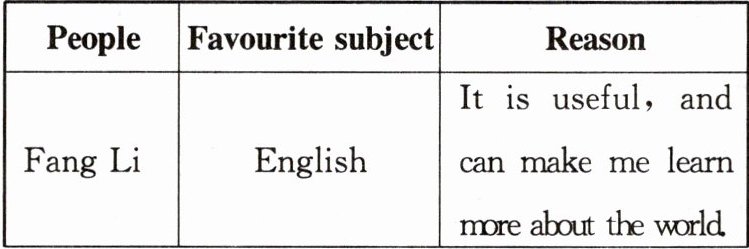
就最喜欢的课程,对组内同伴调查,
并完成调查表
并完成调查表
答案
| People | Favourite subject | Reason |
| ---- | ---- | ---- |
| Fang Li | English | It is useful, and can make me learn more about the world. |
| Li Jun | P.E. | It is relaxing, and I can play basketball with my classmates. |
| Chen Na | Art | It is fun, and I love drawing pictures very much. |
| Wu Dong | Math | It is interesting, and it can help me solve many problems in daily life. |
解析
本题为开放性实践调查题,要求采访组内同学,记录他们最喜欢的学科及对应的喜爱原因,以下给出符合七年级上册英语词汇难度的完整表示例供参考,也可根据实际调查的真实内容填写。
一、两人一组,轮流就下表进行问答
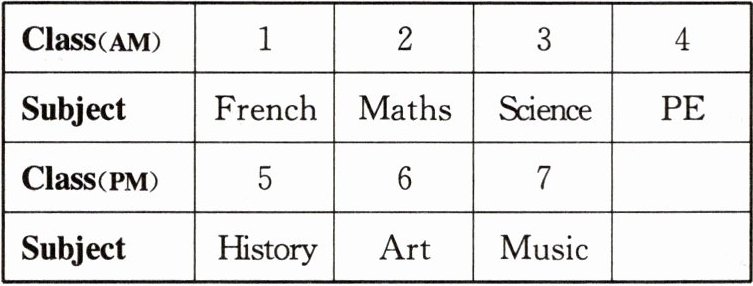
典型句式:
1. What classes do you have in the morning/afternoon?
2. I have ... and ... is my favourite.
典型句式:
1. What classes do you have in the morning/afternoon?
2. I have ... and ... is my favourite.
答案
参考问答示例:
1. —What classes do you have in the morning?
—I have French, Maths, Science and PE, and PE is my favourite.
2. —What classes do you have in the afternoon?
—I have History, Art and Music, and Music is my favourite.
(注:最喜欢的科目可以根据自身喜好替换为表格里任意科目,答案不唯一)
1. —What classes do you have in the morning?
—I have French, Maths, Science and PE, and PE is my favourite.
2. —What classes do you have in the afternoon?
—I have History, Art and Music, and Music is my favourite.
(注:最喜欢的科目可以根据自身喜好替换为表格里任意科目,答案不唯一)
解析
这是口语互动训练题,需要结合表格中的课程信息,使用题目给出的固定典型句式完成问答,表格中上午的课程有法语、数学、科学、体育,下午的课程有历史、美术、音乐,按照句型结构替换对应内容即可完成对话。
二、两人一组,轮流就将来想从事的
工作进行问答
典型句式:
1. What do you want to be in the future?
2. I want ...
工作进行问答
典型句式:
1. What do you want to be in the future?
2. I want ...
答案
参考示例问答:
A: What do you want to be in the future?
B: I want to be an English teacher.
B: What do you want to be in the future?
A: I want to be a doctor.
A: What do you want to be in the future?
B: I want to be an English teacher.
B: What do you want to be in the future?
A: I want to be a doctor.
解析
本题是口语互动练习,考察对询问未来理想职业句型的掌握,结合七年级上册已学的职业类词汇,使用给出的典型句式完成问答即可,表达简单贴合当前学段的词汇储备要求。
The Internet makes our life easy and colourful.
互联网使我们的生活轻松且丰富多彩。
拓展 复合结构“make+宾语+宾语补足语”的构成及意义:
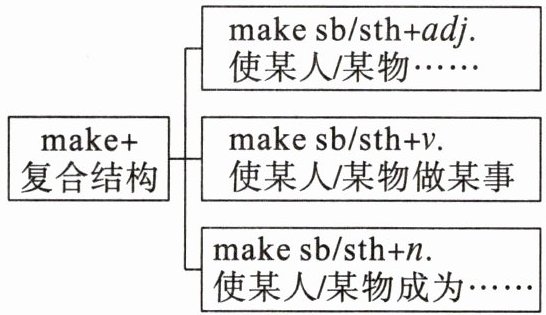
The hot weather makes us stay in the whole day.
炎热天气使我们一整天待在家里。
Trees can make our city beautiful.
树木会使我们的城市美丽。
Classmates want to make Li Bin monitor of our class.
同学们想让李斌当我们班班长。
跟踪练习
①She makes her boy
A. to wash B. washes
C. washing D. wash
②吃甜食太多会使你发胖。
Eating too much sweet food can
2. We learn how to work out maths problems in class.
在课上,我们学习如何算出数学题。
剖析 how to work out ...为“动词不定式短语”结构,在句中做宾语。其结构为:wh-词+动词不定式(短语)。可用于该结构的wh-词有 how, where, when, what,
which等。
I don't know what to do next.
我不知道下一步该做什么。
Please tell me where to find the lost things.
请告诉我到哪里去找到丢失的东西。
跟踪练习
①Hobo doesn't know
A. when to do B. where to do
C. how to do D. what to do
②The notice tells us where we can go.
(改成简单句)
The notice tells us
互联网使我们的生活轻松且丰富多彩。
拓展 复合结构“make+宾语+宾语补足语”的构成及意义:
The hot weather makes us stay in the whole day.
炎热天气使我们一整天待在家里。
Trees can make our city beautiful.
树木会使我们的城市美丽。
Classmates want to make Li Bin monitor of our class.
同学们想让李斌当我们班班长。
跟踪练习
①She makes her boy
D
his hands before eating.A. to wash B. washes
C. washing D. wash
②吃甜食太多会使你发胖。
Eating too much sweet food can
make
you
fat
.2. We learn how to work out maths problems in class.
在课上,我们学习如何算出数学题。
剖析 how to work out ...为“动词不定式短语”结构,在句中做宾语。其结构为:wh-词+动词不定式(短语)。可用于该结构的wh-词有 how, where, when, what,
which等。
I don't know what to do next.
我不知道下一步该做什么。
Please tell me where to find the lost things.
请告诉我到哪里去找到丢失的东西。
跟踪练习
①Hobo doesn't know
D
.A. when to do B. where to do
C. how to do D. what to do
②The notice tells us where we can go.
(改成简单句)
The notice tells us
where
to
go
.答案
1. ①D ②make you fat
2. ①D 句意:Hobo 不知道怎么办/该做什么。考查“疑问词+不定式”结构。
when、where、how 均属于疑问副词,做状语;what 属于疑问代词,可做主语或宾语。do 是及物动词,需要接宾语,所以用 what to do 构成“疑问词+不定式”结构。故选 D 项。
②where to go
2. ①D 句意:Hobo 不知道怎么办/该做什么。考查“疑问词+不定式”结构。
when、where、how 均属于疑问副词,做状语;what 属于疑问代词,可做主语或宾语。do 是及物动词,需要接宾语,所以用 what to do 构成“疑问词+不定式”结构。故选 D 项。
②where to go
