

 登录
登录
Ⅳ. 完形填空。
Martin Jackson’s story with water began when he was a boy. He often went fishing with his
When Martin
At the company, Martin helps industries clean and reuse water. The company uses advanced technology to turn wastewater into clean water and dry solid waste, which is
To Martin, water is not simply a resource (资源); it is the key to life. He decides to help factories use water
Looking forward, Martin is
()1. A. friend B. cousin C. father
()2. A. gave up B. grew up C. showed up
()3. A. left B. joined C. changed
()4. A. safe B. famous C. popular
()5. A. unless B. because C. though
()6. A. wisely B. easily C. quickly
()7. A. water B. nature C. sky
()8. A. worried B. angry C. hopeful
Martin Jackson’s story with water began when he was a boy. He often went fishing with his
C
1 along clear rivers. Spending those peaceful days outdoors taught him how important clean water is to all living things.When Martin
B
2, he chose a job that focused on protecting water. For his first job, he spent 17 years helping factories recycle and reuse water. After that, he worked at a water treatment company for another 16 years. In 2020, that company B
3 a big water treatment company, where Martin now serves as a sales manager.At the company, Martin helps industries clean and reuse water. The company uses advanced technology to turn wastewater into clean water and dry solid waste, which is
A
4 for the environment. Martin finds his work very meaningful B
5 it connects his childhood memories of nature with his goal of making sure the water is clean for people.To Martin, water is not simply a resource (资源); it is the key to life. He decides to help factories use water
A
6 and avoid polluting rivers and lakes. Today, he also takes his children out into B
7, teaching them to protect water resources just as his father taught him while fishing.Looking forward, Martin is
C
8 that with better technology and greater care, we can create a future where everyone has safe, clean water. For Martin, protecting water is not just a job; it is a lifelong goal that he continues with love and purpose.()1. A. friend B. cousin C. father
()2. A. gave up B. grew up C. showed up
()3. A. left B. joined C. changed
()4. A. safe B. famous C. popular
()5. A. unless B. because C. though
()6. A. wisely B. easily C. quickly
()7. A. water B. nature C. sky
()8. A. worried B. angry C. hopeful
答案
1.C
2.B
3.B
4.A
5.B
6.A
7.B
8.C
2.B
3.B
4.A
5.B
6.A
7.B
8.C
解析
【分析】
做这篇完形填空需结合上下文语境、词汇含义及逻辑关系逐一分析每个空格:
1. 第1空:后文明确提到“just as his father taught him while fishing”,可知他小时候和父亲去钓鱼,对应选father。
2. 第2空:前文讲述童年经历,此处指长大后选择与水保护相关的工作,grew up(长大)符合语境,其他选项不符合逻辑。
3. 第3空:2020年他所在的公司加入了一家大型水处理公司,joined(加入)符合商业合作的逻辑,其他选项不合适。
4. 第4空:公司用先进技术将废水转化为净水和固体废弃物,这对环境是安全的,safe(安全的)符合环保语境,其他选项不符合。
5. 第5空:他觉得工作有意义,因为这份工作连接了童年自然记忆和清洁水源的目标,because表原因,符合逻辑关系。
6. 第6空:他决定帮助工厂明智地用水,避免污染,wisely(明智地)符合环保行动的要求,其他选项不符合。
7. 第7空:带孩子去自然中,像父亲教他那样保护水资源,nature(自然)符合语境,其他选项不合适。
8. 第8空:展望未来,他对创造人人有安全净水的未来充满希望,hopeful(有希望的)符合语境,其他选项不符合。
【解析】
1. 选C:根据后文“just as his father taught him while fishing”可知,他小时候和父亲去钓鱼,故选father。
2. 选B:前文讲童年经历,此处指长大后选择与水保护相关的工作,grew up(长大)符合语境,gave up(放弃)、showed up(出现)均不符合。
3. 选B:2020年他所在的公司加入了一家大型水处理公司,joined(加入)符合逻辑,left(离开)、changed(改变)不符合。
4. 选A:将废水转化为净水和固体废弃物,这对环境是安全的,safe(安全的)符合,famous(著名的)、popular(受欢迎的)不符合。
5. 选B:他觉得工作有意义,因为这份工作连接了童年自然记忆和清洁水源的目标,because表原因,unless(除非)、though(虽然)不符合。
6. 选A:帮助工厂明智地用水,避免污染,wisely(明智地)符合,easily(容易地)、quickly(快速地)不符合。
7. 选B:带孩子去自然中,像父亲教他那样保护水资源,nature(自然)正确,water(水)、sky(天空)不符合。
8. 选C:展望未来,他对创造人人有安全净水的未来充满希望,hopeful(有希望的)符合,worried(担心的)、angry(生气的)不符合。
【答案】
1.C 2.B 3.B 4.A 5.B 6.A 7.B 8.C
【知识点】
完形填空、词汇辨析、语境理解
【点评】
本文围绕Martin Jackson保护水资源的经历展开,上下文线索明确,主要考查学生对词汇在具体语境中的运用能力,难度适中,适合初中阶段学生练习。
【难度系数】
0.6
做这篇完形填空需结合上下文语境、词汇含义及逻辑关系逐一分析每个空格:
1. 第1空:后文明确提到“just as his father taught him while fishing”,可知他小时候和父亲去钓鱼,对应选father。
2. 第2空:前文讲述童年经历,此处指长大后选择与水保护相关的工作,grew up(长大)符合语境,其他选项不符合逻辑。
3. 第3空:2020年他所在的公司加入了一家大型水处理公司,joined(加入)符合商业合作的逻辑,其他选项不合适。
4. 第4空:公司用先进技术将废水转化为净水和固体废弃物,这对环境是安全的,safe(安全的)符合环保语境,其他选项不符合。
5. 第5空:他觉得工作有意义,因为这份工作连接了童年自然记忆和清洁水源的目标,because表原因,符合逻辑关系。
6. 第6空:他决定帮助工厂明智地用水,避免污染,wisely(明智地)符合环保行动的要求,其他选项不符合。
7. 第7空:带孩子去自然中,像父亲教他那样保护水资源,nature(自然)符合语境,其他选项不合适。
8. 第8空:展望未来,他对创造人人有安全净水的未来充满希望,hopeful(有希望的)符合语境,其他选项不符合。
【解析】
1. 选C:根据后文“just as his father taught him while fishing”可知,他小时候和父亲去钓鱼,故选father。
2. 选B:前文讲童年经历,此处指长大后选择与水保护相关的工作,grew up(长大)符合语境,gave up(放弃)、showed up(出现)均不符合。
3. 选B:2020年他所在的公司加入了一家大型水处理公司,joined(加入)符合逻辑,left(离开)、changed(改变)不符合。
4. 选A:将废水转化为净水和固体废弃物,这对环境是安全的,safe(安全的)符合,famous(著名的)、popular(受欢迎的)不符合。
5. 选B:他觉得工作有意义,因为这份工作连接了童年自然记忆和清洁水源的目标,because表原因,unless(除非)、though(虽然)不符合。
6. 选A:帮助工厂明智地用水,避免污染,wisely(明智地)符合,easily(容易地)、quickly(快速地)不符合。
7. 选B:带孩子去自然中,像父亲教他那样保护水资源,nature(自然)正确,water(水)、sky(天空)不符合。
8. 选C:展望未来,他对创造人人有安全净水的未来充满希望,hopeful(有希望的)符合,worried(担心的)、angry(生气的)不符合。
【答案】
1.C 2.B 3.B 4.A 5.B 6.A 7.B 8.C
【知识点】
完形填空、词汇辨析、语境理解
【点评】
本文围绕Martin Jackson保护水资源的经历展开,上下文线索明确,主要考查学生对词汇在具体语境中的运用能力,难度适中,适合初中阶段学生练习。
【难度系数】
0.6
Ⅴ. 阅读下面的非连续性文本,根据语篇内容,回答问题。
Mobile phones help us keep in touch with each other. Fridges keep food cool and fresh. Televisions make our lives fun. But all these things can get older as time goes by and then become e-waste. In fact, e-waste doesn’t only come from these things but also
from other products.
What is e-waste?
It includes all things with batteries (电池) or wires (电线).
E-waste is bad for the earth.
In 2022, the world produced around 53 million tons of e-waste. This is even heavier than all adults in Europe. However, as it is shown in Chart Ⅰ, not all e-waste is well collected.
According to Chart Ⅱ, the problem of e-waste is becoming much more serious. The world’s e-waste will reach around 74 million tons by 2030.
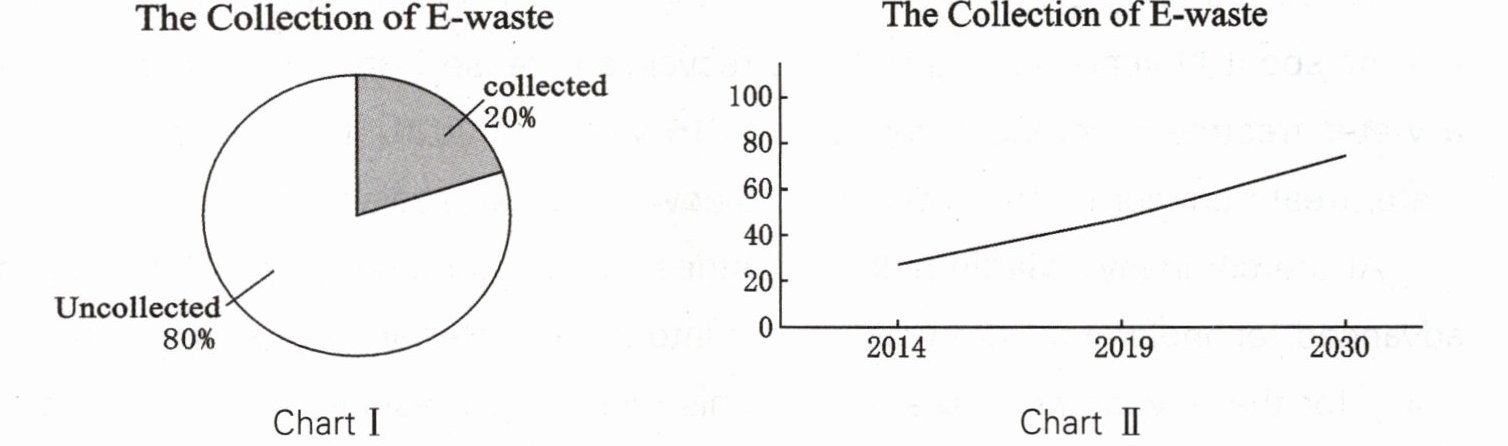
E-waste leads to not only great harm to the environment but also a waste of valuable resources (资源). In fact, e-waste includes valuable resources, such as gold and silver. Besides, one smartphone battery can pollute 600,000 liters (升) of water.
How can we deal with e-waste?
◆Recycling
You can give it to a recycling centre in your community or some recycling companies. You can also repair your electronics instead of buying new ones.
◆
You can sell it in a second-hand market. Some people prefer to use old products that are at good prices. At the same time, you can get money from these old things.
◆Donating (捐献)
You can donate it to someone in need or those who can’t afford new products.
The Earth is the home of all humanity, and each of us should do our part to protect it.
1. What does e-waste include?
2. What percent of e-waste is not collected?
3. Why does the writer mention Chart Ⅱ?
4. What is the best subtitle (小标题) for the blank?
5. Do you produce e-waste in your daily life? How will you deal with it after reading the passage?
Mobile phones help us keep in touch with each other. Fridges keep food cool and fresh. Televisions make our lives fun. But all these things can get older as time goes by and then become e-waste. In fact, e-waste doesn’t only come from these things but also
from other products.
What is e-waste?
It includes all things with batteries (电池) or wires (电线).
E-waste is bad for the earth.
In 2022, the world produced around 53 million tons of e-waste. This is even heavier than all adults in Europe. However, as it is shown in Chart Ⅰ, not all e-waste is well collected.
According to Chart Ⅱ, the problem of e-waste is becoming much more serious. The world’s e-waste will reach around 74 million tons by 2030.
E-waste leads to not only great harm to the environment but also a waste of valuable resources (资源). In fact, e-waste includes valuable resources, such as gold and silver. Besides, one smartphone battery can pollute 600,000 liters (升) of water.
How can we deal with e-waste?
◆Recycling
You can give it to a recycling centre in your community or some recycling companies. You can also repair your electronics instead of buying new ones.
◆
You can sell it in a second-hand market. Some people prefer to use old products that are at good prices. At the same time, you can get money from these old things.
◆Donating (捐献)
You can donate it to someone in need or those who can’t afford new products.
The Earth is the home of all humanity, and each of us should do our part to protect it.
1. What does e-waste include?
It includes all things with batteries or wires.
2. What percent of e-waste is not collected?
80%.
3. Why does the writer mention Chart Ⅱ?
Because the writer wants to show that the problem of e-waste is becoming more and more serious.
4. What is the best subtitle (小标题) for the blank?
Selling.
5. Do you produce e-waste in your daily life? How will you deal with it after reading the passage?
Yes, I do. I will donate it to someone in need after reading the passage. / Yes, I do. I will sell it at a second-hand market after reading the passage.
答案
1. It includes all things with batteries or wires.
2. 80%.
3. Because the writer wants to show that the problem of e-waste is becoming more and more serious.
4. Selling.
5. Yes, I do. I will donate it to someone in need after reading the passage. / Yes, I do. I will sell it at a second-hand market after reading the passage.
2. 80%.
3. Because the writer wants to show that the problem of e-waste is becoming more and more serious.
4. Selling.
5. Yes, I do. I will donate it to someone in need after reading the passage. / Yes, I do. I will sell it at a second-hand market after reading the passage.
解析
【分析】
1. 第1题需定位原文中关于电子垃圾定义的内容,查找其包含的事物;
2. 第2题需观察Chart I的标注,提取未被收集的电子垃圾占比;
3. 第3题需定位原文提及Chart II的语句,明确作者展示该图表的目的;
4. 第4题需分析空白处下方的内容,提炼核心动作作为小标题;
5. 第5题为开放题,需结合原文提到的电子垃圾处理方式,给出合理回答。
【解析】
1. 定位原文“What is e-waste?”段落,找到句子“It includes all things with batteries or wires.”,即为答案;
2. 观察Chart I,“Uncollected”对应的百分比为80%,直接得出答案;
3. 定位原文“According to Chart Ⅱ, the problem of e-waste is becoming much more serious.”,可知作者提及Chart II是为了说明电子垃圾问题愈发严重;
4. 空白下方内容围绕“卖二手物品”展开,核心动作是“卖”,故小标题为“Selling”;
5. 结合原文提到的捐赠、卖二手等处理方式,给出符合要求的回答即可。
【答案】
1. It includes all things with batteries or wires.
2. 80%.
3. Because the writer wants to show that the problem of e-waste is becoming more and more serious.
4. Selling.
5. Yes, I do. I will donate it to someone in need after reading the passage. / Yes, I do. I will sell it at a second-hand market after reading the passage.
【知识点】英语阅读、图表信息提取、细节理解
【点评】本题为非连续性文本阅读题,结合图表考查学生的信息定位、提取与理解能力,题型涵盖细节题和开放题,整体难度适中,要求学生仔细阅读文本和图表,精准对应问题找答案。
【难度系数】0.5
1. 第1题需定位原文中关于电子垃圾定义的内容,查找其包含的事物;
2. 第2题需观察Chart I的标注,提取未被收集的电子垃圾占比;
3. 第3题需定位原文提及Chart II的语句,明确作者展示该图表的目的;
4. 第4题需分析空白处下方的内容,提炼核心动作作为小标题;
5. 第5题为开放题,需结合原文提到的电子垃圾处理方式,给出合理回答。
【解析】
1. 定位原文“What is e-waste?”段落,找到句子“It includes all things with batteries or wires.”,即为答案;
2. 观察Chart I,“Uncollected”对应的百分比为80%,直接得出答案;
3. 定位原文“According to Chart Ⅱ, the problem of e-waste is becoming much more serious.”,可知作者提及Chart II是为了说明电子垃圾问题愈发严重;
4. 空白下方内容围绕“卖二手物品”展开,核心动作是“卖”,故小标题为“Selling”;
5. 结合原文提到的捐赠、卖二手等处理方式,给出符合要求的回答即可。
【答案】
1. It includes all things with batteries or wires.
2. 80%.
3. Because the writer wants to show that the problem of e-waste is becoming more and more serious.
4. Selling.
5. Yes, I do. I will donate it to someone in need after reading the passage. / Yes, I do. I will sell it at a second-hand market after reading the passage.
【知识点】英语阅读、图表信息提取、细节理解
【点评】本题为非连续性文本阅读题,结合图表考查学生的信息定位、提取与理解能力,题型涵盖细节题和开放题,整体难度适中,要求学生仔细阅读文本和图表,精准对应问题找答案。
【难度系数】0.5
