

 登录
登录
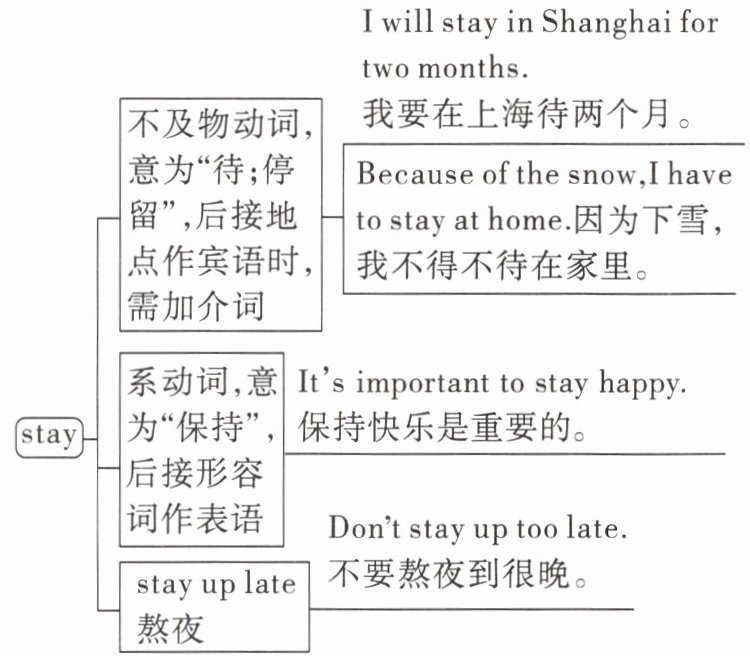
探究点1 stay 的用法
情境应用
1. You can here and have dinner with us. (stay)
2. Vegetables and fruit are good for us to . (保持健康)
情境应用
1. You can here and have dinner with us. (stay)
2. Vegetables and fruit are good for us to . (保持健康)
答案
1. stay
2. stay healthy
2. stay healthy
解析
1. 情态动词can后要接动词原形,here是地点副词,前面不需要加介词,结合提示词stay,此处表达“待在这里”,直接填入stay即可。
2. 此处考查stay作系动词的用法,stay意为“保持”时后接形容词作表语,“健康的”英文是healthy,空前的to后面需要接动词原形,所以“保持健康”的对应表达是stay healthy。
2. 此处考查stay作系动词的用法,stay意为“保持”时后接形容词作表语,“健康的”英文是healthy,空前的to后面需要接动词原形,所以“保持健康”的对应表达是stay healthy。
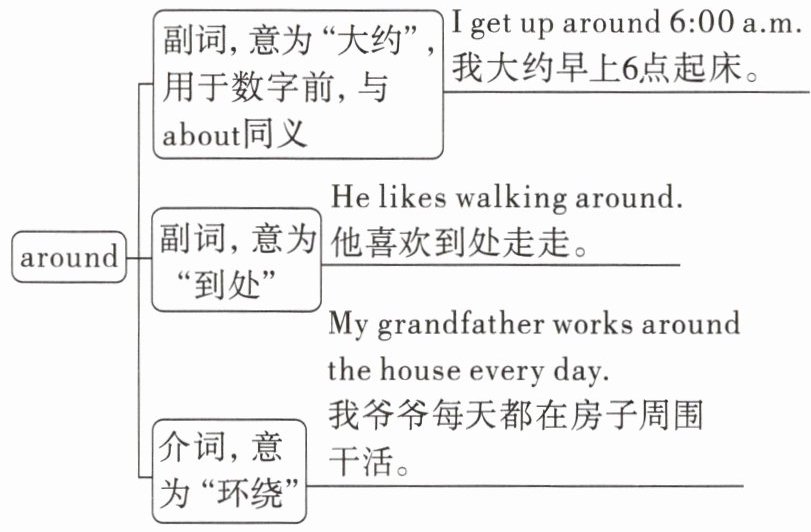
探究点2 around 的用法
情境应用
1. As we all know, the earth runs the sun. (围绕)
2. She usually gets home at 5:30 p.m. (大约)
情境应用
1. As we all know, the earth runs the sun. (围绕)
2. She usually gets home at 5:30 p.m. (大约)
答案
1. around
2. around
2. around
解析
1. 此处表达“围绕”的含义,around作介词时意为“环绕、围绕”,符合地球围绕太阳运转的语境,因此填入around。
2. 此处表达“大约”的含义,around作副词时可放在时间数字前,意为“大约”,和about同义,符合“大约下午5点半到家”的语境,因此填入around。
2. 此处表达“大约”的含义,around作副词时可放在时间数字前,意为“大约”,和about同义,符合“大约下午5点半到家”的语境,因此填入around。
()1. It's 5:30 p.m. It's time to .
A.go to school
B.go to bed
C.go home
D.have lunch
A.go to school
B.go to bed
C.go home
D.have lunch
答案
C
解析
已知时间是下午5:30,逐一判断选项场景:A项去上学通常在上午,B项上床睡觉不符合该时间,D项吃午饭是中午的行为,下午5:30对应的合理行为是回家,因此选C。
()2. — is it now?
—It’s 9:20.
A.What time
B.How far
C.What day
D.How long
—It’s 9:20.
A.What time
B.How far
C.What day
D.How long
答案
A
解析
答句给出的是具体时刻9:20。A选项What time用于询问时间点,B选项用于询问距离,C选项用于询问星期,D选项用于询问时长或物体长度,只有A符合语境。
()3. I usually get up 6:30 school days.
A.at;at
B.at;in
C.on;on
D.at;on
A.at;at
B.at;in
C.on;on
D.at;on
答案
D
解析
表示具体时刻的时间点前要使用介词at,6:30是具体时刻,第一空填at;表示“在上学日”是固定搭配on school days,特定的日子前用介词on,第二空填on,符合的选项是D。
Ⅱ.根据句意,用括号中所给词的适当形式填空
1. My favourite is "Practice makes perfect(熟能生巧)". (say)
2. My sister wants to be a in the future. (report)
3. We should brush our at least twice a day. (tooth)
4. Early to bed and early makes a man healthy. (rise)
1. My favourite is "Practice makes perfect(熟能生巧)". (say)
2. My sister wants to be a in the future. (report)
3. We should brush our at least twice a day. (tooth)
4. Early to bed and early makes a man healthy. (rise)
答案
1. saying
2. reporter
3. teeth
4. to rise
2. reporter
3. teeth
4. to rise
解析
1. 空格处需要填名词作主语,动词say对应的表示“谚语、格言”的名词是saying,句中be动词为is,用单数即可,符合句意。
2. 空格处要填表示职业的名词,动词report(报道)对应的职业名词“记者”是reporter,空前有不定冠词a,填单数形式。
3. 固定搭配brush one's teeth意为“刷牙”,可数名词tooth(牙齿)要使用复数特殊变化形式teeth。
4. 这是英语常见谚语的固定表达,and并列前后结构要一致,和前面的Early to bed对应,此处填to rise,构成“Early to bed and early to rise(早睡早起)”的固定搭配。
2. 空格处要填表示职业的名词,动词report(报道)对应的职业名词“记者”是reporter,空前有不定冠词a,填单数形式。
3. 固定搭配brush one's teeth意为“刷牙”,可数名词tooth(牙齿)要使用复数特殊变化形式teeth。
4. 这是英语常见谚语的固定表达,and并列前后结构要一致,和前面的Early to bed对应,此处填to rise,构成“Early to bed and early to rise(早睡早起)”的固定搭配。
Ⅲ.将下列句子中汉语部分译成英语,注意使用适当的形式
1. Let me tell you about my .(上学日的日常)
2. My brother sometimes at 10:30.(上床睡觉)
3. I often get up at 7:00 and then for 40 minutes.(做运动)
4. I usually in the morning.(淋浴)
1. Let me tell you about my .(上学日的日常)
2. My brother sometimes at 10:30.(上床睡觉)
3. I often get up at 7:00 and then for 40 minutes.(做运动)
4. I usually in the morning.(淋浴)
答案
1. daily life on school days
2. goes to bed
3. do exercise / play sports
4. take a shower
2. goes to bed
3. do exercise / play sports
4. take a shower
解析
1. 本题考查本单元日常话题相关的名词短语翻译,“上学日”对应school days,“日常”对应daily life,组合得到符合语义的正确表达。
2. 本题考查一般现在时的谓语变化,主语my brother是第三人称单数,频度副词sometimes表明时态为一般现在时,固定短语go to bed表示“上床睡觉”,谓语动词要变为三单形式。
3. 本题考查并列谓语用法,and连接的动词和前面的get up形式保持一致,用动词原形,“做运动”是本单元核心常用短语。
4. 本题考查固定短语,频度副词usually表明时态为一般现在时,主语是I,谓语用动词原形,“淋浴”是本单元要求掌握的固定搭配。
2. 本题考查一般现在时的谓语变化,主语my brother是第三人称单数,频度副词sometimes表明时态为一般现在时,固定短语go to bed表示“上床睡觉”,谓语动词要变为三单形式。
3. 本题考查并列谓语用法,and连接的动词和前面的get up形式保持一致,用动词原形,“做运动”是本单元核心常用短语。
4. 本题考查固定短语,频度副词usually表明时态为一般现在时,主语是I,谓语用动词原形,“淋浴”是本单元要求掌握的固定搭配。
