

 登录
登录
任务驱动1 环球礼仪大发现
小组合作,调研下面几个国家的聚会礼仪,从到达时间、礼物礼仪、着装风格、安全的交谈话题四个维度完成表格。
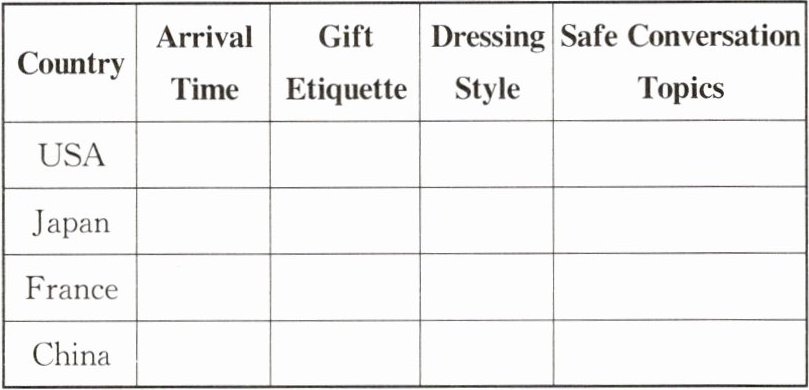
小组合作,调研下面几个国家的聚会礼仪,从到达时间、礼物礼仪、着装风格、安全的交谈话题四个维度完成表格。
答案
| Country | Arrival Time | Gift Etiquette | Dressing Style | Safe Conversation Topics |
|---------|--------------|----------------|----------------|---------------------------|
| USA | It's acceptable to arrive on time or 5~10 minutes late; arriving far earlier than the agreed time is considered impolite, as it may disturb the host's final preparation. | Casual small gifts such as wine, handmade desserts, fresh flowers or exquisite souvenirs are proper; gifts are usually opened immediately in front of the giver to show appreciation. | The dress code is flexible and casual for ordinary parties, you can choose clean casual wear like shirts and jeans; for formal parties, you need to follow the dress code to wear formal suits or elegant dresses. | Hobbies, travel experiences, movies and music, local food, work interesting anecdotes are safe topics; avoid asking others' privacy such as specific income, age and religious beliefs at will. |
| Japan | It is required to arrive 5~10 minutes earlier than the agreed time, which is a basic performance of respecting the host, and being late is a very impolite behavior. | Gifts should be wrapped in exquisite packaging, you need to present the gift with both hands, and the recipient will not open the gift immediately in front of the giver to avoid appearing greedy; avoid giving comb, handkerchief or gifts with the number 4 related patterns, which have unlucky implied meaning. | For formal parties, you should wear formal and low-key dark suits or kimono; for ordinary gatherings, you should choose neat and modest casual wear, and avoid overly exposed or exaggerated clothes. | Travel experiences, Japanese traditional culture, food, work hobbies, scenic spots are safe topics; avoid talking about sensitive historical issues, and do not comment on others' private life at will. |
| France | It is appropriate to arrive 10~15 minutes later than the agreed time, which is a local custom, and arriving too early will make the host feel pressured. | Exquisite small gifts such as high-quality wine, chocolate, and art postcards are very popular; avoid giving chrysanthemums which are only used for funerals, and avoid giving gifts with obvious brand logos that make people feel like showing off. | Parties pay attention to elegance and sophistication: men can wear tailored casual suits, women can wear delicate small dresses with delicate accessories, and the overall style is fashionable and appropriate. | Art, fashion, food, travel, literature, film are safe topics; avoid talking about personal income, age, and do not comment on topics related to politics and religion at will. |
| China | It is recommended to arrive on time or a few minutes in advance to help the host with trivial preparations, and being late for no reason is considered impolite. | Proper gifts are tea, health care products, fruit, exquisite souvenirs; the recipient usually declines politely first and then accepts the gift, and generally will not open the gift immediately in front of the giver; avoid giving pears (homophonic for "separation") and clocks (homophonic for "end") which have bad implied meaning. | For ordinary parties, neat and comfortable casual wear is acceptable; for formal banquets, you can wear formal suits or cheongsams and other elegant clothes. | Food, travel, family interesting anecdotes, work development, hobbies are safe topics; avoid asking others' specific income, and do not talk about negative topics such as illness and disaster at happy parties. |
|---------|--------------|----------------|----------------|---------------------------|
| USA | It's acceptable to arrive on time or 5~10 minutes late; arriving far earlier than the agreed time is considered impolite, as it may disturb the host's final preparation. | Casual small gifts such as wine, handmade desserts, fresh flowers or exquisite souvenirs are proper; gifts are usually opened immediately in front of the giver to show appreciation. | The dress code is flexible and casual for ordinary parties, you can choose clean casual wear like shirts and jeans; for formal parties, you need to follow the dress code to wear formal suits or elegant dresses. | Hobbies, travel experiences, movies and music, local food, work interesting anecdotes are safe topics; avoid asking others' privacy such as specific income, age and religious beliefs at will. |
| Japan | It is required to arrive 5~10 minutes earlier than the agreed time, which is a basic performance of respecting the host, and being late is a very impolite behavior. | Gifts should be wrapped in exquisite packaging, you need to present the gift with both hands, and the recipient will not open the gift immediately in front of the giver to avoid appearing greedy; avoid giving comb, handkerchief or gifts with the number 4 related patterns, which have unlucky implied meaning. | For formal parties, you should wear formal and low-key dark suits or kimono; for ordinary gatherings, you should choose neat and modest casual wear, and avoid overly exposed or exaggerated clothes. | Travel experiences, Japanese traditional culture, food, work hobbies, scenic spots are safe topics; avoid talking about sensitive historical issues, and do not comment on others' private life at will. |
| France | It is appropriate to arrive 10~15 minutes later than the agreed time, which is a local custom, and arriving too early will make the host feel pressured. | Exquisite small gifts such as high-quality wine, chocolate, and art postcards are very popular; avoid giving chrysanthemums which are only used for funerals, and avoid giving gifts with obvious brand logos that make people feel like showing off. | Parties pay attention to elegance and sophistication: men can wear tailored casual suits, women can wear delicate small dresses with delicate accessories, and the overall style is fashionable and appropriate. | Art, fashion, food, travel, literature, film are safe topics; avoid talking about personal income, age, and do not comment on topics related to politics and religion at will. |
| China | It is recommended to arrive on time or a few minutes in advance to help the host with trivial preparations, and being late for no reason is considered impolite. | Proper gifts are tea, health care products, fruit, exquisite souvenirs; the recipient usually declines politely first and then accepts the gift, and generally will not open the gift immediately in front of the giver; avoid giving pears (homophonic for "separation") and clocks (homophonic for "end") which have bad implied meaning. | For ordinary parties, neat and comfortable casual wear is acceptable; for formal banquets, you can wear formal suits or cheongsams and other elegant clothes. | Food, travel, family interesting anecdotes, work development, hobbies are safe topics; avoid asking others' specific income, and do not talk about negative topics such as illness and disaster at happy parties. |
任务驱动2 法国礼仪知多少
阅读1b中的邮件,回答下列问题。
1. How did Nancy feel at first in France?
2. What was Nancy's friend doing when Nancy arrived to a party last month?
3. What did Nancy wear to the party last month?
4. What conversation topics does Nancy think are safe in France?
阅读1b中的邮件,回答下列问题。
1. How did Nancy feel at first in France?
A little lonely.
2. What was Nancy's friend doing when Nancy arrived to a party last month?
He was still getting everything ready.
3. What did Nancy wear to the party last month?
A simple blouse and shorts.
4. What conversation topics does Nancy think are safe in France?
Food and culture.
答案
1. A little lonely.
2. He was still getting everything ready.
3. A simple blouse and shorts.
4. Food and culture.
2. He was still getting everything ready.
3. A simple blouse and shorts.
4. Food and culture.
解析
【分析】
本题为基于指定阅读材料(1b邮件)的细节理解题,解题思路是:先明确每个问题的核心,再回到阅读材料中定位对应信息,提取与问题匹配的准确内容,即可得出答案。
【解析】
本题考查阅读细节定位能力,需结合1b邮件内容逐一分析:1. 查找Nancy初到法国时的感受,对应原文表述为“A little lonely”;2. 查找上个月Nancy参加派对时朋友的行为,对应原文为“He was still getting everything ready”;3. 查找Nancy参加派对的穿着,对应原文为“A simple blouse and shorts”;4. 查找Nancy认为法国安全的谈话话题,对应原文为“Food and culture”。
【答案】
1. A little lonely.
2. He was still getting everything ready.
3. A simple blouse and shorts.
4. Food and culture.
【知识点】
英语阅读理解,细节信息提取
【点评】
本题属于基础阅读理解细节题,主要考查学生对阅读材料中关键信息的定位与提取能力,只要认真阅读指定邮件内容即可轻松作答。
【难度系数】
0.6
本题为基于指定阅读材料(1b邮件)的细节理解题,解题思路是:先明确每个问题的核心,再回到阅读材料中定位对应信息,提取与问题匹配的准确内容,即可得出答案。
【解析】
本题考查阅读细节定位能力,需结合1b邮件内容逐一分析:1. 查找Nancy初到法国时的感受,对应原文表述为“A little lonely”;2. 查找上个月Nancy参加派对时朋友的行为,对应原文为“He was still getting everything ready”;3. 查找Nancy参加派对的穿着,对应原文为“A simple blouse and shorts”;4. 查找Nancy认为法国安全的谈话话题,对应原文为“Food and culture”。
【答案】
1. A little lonely.
2. He was still getting everything ready.
3. A simple blouse and shorts.
4. Food and culture.
【知识点】
英语阅读理解,细节信息提取
【点评】
本题属于基础阅读理解细节题,主要考查学生对阅读材料中关键信息的定位与提取能力,只要认真阅读指定邮件内容即可轻松作答。
【难度系数】
0.6
任务驱动3 设计"我"的礼仪海报
以"尊重文化,乐享聚会"为主题,用英文创作一张海报。海报需包含至少3条法国的聚会礼仪,要求图文结合、画面新颖。
以"尊重文化,乐享聚会"为主题,用英文创作一张海报。海报需包含至少3条法国的聚会礼仪,要求图文结合、画面新颖。
答案
# Respect Cultures, Enjoy Gatherings
French Party Etiquette
1. Be on time
(配图:绘制一位手持手表、面带微笑赴约的人物)
In France, it's polite to arrive on time for a party. Don't be too early or too late.
2. Mind Table Manners
(配图:绘制一个人双手持刀叉、优雅用餐的场景)
Keep your hands on the table while eating, but don't put your elbows on it. Use forks and knives correctly.
3. Greet with Cheek Kisses
(配图:绘制两人脸颊轻碰问候的画面)
When meeting friends at the party, greet them with 2-4 cheek kisses (the number varies by region).
French Party Etiquette
1. Be on time
(配图:绘制一位手持手表、面带微笑赴约的人物)
In France, it's polite to arrive on time for a party. Don't be too early or too late.
2. Mind Table Manners
(配图:绘制一个人双手持刀叉、优雅用餐的场景)
Keep your hands on the table while eating, but don't put your elbows on it. Use forks and knives correctly.
3. Greet with Cheek Kisses
(配图:绘制两人脸颊轻碰问候的画面)
When meeting friends at the party, greet them with 2-4 cheek kisses (the number varies by region).
解析
【分析】
本题要求设计以“尊重文化,乐享聚会”为主题的英文海报,核心是包含至少3条法国聚会礼仪,需图文结合。解题时需先明确法国典型的聚会礼仪,选取3条准确且有代表性的内容,用简洁英文表述,同时搭配对应配图说明,符合海报的呈现形式。
【解析】
先确定海报主题英文标题,再选取法国聚会中常见的3条礼仪,每条明确内容并标注对应配图,用规范英文表达:
1. 选取守时礼仪,说明法国聚会需准时到达,配图为手持手表赴约的人物;
2. 选取餐桌礼仪,说明用餐时手放桌面、不架肘、正确使用刀叉,配图为优雅用餐的场景;
3. 选取贴面问候礼仪,说明见面用2-4次贴面礼(地区不同有差异),配图为脸颊轻碰问候的画面。
【答案】
# Respect Cultures, Enjoy Gatherings
French Party Etiquette
1. Be on time
(配图:绘制一位手持手表、面带微笑赴约的人物)
In France, it's polite to arrive on time for a party. Don't be too early or too late.
2. Mind Table Manners
(配图:绘制一个人双手持刀叉、优雅用餐的场景)
Keep your hands on the table while eating, but don't put your elbows on it. Use forks and knives correctly.
3. Greet with Cheek Kisses
(配图:绘制两人脸颊轻碰问候的画面)
When meeting friends at the party, greet them with 2-4 cheek kisses (the number varies by region).
【知识点】
跨文化交际、法国聚会礼仪、英文海报设计
【点评】
本题结合文化知识与英文应用,考查学生对法国礼仪的掌握及创意设计能力,要求图文结合,兼具实用性与文化传播性。
【难度系数】
0.5
本题要求设计以“尊重文化,乐享聚会”为主题的英文海报,核心是包含至少3条法国聚会礼仪,需图文结合。解题时需先明确法国典型的聚会礼仪,选取3条准确且有代表性的内容,用简洁英文表述,同时搭配对应配图说明,符合海报的呈现形式。
【解析】
先确定海报主题英文标题,再选取法国聚会中常见的3条礼仪,每条明确内容并标注对应配图,用规范英文表达:
1. 选取守时礼仪,说明法国聚会需准时到达,配图为手持手表赴约的人物;
2. 选取餐桌礼仪,说明用餐时手放桌面、不架肘、正确使用刀叉,配图为优雅用餐的场景;
3. 选取贴面问候礼仪,说明见面用2-4次贴面礼(地区不同有差异),配图为脸颊轻碰问候的画面。
【答案】
# Respect Cultures, Enjoy Gatherings
French Party Etiquette
1. Be on time
(配图:绘制一位手持手表、面带微笑赴约的人物)
In France, it's polite to arrive on time for a party. Don't be too early or too late.
2. Mind Table Manners
(配图:绘制一个人双手持刀叉、优雅用餐的场景)
Keep your hands on the table while eating, but don't put your elbows on it. Use forks and knives correctly.
3. Greet with Cheek Kisses
(配图:绘制两人脸颊轻碰问候的画面)
When meeting friends at the party, greet them with 2-4 cheek kisses (the number varies by region).
【知识点】
跨文化交际、法国聚会礼仪、英文海报设计
【点评】
本题结合文化知识与英文应用,考查学生对法国礼仪的掌握及创意设计能力,要求图文结合,兼具实用性与文化传播性。
【难度系数】
0.5
一、用方框中所给词的适当形式填空
custom marry private blouse nice
1. We should try our best to use
less and improve our environment.
2. The blue
shirt is for her brother, Jim.
3. When living with a host family, it's
important to respect their
4. She decorated the room
party.
5. Now a
children.
custom marry private blouse nice
1. We should try our best to use
private
carsless and improve our environment.
2. The blue
blouse
is for Jane and the whiteshirt is for her brother, Jim.
3. When living with a host family, it's
important to respect their
customs
.4. She decorated the room
nicely
for theparty.
5. Now a
married
couple can have threechildren.
答案
1. private 2. blouse 3. customs
4. nicely 5. married
4. nicely 5. married
解析
【分析】本题要求用方框中所给词的适当形式填空,解题时需先理解每个句子的语境,明确空格处所需的词性,再结合所给词的词义和词性转换规则,匹配并调整词的形式,确保符合句子逻辑和语法要求。
【解析】
1. 句意:我们应尽量少用私家车来改善环境。空格修饰名词cars,需用形容词,所给词中private(私人的)为形容词,符合语境,故填private。
2. 句意:这件蓝色女式衬衫是给简的,白色衬衫是给她弟弟吉姆的。根据后文“shirt”及be动词“is”,空格需填单数名词,所给词中blouse(女式衬衫)符合,故填blouse。
3. 句意:住在寄宿家庭时,尊重他们的习俗很重要。所给词custom是可数名词,此处指寄宿家庭的各类习俗,需用复数形式,故填customs。
4. 句意:她为派对把房间装饰得很漂亮。空格修饰动词decorated,需用副词,所给词nice的副词形式为nicely,故填nicely。
5. 句意:现在已婚夫妇可以有三个孩子。空格修饰名词couple,需用形容词,所给词marry的形容词形式为married(已婚的),故填married。
【答案】1. private 2. blouse 3. customs 4. nicely 5. married
【知识点】形容词的用法、名词的单复数、副词的用法
【点评】本题考查基础词汇的适当形式运用,需学生掌握所给词的词性转换规则,结合句子语境判断所需形式,属于基础题型,注重词汇的灵活运用。
【难度系数】0.5
【解析】
1. 句意:我们应尽量少用私家车来改善环境。空格修饰名词cars,需用形容词,所给词中private(私人的)为形容词,符合语境,故填private。
2. 句意:这件蓝色女式衬衫是给简的,白色衬衫是给她弟弟吉姆的。根据后文“shirt”及be动词“is”,空格需填单数名词,所给词中blouse(女式衬衫)符合,故填blouse。
3. 句意:住在寄宿家庭时,尊重他们的习俗很重要。所给词custom是可数名词,此处指寄宿家庭的各类习俗,需用复数形式,故填customs。
4. 句意:她为派对把房间装饰得很漂亮。空格修饰动词decorated,需用副词,所给词nice的副词形式为nicely,故填nicely。
5. 句意:现在已婚夫妇可以有三个孩子。空格修饰名词couple,需用形容词,所给词marry的形容词形式为married(已婚的),故填married。
【答案】1. private 2. blouse 3. customs 4. nicely 5. married
【知识点】形容词的用法、名词的单复数、副词的用法
【点评】本题考查基础词汇的适当形式运用,需学生掌握所给词的词性转换规则,结合句子语境判断所需形式,属于基础题型,注重词汇的灵活运用。
【难度系数】0.5
二、补全对话
根据下面的对话情景,在每个空白处填上一个适当的句子,使对话的意思连贯、完整。
A: Hello, Mary. My brother told me that you
stayed in China for about a month in the past.
B:1.
Henan with my family last winter.
A:I'm going to China to visit my friends next
month. 2.
B:No problem.
A:If someone invites me for dinner, should I
arrive on time?
B:3.
you can't arrive on time, you must call the
host and tell him or her why.
A:4.
B:Shaking hands is OK.
A:I got it. 5.
B:Yes,there are. For example, you shouldn't
stick your chopsticks upright in the rice.
A:I see. Thanks a lot.
根据下面的对话情景,在每个空白处填上一个适当的句子,使对话的意思连贯、完整。
A: Hello, Mary. My brother told me that you
stayed in China for about a month in the past.
B:1.
That's true/...
. I went toHenan with my family last winter.
A:I'm going to China to visit my friends next
month. 2.
Could you give me some advice about Chinese customs/...
?B:No problem.
A:If someone invites me for dinner, should I
arrive on time?
B:3.
Yes, you should/...
. Ifyou can't arrive on time, you must call the
host and tell him or her why.
A:4.
What should I do when I meet someone for the first time/...
?B:Shaking hands is OK.
A:I got it. 5.
Are there any table manners/...
?B:Yes,there are. For example, you shouldn't
stick your chopsticks upright in the rice.
A:I see. Thanks a lot.
答案
1. That's true/...
2. Could you give me some advice about
Chinese customs/...
3. Yes, you should/...
4. What should I do when I meet someone
for the first time/...
5. Are there any table manners/...
2. Could you give me some advice about
Chinese customs/...
3. Yes, you should/...
4. What should I do when I meet someone
for the first time/...
5. Are there any table manners/...
解析
【分析】
本题为补全对话,需结合上下文语境、对话逻辑及日常交际用语填写合适句子。第1空:A提及Mary过去在中国待过,B需回应确认该事实;第2空:A即将去中国,向有经验的B请求关于中国习俗的建议;第3空:A询问赴宴是否要准时,B需给出肯定回答并补充说明;第4空:B提到初次见面握手即可,A需询问初次见面的礼仪;第5空:B举例餐桌礼仪禁忌,A需询问是否有其他餐桌礼仪。
【解析】
1. 结合A的陈述,B可回应“That's true”确认事实;
2. A要去中国,请求B提供中国习俗相关建议,故填“Could you give me some advice about Chinese customs”;
3. A询问赴宴是否需准时,B给出肯定回答,故填“Yes, you should”;
4. B说明初次见面握手即可,A询问初次见面的礼仪,故填“What should I do when I meet someone for the first time”;
5. B提及餐桌礼仪禁忌,A询问是否有其他餐桌礼仪,故填“Are there any table manners”。
【答案】
1. That's true/...
2. Could you give me some advice about Chinese customs/...
3. Yes, you should/...
4. What should I do when I meet someone for the first time/...
5. Are there any table manners/...
【知识点】
补全对话;日常交际用语;中国习俗表达
【点评】
本题围绕中国习俗的日常交际展开,考查学生的语境理解与口语运用能力,需结合对话上下文逻辑填写,是常见的补全对话题型,难度适中。
【难度系数】
0.5
本题为补全对话,需结合上下文语境、对话逻辑及日常交际用语填写合适句子。第1空:A提及Mary过去在中国待过,B需回应确认该事实;第2空:A即将去中国,向有经验的B请求关于中国习俗的建议;第3空:A询问赴宴是否要准时,B需给出肯定回答并补充说明;第4空:B提到初次见面握手即可,A需询问初次见面的礼仪;第5空:B举例餐桌礼仪禁忌,A需询问是否有其他餐桌礼仪。
【解析】
1. 结合A的陈述,B可回应“That's true”确认事实;
2. A要去中国,请求B提供中国习俗相关建议,故填“Could you give me some advice about Chinese customs”;
3. A询问赴宴是否需准时,B给出肯定回答,故填“Yes, you should”;
4. B说明初次见面握手即可,A询问初次见面的礼仪,故填“What should I do when I meet someone for the first time”;
5. B提及餐桌礼仪禁忌,A询问是否有其他餐桌礼仪,故填“Are there any table manners”。
【答案】
1. That's true/...
2. Could you give me some advice about Chinese customs/...
3. Yes, you should/...
4. What should I do when I meet someone for the first time/...
5. Are there any table manners/...
【知识点】
补全对话;日常交际用语;中国习俗表达
【点评】
本题围绕中国习俗的日常交际展开,考查学生的语境理解与口语运用能力,需结合对话上下文逻辑填写,是常见的补全对话题型,难度适中。
【难度系数】
0.5
