

 登录
登录
阅读赏析。
Ann:Hi, John! I'll fly to China next week for a summer exchange program. Have you ever been to China before?
John:No, I haven't. But I've heard that Chinese customs are very important. Is that true?
Ann:Yes, that's right. For example, when you meet someone for the first time, it's necessary to shake hands to greet them. And if you meet the elders, a slight bow is also seen as polite.
John:Oh, I see. What about the customs during the meals? I've heard that there are many rules to follow.
Ann:When you have dinner with others, it's important to let the oldest person sit first and eat first before you start. Also, it's impolite to stick your chopsticks vertically into your rice bowl—it's considered bad luck. And you shouldn't hit your bowl with chopsticks, either.
John:It's interesting. Are there any other customs I should pay attention to when visiting someone's home?
Ann:Yes, there are many other customs you should follow. For example, when you give or receive gifts, it's polite to use both hands. And when you visit someone's home, it's important to remove your shoes before entering, especially if the host has prepared slippers(拖鞋). Also, it's polite to bring a small gift like fruit or tea for the host.
John:Thank you so much for telling me these details. You help me know so many customs. I'll keep them in mind if I visit China someday.
Ann:You're welcome. I'm sure you'll have a great time if you go to China. The people there are very friendly, and they'll appreciate(感激) your respect for their customs.
任务一:根据对话填写中国风俗习惯的信息。
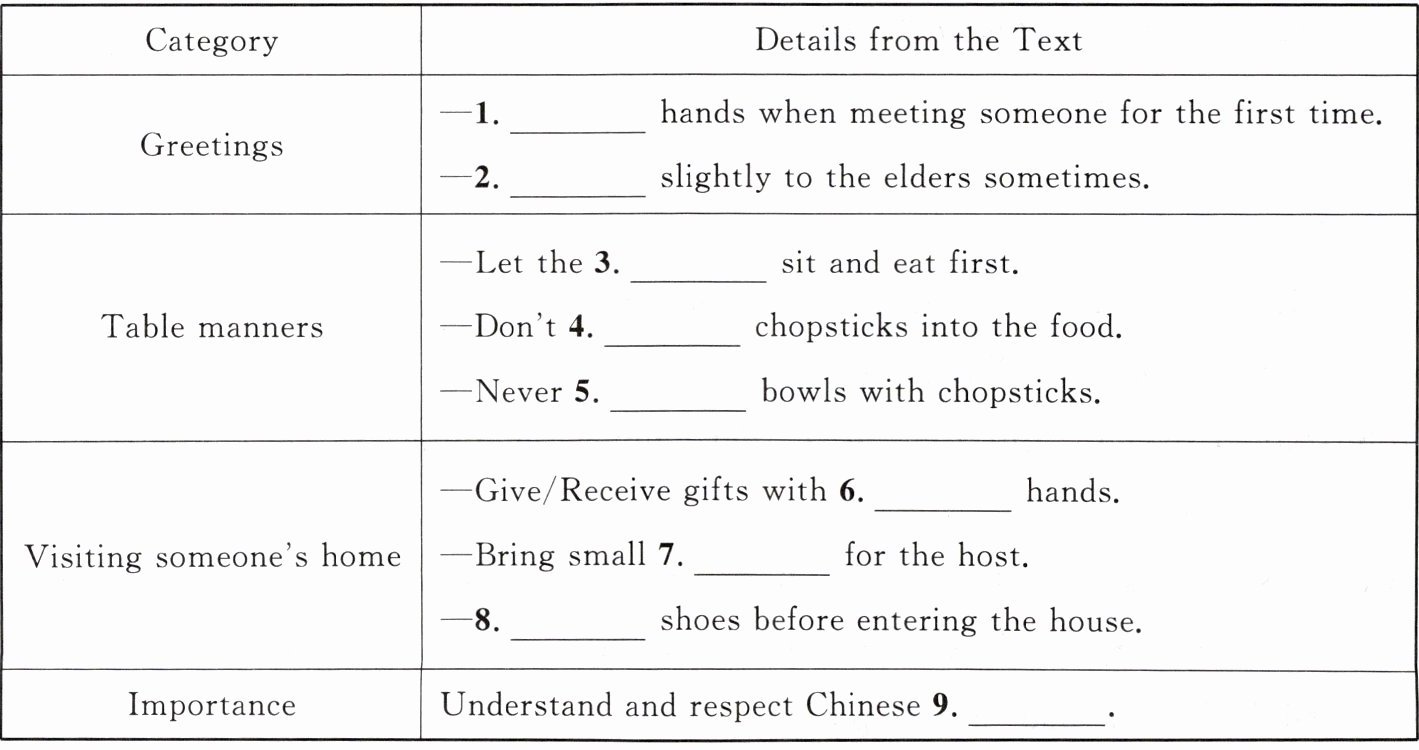
Category Details from the Text
Greetings —1. hands when meeting someone for the first time.
—2. slightly to the elders sometimes.
Table manners —Let the 3. sit and eat first.
—Don't 4. chopsticks into the food.
—Never 5. bowls with chopsticks.
Visiting someone's home —Give/Receive gifts with 6. hands.
—Bring small 7. for the host.
—8. shoes before entering the house.
Importance Understand and respect Chinese 9. .
任务二:如果你想在不同的文化里表现得得体大方,你应该怎么做? 根据对话内容,完成培养良好礼仪的任务。
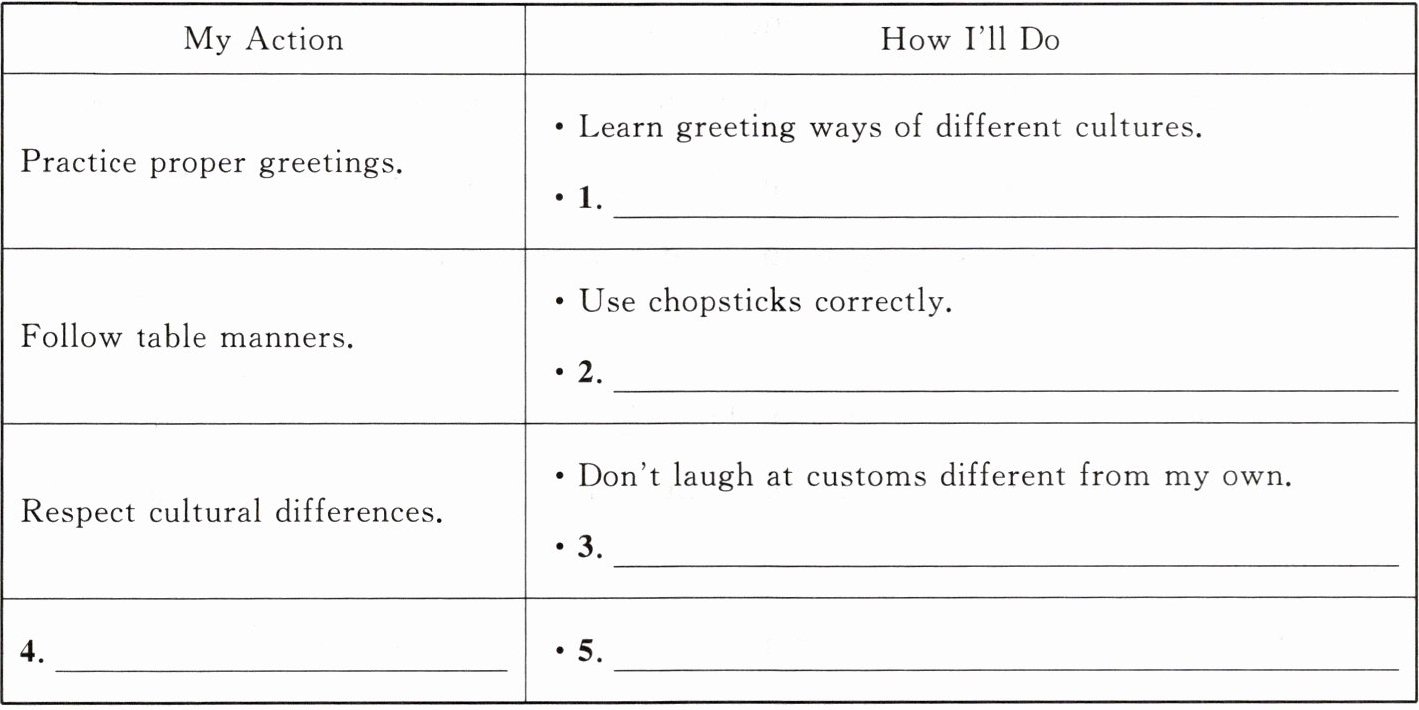
My Action How I'll Do
Practice proper greetings. • Learn greeting ways of different cultures.
• 1.
Follow table manners. • Use chopsticks correctly.
• 2.
Respect cultural differences. • Don't laugh at customs different from my own.
• 3.
4. • 5.
Ann:Hi, John! I'll fly to China next week for a summer exchange program. Have you ever been to China before?
John:No, I haven't. But I've heard that Chinese customs are very important. Is that true?
Ann:Yes, that's right. For example, when you meet someone for the first time, it's necessary to shake hands to greet them. And if you meet the elders, a slight bow is also seen as polite.
John:Oh, I see. What about the customs during the meals? I've heard that there are many rules to follow.
Ann:When you have dinner with others, it's important to let the oldest person sit first and eat first before you start. Also, it's impolite to stick your chopsticks vertically into your rice bowl—it's considered bad luck. And you shouldn't hit your bowl with chopsticks, either.
John:It's interesting. Are there any other customs I should pay attention to when visiting someone's home?
Ann:Yes, there are many other customs you should follow. For example, when you give or receive gifts, it's polite to use both hands. And when you visit someone's home, it's important to remove your shoes before entering, especially if the host has prepared slippers(拖鞋). Also, it's polite to bring a small gift like fruit or tea for the host.
John:Thank you so much for telling me these details. You help me know so many customs. I'll keep them in mind if I visit China someday.
Ann:You're welcome. I'm sure you'll have a great time if you go to China. The people there are very friendly, and they'll appreciate(感激) your respect for their customs.
任务一:根据对话填写中国风俗习惯的信息。
Category Details from the Text
Greetings —1. hands when meeting someone for the first time.
—2. slightly to the elders sometimes.
Table manners —Let the 3. sit and eat first.
—Don't 4. chopsticks into the food.
—Never 5. bowls with chopsticks.
Visiting someone's home —Give/Receive gifts with 6. hands.
—Bring small 7. for the host.
—8. shoes before entering the house.
Importance Understand and respect Chinese 9. .
任务二:如果你想在不同的文化里表现得得体大方,你应该怎么做? 根据对话内容,完成培养良好礼仪的任务。
My Action How I'll Do
Practice proper greetings. • Learn greeting ways of different cultures.
• 1.
Follow table manners. • Use chopsticks correctly.
• 2.
Respect cultural differences. • Don't laugh at customs different from my own.
• 3.
4. • 5.
答案
任务一:
1. Shake
2. Bow
3. elders / oldest person
4. stick
5. hit
6. both
7. gift / gifts
8. Remove
9. customs
任务二(答案不唯一,合理即可):
1. Greet others politely as the local rules require
2. Follow the local dining rules before having meals
3. Try to learn and respect different local customs actively
4. Behave properly when visiting others' homes
5. Take off shoes before entering the house and bring a small gift for the host
1. Shake
2. Bow
3. elders / oldest person
4. stick
5. hit
6. both
7. gift / gifts
8. Remove
9. customs
任务二(答案不唯一,合理即可):
1. Greet others politely as the local rules require
2. Follow the local dining rules before having meals
3. Try to learn and respect different local customs actively
4. Behave properly when visiting others' homes
5. Take off shoes before entering the house and bring a small gift for the host
解析
任务一可直接从对话原文定位对应细节,结合祈使句、名词搭配等语法要求填写正确内容;任务二为开放性作答,结合对话提及的不同场景礼仪要求,写出符合对应主题、表达通顺合理的内容即可,答案不唯一。
1. 定位原文"when you meet someone for the first time, it's necessary to shake hands to greet them",初次见面需要握手,祈使句用动词原形开头;
2. 定位原文"And if you meet the elders, a slight bow is also seen as polite",对长辈微微鞠躬是礼貌行为;
3. 定位原文"it's important to let the oldest person sit first and eat first before you start",用餐时需要让年长者先入座、先动筷;
4. 定位原文"it's impolite to stick your chopsticks vertically into your rice bowl",不要把筷子竖直插在食物/米饭里;
5. 定位原文"And you shouldn't hit your bowl with chopsticks, either",绝对不能用筷子敲碗;
6. 定位原文"when you give or receive gifts, it's polite to use both hands",递接礼物需要用双手;
7. 定位原文"it's polite to bring a small gift like fruit or tea for the host",拜访他人要为主人准备小礼物;
8. 定位原文"it's important to remove your shoes before entering",进屋前要脱鞋;
9. 全文主旨提示我们要理解、尊重当地的风俗习惯。
任务二的内容需要对应每一栏的主题,贴合跨文化得体交际的要求,表达符合八年级英语难度即可。
1. 定位原文"when you meet someone for the first time, it's necessary to shake hands to greet them",初次见面需要握手,祈使句用动词原形开头;
2. 定位原文"And if you meet the elders, a slight bow is also seen as polite",对长辈微微鞠躬是礼貌行为;
3. 定位原文"it's important to let the oldest person sit first and eat first before you start",用餐时需要让年长者先入座、先动筷;
4. 定位原文"it's impolite to stick your chopsticks vertically into your rice bowl",不要把筷子竖直插在食物/米饭里;
5. 定位原文"And you shouldn't hit your bowl with chopsticks, either",绝对不能用筷子敲碗;
6. 定位原文"when you give or receive gifts, it's polite to use both hands",递接礼物需要用双手;
7. 定位原文"it's polite to bring a small gift like fruit or tea for the host",拜访他人要为主人准备小礼物;
8. 定位原文"it's important to remove your shoes before entering",进屋前要脱鞋;
9. 全文主旨提示我们要理解、尊重当地的风俗习惯。
任务二的内容需要对应每一栏的主题,贴合跨文化得体交际的要求,表达符合八年级英语难度即可。
