

 登录
登录
【学习导航】
我们与他人共享这个世界,从公交车站的偶遇,到聚会上的寒暄、闲聊都是连接彼此温暖的桥梁。学习闲聊,不仅是掌握反意疑问句的用法,更是读懂社交场景中的善意与默契。这个暑假,让我们带着观察与思考走进日常对话,选择一个生活场景——公交站、咖啡馆或校园等,完成下列任务:
• Write a short conversation by using tag questions(反意疑问句).
• Think about how tag questions help you start and continue a conversation.
• Talk about what you can do to make small talk more natural and friendly.
【基础篇】
我们与他人共享这个世界,从公交车站的偶遇,到聚会上的寒暄、闲聊都是连接彼此温暖的桥梁。学习闲聊,不仅是掌握反意疑问句的用法,更是读懂社交场景中的善意与默契。这个暑假,让我们带着观察与思考走进日常对话,选择一个生活场景——公交站、咖啡馆或校园等,完成下列任务:
• Write a short conversation by using tag questions(反意疑问句).
• Think about how tag questions help you start and continue a conversation.
• Talk about what you can do to make small talk more natural and friendly.
【基础篇】
答案
1. 带反意疑问句的短对话(场景:咖啡馆排队点单,你偶遇同校的学长):
You: The iced lemon tea in this shop tastes great, doesn't it?
Schoolmate: Yeah, it's my favorite drink here. You are from Grade 8, aren't you? I saw you play basketball on the school playground last week.
You: That's me! You won the city's junior high basketball match last month, didn't you? I watched the live match with my classmates.
Schoolmate: It was a really exciting game. The sun is so strong outside today, we really need a cold drink to relax, don't we?
You: Totally! We can sit at the same table later if you want.
2. 反意疑问句对开启和延续对话的作用:
反意疑问句采用“陈述共识内容+简短反问”的结构,语气非常柔和,不会像生硬的特殊疑问句那样有盘问感,很容易让对方放下戒备,顺着你抛出的共识点给出回应,自然开启闲聊;在对话过程中使用反意疑问句,可以顺着当前的聊天内容延伸出新的相关小话题,引导对方主动表达想法,避免对话冷场,让闲聊顺畅地延续下去。
3. 让闲聊更自然友好的做法:
① 交流时保持放松的微笑,眼神温和看向对方,不要频繁低头看手机;
② 优先选择天气、周边美食、共同熟悉的轻松日常话题,不要贸然询问对方的年龄、隐私情况等敏感内容;
③ 对方讲话时认真倾听,适当点头给出回应,不要随意打断对方的表达;
④ 多使用语气委婉、带商榷感的句式,比如反意疑问句,不要用过于强硬的表达强迫对方认同自己的观点。
You: The iced lemon tea in this shop tastes great, doesn't it?
Schoolmate: Yeah, it's my favorite drink here. You are from Grade 8, aren't you? I saw you play basketball on the school playground last week.
You: That's me! You won the city's junior high basketball match last month, didn't you? I watched the live match with my classmates.
Schoolmate: It was a really exciting game. The sun is so strong outside today, we really need a cold drink to relax, don't we?
You: Totally! We can sit at the same table later if you want.
2. 反意疑问句对开启和延续对话的作用:
反意疑问句采用“陈述共识内容+简短反问”的结构,语气非常柔和,不会像生硬的特殊疑问句那样有盘问感,很容易让对方放下戒备,顺着你抛出的共识点给出回应,自然开启闲聊;在对话过程中使用反意疑问句,可以顺着当前的聊天内容延伸出新的相关小话题,引导对方主动表达想法,避免对话冷场,让闲聊顺畅地延续下去。
3. 让闲聊更自然友好的做法:
① 交流时保持放松的微笑,眼神温和看向对方,不要频繁低头看手机;
② 优先选择天气、周边美食、共同熟悉的轻松日常话题,不要贸然询问对方的年龄、隐私情况等敏感内容;
③ 对方讲话时认真倾听,适当点头给出回应,不要随意打断对方的表达;
④ 多使用语气委婉、带商榷感的句式,比如反意疑问句,不要用过于强硬的表达强迫对方认同自己的观点。
解析
本题结合八年级所学反意疑问句知识点,考查学生的英语语言实际运用能力和日常社交场景感知能力,选取生活化的咖啡馆偶遇场景,依次完成三个任务即可,内容贴合八年级英语水平,符合日常闲聊的真实逻辑。
【Start Your Journey】
A.给下列单词选择相符的中文释义。

A.给下列单词选择相符的中文释义。
答案
1.B 2.C 3.A 4.E 5.D
解析
我们可以根据每个单词的词性和词义匹配对应的释义:
1. shyly是副词,含义为“害羞地;羞怯地”,对应选项B;
2. secret可作名词,含义为“秘密;秘诀”,对应选项C;
3. customer是名词,含义为“顾客”,对应选项A;
4. chance是名词,含义为“机会;可能性”,对应选项E;
5. avoid是动词,含义为“避免;回避”,对应选项D。
1. shyly是副词,含义为“害羞地;羞怯地”,对应选项B;
2. secret可作名词,含义为“秘密;秘诀”,对应选项C;
3. customer是名词,含义为“顾客”,对应选项A;
4. chance是名词,含义为“机会;可能性”,对应选项E;
5. avoid是动词,含义为“避免;回避”,对应选项D。
B. 根据所给场景,补全反意疑问句及其回应,并自主编写一组发生在学校食堂里的场景对话。
| Place | Student A | Student B |
| --- | --- | --- |
| at the school gate | School starts soon,
1. ? | Yes, 2. .
We need to hurry up. |
| on the playground | It's great for running,
3.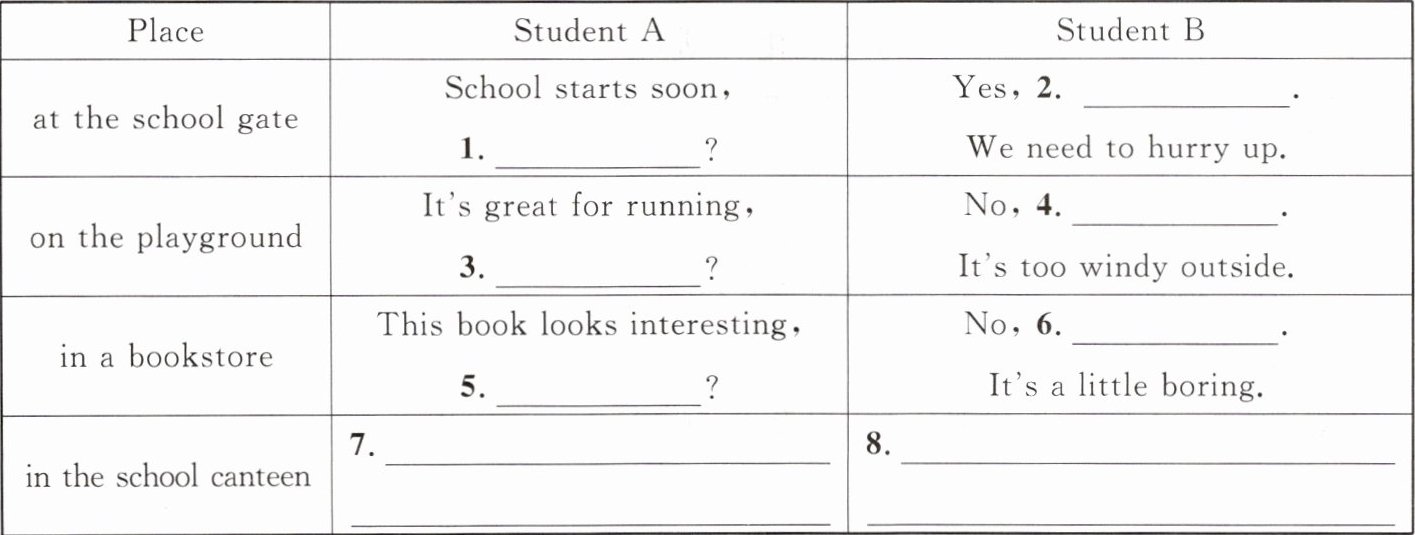 ? | No, 4. .
It's too windy outside. |
| in a bookstore | This book looks interesting,
5. ? | No, 6. .
It's a little boring. |
| in the school canteen | 7. | 8. |
| Place | Student A | Student B |
| --- | --- | --- |
| at the school gate | School starts soon,
1. ? | Yes, 2. .
We need to hurry up. |
| on the playground | It's great for running,
3.
? | No, 4. .It's too windy outside. |
| in a bookstore | This book looks interesting,
5. ? | No, 6. .
It's a little boring. |
| in the school canteen | 7. | 8. |
答案
1. doesn't it
2. it does
3. isn't it
4. it isn't
5. doesn't it
6. it doesn't
7. The tomato and egg rice here tastes really nice, doesn't it?(答案不唯一,符合场景即可)
8. Yes, it does. I always order this dish for my lunch.(答案不唯一,对应A的反意疑问、符合场景即可)
2. it does
3. isn't it
4. it isn't
5. doesn't it
6. it doesn't
7. The tomato and egg rice here tastes really nice, doesn't it?(答案不唯一,符合场景即可)
8. Yes, it does. I always order this dish for my lunch.(答案不唯一,对应A的反意疑问、符合场景即可)
解析
本题考查反意疑问句的用法,反意疑问句遵循"前肯后否、前否后肯"的规则,附加疑问部分的助动词/系动词要和前半句的时态、人称保持一致,回应需要根据实际场景的事实匹配Yes/No的逻辑,最后编写食堂场景对话也需要符合反意疑问句规则和场景合理性。
1. 前半句"School starts soon"是一般现在时的肯定句,谓语为实义动词starts,主语用it指代这件事,附加疑问部分用否定形式doesn't it。
2. 后文B说要快点,是对"马上要上课"的肯定认同,所以回应为it does。
3. 前半句"It's great for running"是it is引导的肯定句,附加疑问部分用否定形式isn't it。
4. 后文B说外面风太大,说明并不适合跑步,事实为否定,对应No的回应,填it isn't。
5. 前半句"This book looks interesting"是一般现在时的肯定句,谓语为实义动词looks,用it指代书,附加疑问部分用否定形式doesn't it。
6. 后文B说书有点无聊,说明书并不像看起来那么有趣,事实为否定,对应No的回应,填it doesn't。
7. 按照食堂场景编写带反意疑问句的A的表述,符合语法和场景即可。
8. 编写对应B的回应,符合逻辑和场景即可。
1. 前半句"School starts soon"是一般现在时的肯定句,谓语为实义动词starts,主语用it指代这件事,附加疑问部分用否定形式doesn't it。
2. 后文B说要快点,是对"马上要上课"的肯定认同,所以回应为it does。
3. 前半句"It's great for running"是it is引导的肯定句,附加疑问部分用否定形式isn't it。
4. 后文B说外面风太大,说明并不适合跑步,事实为否定,对应No的回应,填it isn't。
5. 前半句"This book looks interesting"是一般现在时的肯定句,谓语为实义动词looks,用it指代书,附加疑问部分用否定形式doesn't it。
6. 后文B说书有点无聊,说明书并不像看起来那么有趣,事实为否定,对应No的回应,填it doesn't。
7. 按照食堂场景编写带反意疑问句的A的表述,符合语法和场景即可。
8. 编写对应B的回应,符合逻辑和场景即可。
