

 登录
Ⅱ. 根据课本 P28~29 Understanding ideas 的课文,从方框内选择适当的词,并根据需要用其正确形式填空,使文章语法正确、完整连贯。注意:每空一词,每词仅用一次,有两词为多余选项
encourage up neighbour poem ashamed government relative agree argue lane divide act
In China, there are many narrow 6.
Long ago in the Qing Dynasty, two families, the Zhangs and the Wus, 7.
Zhang Ying sent a 11.
Many years later, the lane is still there. People in Tongcheng remember the poem and how kindness 15.
encourage up neighbour poem ashamed government relative agree argue lane divide act
In China, there are many narrow 6.
lanes
. One famous one is in Tongcheng, Anhui. It is called Liuchixiang(Six-chi Lane).Long ago in the Qing Dynasty, two families, the Zhangs and the Wus, 7.
argued
over the dividing line between their houses. They could not reach 8. agreement
. The Zhangs wrote to their 9. relative
,Zhang Ying, who worked in the 10. government
.Zhang Ying sent a 11.
poem
back. It said to give three chi to the 12. neighbour
. The Zhangs felt 13. ashamed
and did this. The Wus also gave 14. up
three chi. And so came a six-chi-wide lane.Many years later, the lane is still there. People in Tongcheng remember the poem and how kindness 15.
encourages
more kindness.答案
6. lanes 7. argued 8. agreement 9. relative
10. government 11. poem 12. neighbour 13. ashamed
14. up 15. encourages
解析
【分析】首先通读全文,明确文章讲述六尺巷的故事,再结合方框内的词汇,根据句子的语法结构、时态、固定搭配以及上下文语境,逐一选择合适的词并调整词形,注意每词仅用一次,避免多余选项。
【解析】1. 第6空:空前有many,需接可数名词复数,结合语境“狭窄的巷”,选lane的复数形式lanes;
2. 第7空:时间状语为清朝(过去时态),两个家族因分界线争吵,用argue的过去式argued;
3. 第8空:固定搭配reach agreement(达成协议),填名词agreement;
4. 第9空:写信给亲戚,选名词relative;
5. 第10空:Zhang Ying在政府任职,选名词government;
6. 第11空:send a poem(寄一首诗),结合后文提到的诗,填名词poem;
7. 第12空:给邻居,选名词neighbour;
8. 第13空:固定搭配feel ashamed(感到羞愧),填形容词ashamed;
9. 第14空:固定搭配give up(让出),填副词up;
10. 第15空:主语kindness为单数,一般现在时,encourage的第三人称单数形式encourages。
【答案】6. lanes 7. argued 8. agreement 9. relative 10. government 11. poem 12. neighbour 13. ashamed 14. up 15. encourages
【知识点】词汇运用、固定搭配、语境理解
【点评】本题为结合课文的选词填空题,考查学生对词汇词义、词形变化的掌握,以及固定搭配和上下文语境的理解,需仔细分析每个空的语法和语境,难度适中。
【难度系数】0.6
Ⅰ. 根据画线部分的读音将下列单词归类
who, nor, plann, build, message, paint, buy, impossible, whom, sing, whose, primary, thing, bathroom
| /h/ | 1.
| /m/ | 2.
| /n/ | 3. 图1
| /ŋ/ | 4.
| /b/ | 5.
who, nor, plann, build, message, paint, buy, impossible, whom, sing, whose, primary, thing, bathroom
| /h/ | 1.
who, whom, whose
|| /m/ | 2.
message, impossible, primary
|| /n/ | 3. 图1
nor, plan, paint
|| /ŋ/ | 4.
sing, thing
|| /b/ | 5.
build, buy, bathroom
|答案
1. who, whom, whose 2. message, impossible, primary
3. nor, plan, paint 4. sing, thing 5. build, buy, bathroom
解析
【分析】
要完成单词归类,需先明确题目要求的五个音标,再逐一判断所给单词画线部分的发音,将发音匹配的单词归入对应类别。先梳理每个音标的对应单词,确保发音匹配准确即可完成归类。
【解析】
1. 音标/h/:单词who、whom、whose的画线部分(wh)发音为/h/,归入该类;
2. 音标/m/:单词message、impossible、primary的画线部分发音为/m/,归入该类;
3. 音标/n/:单词nor、plan、paint的画线部分发音为/n/,归入该类;
4. 音标/ŋ/:单词sing、thing的画线部分发音为/ŋ/,归入该类;
5. 音标/b/:单词build、buy、bathroom的画线部分发音为/b/,归入该类。
【答案】
1. who, whom, whose 2. message, impossible, primary 3. nor, plan, paint 4. sing, thing 5. build, buy, bathroom
【知识点】
英语单词发音归类,音标识别,字母读音规则
【点评】
本题考查英语单词中特定字母或字母组合的发音,侧重基础音标知识和常见字母读音规则的掌握,通过辨别发音完成归类,属于基础题型,适合巩固单词读音的练习。
【难度系数】
0.5
Ⅱ. 根据句意及汉语意思或首字母提示填写单词
6. This road is very wide now, but it was very
7.
8. Grandmother Wang, one of my
9. [跨语文学科]—Do you like Happy Rain on a Spring Night(《春夜喜雨》)?
—Yes. It is a p
10. It's a tradition to visit r
6. This road is very wide now, but it was very
narrow
(狭窄的) ten years ago.7.
Whenever
(每当) my family goes on a trip, we take our new energy car to protect the environment.8. Grandmother Wang, one of my
neighbours
(邻居), is very kind to everyone.9. [跨语文学科]—Do you like Happy Rain on a Spring Night(《春夜喜雨》)?
—Yes. It is a p
oem
by Du Fu.10. It's a tradition to visit r
relatives
on the first day of the Spring Festival. It's called "bainian".答案
6. narrow 7. Whenever 8. neighbours 9. poem
10. relatives
解析
【分析】这类题目需结合句子语境、给出的汉语提示或首字母,同时考虑单词的词性、形式(如名词复数、句首大写等)来填写正确单词。解题思路为:先理解句子语境,再匹配对应提示的单词,最后检查单词形式是否符合语法要求。
【解析】
6. 由句意“这条路现在很宽,但十年前很________”及汉语提示“狭窄的”,可知需填形容词narrow,符合语境。
7. 由句意“______我家去旅行,我们开新能源车环保”及汉语提示“每当”,可知需填连词Whenever,句首首字母大写,符合语法规则。
8. “one of + 可数名词复数”是固定结构,结合汉语提示“邻居”,需填复数形式neighbours,符合搭配要求。
9. 由对话中《春夜喜雨》及首字母p,结合文学常识,可知这是杜甫的诗,故填poem。
10. 由句意“春节第一天拜访________是传统,叫拜年”及首字母r,结合习俗,可知需填复数形式relatives,符合语境。
【答案】6. narrow 7. Whenever 8. neighbours 9. poem 10. relatives
【知识点】英语单词拼写、可数名词复数、连词用法
【点评】本题考查基础词汇的运用,结合语境、提示及语法规则即可完成,属于基础题型。
【难度系数】0.8
Ⅰ. 阅读理解
Habits | Persons
Be outgoing | I am an outgoing person. I do right things, though no one asks me to do them. For example, I exercise twice a week. —Tom
续表
Habits | Persons
Study first, then play | I spend my time on the right things. I say no to things I should not do. I study first. And then I exercise and play games to relax. —Jane
Think for others | I do not do bad things to others. I think the best way to keep friendship is thinking for others.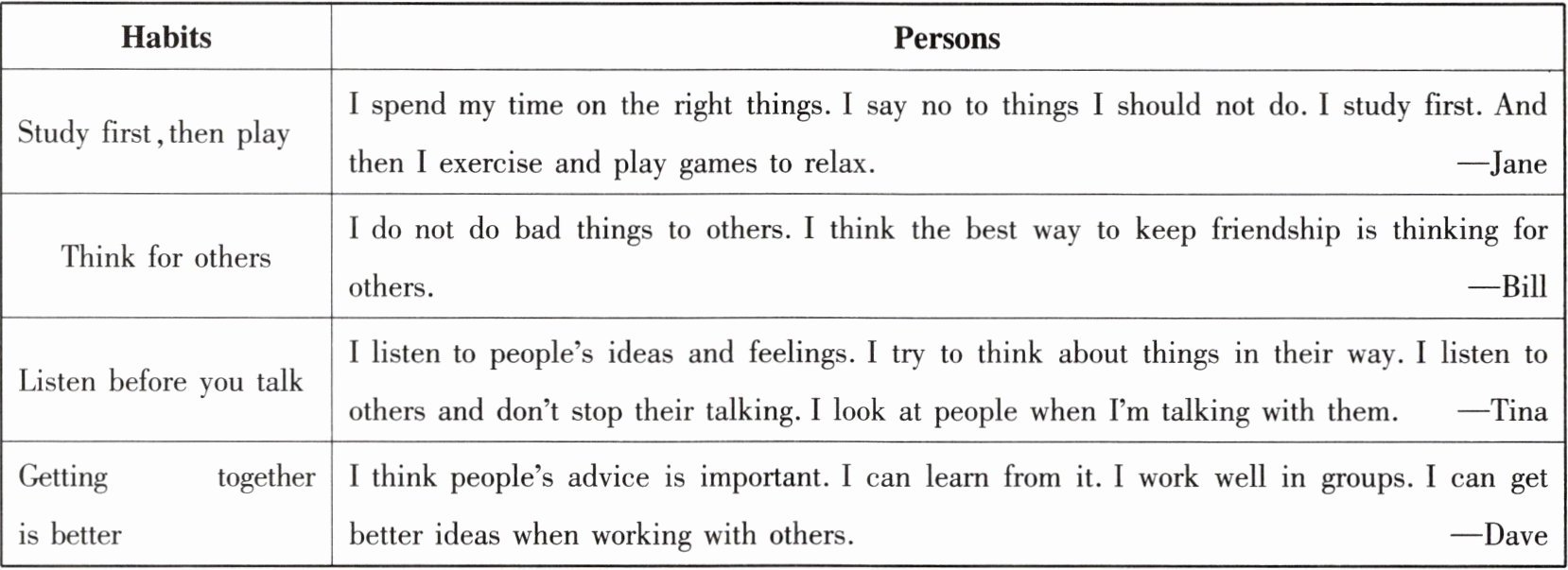 —Bill
Listen before you talk | I listen to people's ideas and feelings. I try to think about things in their way. I listen to others and don't stop their talking. I look at people when I'm talking with them. —Tina
Getting together is better | I think people's advice is important. I can learn from it. I work well in groups. I can get better ideas when working with others. —Dave
(
A. Once a week. B. Twice a week.
C. Once a month. D. Twice a month.
(
A. Being active. B. Studying first.
C. Thinking for others. D. Getting together.
(
A. thinks for a long time B. looks at the person
C. stops others' talking D. listens to others
(
A. Because he always has problems.
B. Because he likes to play with others.
C. Because he always needs help from others.
D. Because he can get better ideas.
(
A. An English dictionary. B. A school magazine.
C. A science report. D. A movie poster.
Habits | Persons
Be outgoing | I am an outgoing person. I do
right things, though no one asks me to do them. For example, I exercise twice a week. —Tom续表
Habits | Persons
Study first, then play | I spend my time on the right things. I say no to things I should not do. I study first. And then I exercise and play games to relax. —Jane
Think for others | I do not do bad things to others. I think the best way to keep friendship is thinking for others.
—BillListen before you talk | I listen to people's ideas and feelings. I try to think about things in their way. I listen to others and don't stop their talking. I look at people when I'm talking with them. —Tina
Getting together is better | I think people's advice is important. I can learn from it. I work well in groups. I can get better ideas when working with others. —Dave
(
B
)1. How often does Tom exercise?A. Once a week. B. Twice a week.
C. Once a month. D. Twice a month.
(
C
)2. What is the best way for Bill to keep friendship?A. Being active. B. Studying first.
C. Thinking for others. D. Getting together.
(
D
)3. Tina before she talks.A. thinks for a long time B. looks at the person
C. stops others' talking D. listens to others
(
D
)4. Why does Dave think getting together is better?A. Because he always has problems.
B. Because he likes to play with others.
C. Because he always needs help from others.
D. Because he can get better ideas.
(
B
)5. [文章来源题]Where is the passage probably from?A. An English dictionary. B. A school magazine.
C. A science report. D. A movie poster.
答案
1. B 2. C 3. D 4. D 5. B
解析
【分析】本题为英语阅读理解题,解题思路是:先快速浏览全文,明确文章是介绍五位学生的不同好习惯;再针对每个小题的问题,精准定位到文中对应人物的描述段落,提取关键信息与选项逐一匹配,最后确认答案的正确性。
【解析】1. 题干询问Tom的锻炼频率,定位到Tom的描述段落,其中明确提到“I exercise twice a week.”,对应选项B。2. 题干问Bill保持友谊的最佳方式,定位Bill的段落,原文表述为“I think the best way to keep friendship is thinking for others.”,对应选项C。3. 题干问Tina说话前的行为,定位Tina的段落,标题为“Listen before you talk”且内容提到“I listen to others and don't stop their talking.”,对应选项D。4. 题干问Dave认为聚在一起更好的原因,定位Dave的段落,原文说明“I can get better ideas when working with others.”,对应选项D。5. 题干判断文章来源,文章围绕学生的好习惯展开,最可能出自学校杂志,对应选项B。
【答案】1.B 2.C 3.D 4.D 5.B
【知识点】英语阅读理解、细节理解、文章出处判断
【点评】本文通过五位学生的分享展现不同的良好习惯,题目侧重考查信息定位与细节理解能力,整体难度适中,适合初中学生巩固阅读技巧。
【难度系数】0.7
