

 登录
16.如图所示,在四边形ABCD中,AD//BC,E为CD的中点,连接AE,BE,延长AE交BC的延长线于点F.
(1)判断FC与AD的数量关系,并说明理由.
(2)若AB=BC+AD,则BE⊥AF吗?为什么?
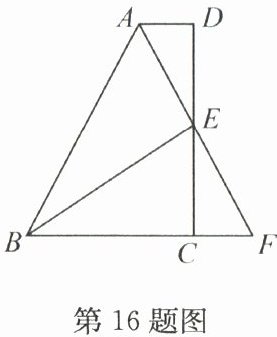
(1)判断FC与AD的数量关系,并说明理由.
(2)若AB=BC+AD,则BE⊥AF吗?为什么?
答案
16. 解:(1)结论:$FC=AD$.
理由:$\because AD// BC,\therefore ∠ADC=∠ECF$.
$\because E$是CD的中点,$\therefore ED=EC$.
在$△ADE$与$△FCE$中,$\begin{cases} ∠ADE=∠FCE, \\ ED=EC, \\ ∠AED=∠FEC, \end{cases}$
$\therefore △ADE≌ △FCE(\mathrm{ASA}),\therefore FC=AD$.
(2)$BE⊥AF$.
理由:由(1)知$△ADE≌ △FCE,\therefore AE=EF,AD=CF$.
$\because AB=BC+AD,\therefore AB=BC+CF$,即$AB=BF$.
又$\because AE=EF,\therefore BE⊥AF$.
三、能力拓展训练
17. 在$△ ABC$中,$∠ ACB$为锐角,点$D$为射线$BC$上一动点,连接$AD$,以$AD$为直角边,点$A$为直角顶点,在$AD$左侧作等腰直角三角形$ADF$,连接$CF$.
(1)若$AB=AC$,$∠ BAC=90°$.
①如图①,当点$D$在线段$BC$上时(不与点$B$重合),试探究$CF$和$BD$的数量关系和位置关系.
②当点$D$在线段$BC$的延长线上时,①中的结论是否仍然成立?请在图②中画出相应的图形,并说明理由.
(2)如图③,若$AB≠AC$,$∠ BAC≠90°$,$∠ BCA=45°$,点$D$在线段$BC$上运动时,试探究$CF$与$BC$的位置关系.
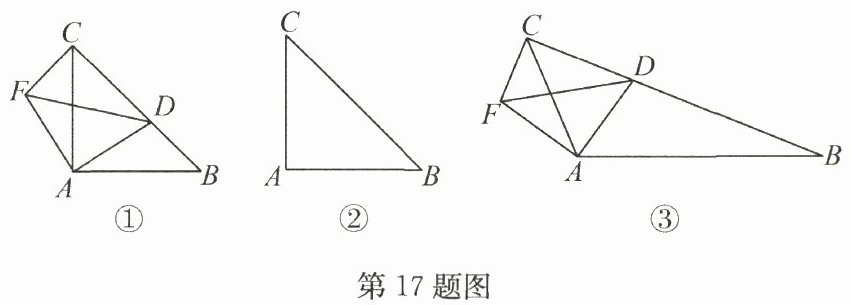
17. 在$△ ABC$中,$∠ ACB$为锐角,点$D$为射线$BC$上一动点,连接$AD$,以$AD$为直角边,点$A$为直角顶点,在$AD$左侧作等腰直角三角形$ADF$,连接$CF$.
(1)若$AB=AC$,$∠ BAC=90°$.
①如图①,当点$D$在线段$BC$上时(不与点$B$重合),试探究$CF$和$BD$的数量关系和位置关系.
②当点$D$在线段$BC$的延长线上时,①中的结论是否仍然成立?请在图②中画出相应的图形,并说明理由.
(2)如图③,若$AB≠AC$,$∠ BAC≠90°$,$∠ BCA=45°$,点$D$在线段$BC$上运动时,试探究$CF$与$BC$的位置关系.
答案
17. 解:(1)①$\because ∠BAC=90°,∠DAF=90°$,
$\therefore ∠BAD=∠CAF$.在$△ABD$和$△ACF$中,
$\begin{cases} AB=AC, \\ ∠BAD=∠CAF, \\ AD=AF, \end{cases}$
$\therefore △ABD≌ △ACF(\mathrm{SAS})$,
$\therefore BD=CF,∠B=∠ACF$.
$\because AB=AC,∠BAC=90°,\therefore ∠B=∠ACB=45°,\therefore ∠ACF=45°$,
$\therefore ∠BCF=∠ACB+∠ACF=45°+45°=90°$,$\therefore CF⊥BD$.
②结论仍然成立.图形如图①.理由:
$\because ∠CAB=∠DAF=90°,\therefore ∠BAD=∠CAF$,
在$△ABD$和$△ACF$中,$\begin{cases} AB=AC, \\ ∠BAD=∠CAF, \\ AD=AF, \end{cases}$
$\therefore △ABD≌ △ACF(\mathrm{SAS})$,
$\therefore BD=CF,∠B=∠ACF$,$\because AB=AC,∠BAC=90°$,
$\therefore ∠B=∠ACB=45°$,$\therefore ∠ACF=45°$,$\therefore ∠BCF=∠ACB+∠ACF=45°+45°=90°$,$\therefore CF⊥BD$.
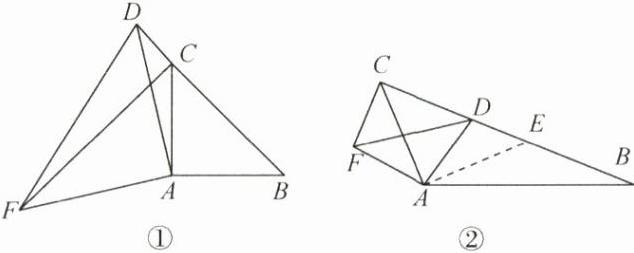
(2)作$AE⊥AC$交BC于点E,如图②.
$\because ∠EAC=90°,∠ACE=45°$,
$\therefore ∠AEC=45°,\therefore ∠ACE=∠AEC,\therefore AE=AC$,
$\because ∠CAE=∠FAD=90°,\therefore ∠DAE=∠FAC$,
在$△ADE$和$△AFC$中,$\begin{cases} AD=AF, \\ ∠DAE=∠FAC, \\ AE=AC, \end{cases}$
$\therefore △ADE≌ △AFC(\mathrm{SAS}).\therefore ∠AED=∠ACF=45°$,
又$∠ACB=45°,\therefore ∠FCB=45°+45°=90°,\therefore FC⊥BC$.
