

 登录
17. 如图,C为线段AD上一点,点B为CD的中点,且AD=9cm,BD=2cm. 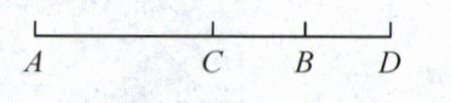
(1)求AC的长.
(2)若点E在直线AD上,且EA=3cm,求BE的长.
(1)求AC的长.
(2)若点E在直线AD上,且EA=3cm,求BE的长.
答案
17. 解:(1)$\because$点$B$为$CD$的中点,
$\therefore CB=BD=2\mathrm{cm}.$
$\therefore CD=BC+BD=4\mathrm{cm}.$
$\therefore AC=AD-CD=9-4=5\mathrm{cm}.$
$\therefore AC$的长为$5\mathrm{cm}.$
(2)$AB=AC+BC=7\mathrm{cm},EA=3\mathrm{cm},$
当点$E$在线段$AD$上时,

$BE=AB-AE=7-3=4\mathrm{cm}.$
当点$E$在线段$DA$的延长线上时,

$BE=AB+AE=7+3=10\mathrm{cm}.$
$\therefore BE$的长为$4\mathrm{cm}$或$10\mathrm{cm}.$
18. 右图是一个正方体的表面展开图,已知在原正方体中,相对面上的数的和为8,求$-2xy+z$的值. 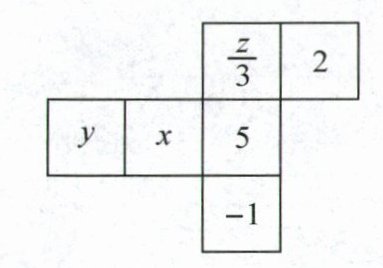
答案
18. 解:将这个展开图折成正方体,则“5”与“$y$”是相对面,“$x$”与“2”是相对面,“$\frac{z}{3}$”与“$-1$”是相对面.
$\because$相对面上的数的和为8,
$\therefore 5+y=8,x+2=8,\frac{z}{3}+(-1)=8.$
$\therefore x=6,y=3,z=27.$
$\therefore -2xy+z=-2×6×3+27=-9.$
$\because$相对面上的数的和为8,
$\therefore 5+y=8,x+2=8,\frac{z}{3}+(-1)=8.$
$\therefore x=6,y=3,z=27.$
$\therefore -2xy+z=-2×6×3+27=-9.$
