

 登录
五、听独白,完成表格。(不超过两个单词)
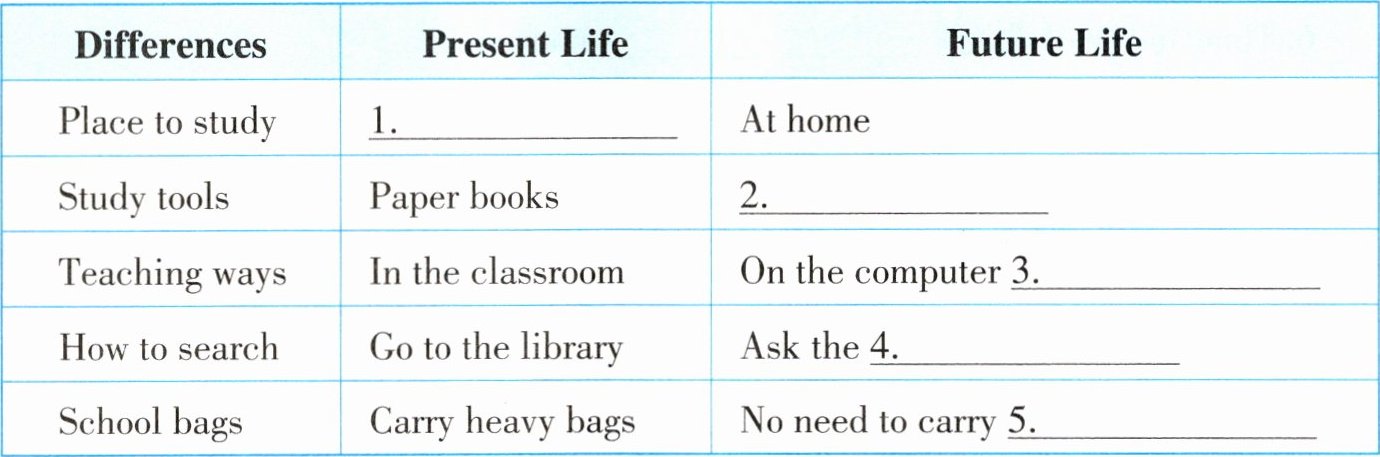
答案
1. At school
2. Computers
3. screen
4. Internet
5. bags
六、完形填空。
Education has changed a great deal over the centuries. It's the most important part of how humans move forward, and it keeps changing as society, technology, and culture change. Education is always finding new ways to help people learn better.
In the past, students went to an old kind of school—a special building where a teacher stood 1 the class. Nowadays, technology is transforming learning in ways we could only imagine before.
One major difference is the use of digital tools. Today, students use mobile phones and other devices to study. All kinds of learning apps make it 2 to get knowledge anywhere, except for places without the Internet. In the future, schools might 3 forever, replaced by virtual classrooms where anyone can learn via a screen.
Traditional education has its advantages. Face-to-face interaction (互动) helps students develop social skills and a positive 4 towards learning. 5, future education could save time and resources. For example, homework could be done offline but handed in online, reducing paper waste.
However, some people find the idea of digital schools 6. Will robots replace teachers? Will students simply 7 machines all day? No one knows for sure, but one thing is clear: education will keep 8 in this century. As technology 9 our path, the development of new methods will shape the progress of learning.
Maybe one day, children will throw away heavy backpacks 10 carry only a tablet. Or perhaps the neighbourhood school will 11, combining (结合) tradition with creation. 12 happens, education will always be a person's key to a brighter future.
(
(
(
(
(
(
(
(
(
(
(
(
13. Which do you think is better for students, traditional classroom learning or future digital education? Give at least 2 reasons to support your opinion.
Education has changed a great deal over the centuries. It's the most important part of how humans move forward, and it keeps changing as society, technology, and culture change. Education is always finding new ways to help people learn better.
In the past, students went to an old kind of school—a special building where a teacher stood 1 the class. Nowadays, technology is transforming learning in ways we could only imagine before.
One major difference is the use of digital tools. Today, students use mobile phones and other devices to study. All kinds of learning apps make it 2 to get knowledge anywhere, except for places without the Internet. In the future, schools might 3 forever, replaced by virtual classrooms where anyone can learn via a screen.
Traditional education has its advantages. Face-to-face interaction (互动) helps students develop social skills and a positive 4 towards learning. 5, future education could save time and resources. For example, homework could be done offline but handed in online, reducing paper waste.
However, some people find the idea of digital schools 6. Will robots replace teachers? Will students simply 7 machines all day? No one knows for sure, but one thing is clear: education will keep 8 in this century. As technology 9 our path, the development of new methods will shape the progress of learning.
Maybe one day, children will throw away heavy backpacks 10 carry only a tablet. Or perhaps the neighbourhood school will 11, combining (结合) tradition with creation. 12 happens, education will always be a person's key to a brighter future.
(
A
)1. A. in front of B. in the middle of C. at the back of D. next to(
B
)2. A. difficult B. convenient C. dangerous D. expensive(
B
)3. A. appear B. disappear C. rebuild D. return(
C
)4. A. progress B. effect C. attitude D. advantage(
C
)5. A. Besides B. Therefore C. However D. Thus(
B
)6. A. exciting B. strange C. boring D. possible(
A
)7. A. look at B. look for C. look up D. look after(
B
)8. A. repeating B. improving C. disappearing D. failing(
A
)9. A. brightens B. widens C. blocks D. follows(
A
)10. A. and B. because C. but D. or(
B
)11. A. leave B. remain C. close D. move(
C
)12. A. Whoever B. Whenever C. Whatever D. Wherever13. Which do you think is better for students, traditional classroom learning or future digital education? Give at least 2 reasons to support your opinion.
I prefer traditional classrooms because teachers can explain difficult topics clearly, and I can
make friends easily. Digital education is convenient, but it feels less personal.
(答案合理即可)
答案
1. A
2. B
3. B
4. C
5. C
6. B
7. A
8. B
9. A
10. A
11. B
12. C
13. Possible version: I prefer traditional classrooms because teachers can explain difficult topics clearly, and I can make friends easily. Digital education is convenient, but it feels less personal. (答案合理即可)
