

 登录
Ⅲ. 句式填写译一译
1. It's running out.
译文:
2. Can you tell me when the next test is?
译文:
3. I wonder how I forgot about the sugar.
译文:
4. You'd better hurry up.
译文:
5. New knowledge is best remembered by linking it with old knowledge.
译文:
6. Pay attention to details. Study how they are different from each other.
译文:
1. It's running out.
译文:
它快用完了。
2. Can you tell me when the next test is?
译文:
你能告诉我下场考试是什么时候吗?
3. I wonder how I forgot about the sugar.
译文:
我纳闷自己怎么把糖忘了。
4. You'd better hurry up.
译文:
你最好快点。
5. New knowledge is best remembered by linking it with old knowledge.
译文:
将新知识与旧知识联系起来,才能最好地记住新知识。
6. Pay attention to details. Study how they are different from each other.
译文:
注意细节,研究它们之间的不同之处。
答案
1. 它快用完了。
2. 你能告诉我下场考试是什么时候吗?
3. 我纳闷自己怎么把糖忘了。
4. 你最好快点。
5. 将新知识与旧知识联系起来,才能最好地记住新知识。
6. 注意细节,研究它们之间的不同之处。
Ⅰ. 听教材1b/1c & 1d/1e的录音,完成任务
1. Fill in the blanks.
(1)I can't remember things you asked me to buy.
(2)Tell me you've got so far.
(3) That's not I asked you to buy.
(4)I wonder I forgot about the sugar.
(5) I don't know I am so forgetful.
2. Listen and write True(T) or False(F).
(1)Billy forgot Fu Xing's birthday the day before. ()
(2) Fu Xing thinks Billy is forgetful because he is ill. ()
(3)Fu Xing left her homework at home and needs to go back for it. ()
(4)The lecture by Professor Green will begin at 9:30. ( )
(5)Fu Xing advises Billy to attend the lecture on time. ()
答案
1. (1)what (2)what (3)what
(4)how (5)why
2. (1)T (2)F (3)F (4)F (5)T
Ⅱ. 听教材2b/2c的录音,选择正确答案
1. What does the professor compare knowledge to?
A. A book. B. A chain. C. A picture.
2. What should we do to avoid mixing up similar words?
A. Pay attention to details.
B. Link them with old knowledge.
C. Separate them by comparing differences.
3. Where is the memory of riding a bike probably stored?
A. In a fast-developing area of the brain.
B. In a stable area of the brain.
C. In a mysterious area of the brain.
答案
1-3 BAB
合作探究·培思维
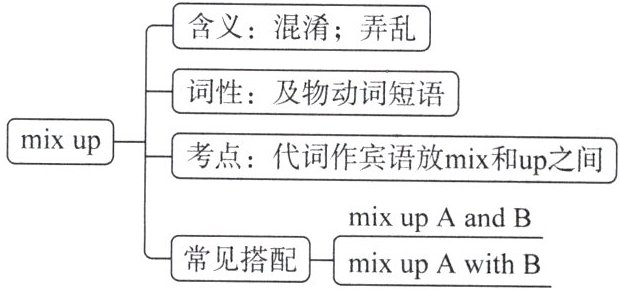
要点1:mix up 混淆;弄乱
【语境感悟】
I often get some words mixed up, like “kitchen” and “chicken”. 我经常把一些单词弄混,比如“kitchen”和“chicken”。(教材·P98)
Don’t mix up the two kinds of seeds when sowing. 播种的时候不要把这两种种子弄混。
She mixed up the exam papers by mistake. 她不小心把试卷弄乱了。
【知识归纳】
【迁移运用】
(1)The little boy always
(2)Don’t
(3)I often English words “accept” and “except” each other.
A. mix; up B. mix; with
C. mix up; with D. mix with; up
要点1:mix up 混淆;弄乱
【语境感悟】
I often get some words mixed up, like “kitchen” and “chicken”. 我经常把一些单词弄混,比如“kitchen”和“chicken”。(教材·P98)
Don’t mix up the two kinds of seeds when sowing. 播种的时候不要把这两种种子弄混。
She mixed up the exam papers by mistake. 她不小心把试卷弄乱了。
【知识归纳】
【迁移运用】
(1)The little boy always
mixes
up
(混淆)the twins.(2)Don’t
mix
up
(弄乱)the keys in the drawer.(3)I often English words “accept” and “except” each other.
A. mix; up B. mix; with
C. mix up; with D. mix with; up
答案
(1)mixes up (2)mix up (3)C
