

 登录
登录
探究点2 辨析any与some
any与some都可以表示“一些”,但用法不同。具体区别如下。
词汇 用法
any 一般用于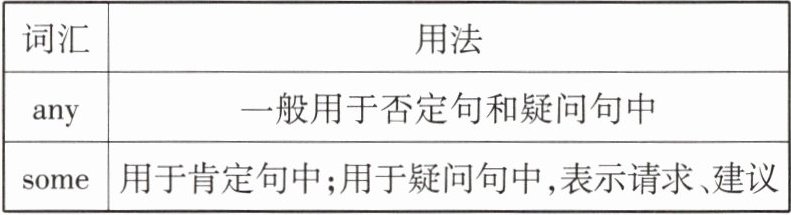 定句和疑问句中
some 用于肯定句中;用于疑问句中,表示请求、建议
I don’t have any money. 我没有钱。
Does he have any hobbies?
他有什么业余爱好吗?
I got some useful information.
我得到了一些有用的信息。
Would you like some tea?
你要来点茶吗?
情境应用
—Do you have oranges?
—No, we don’t. We have apples.
A.any;any
B.some;any
C.some;some
D.any;some
any与some都可以表示“一些”,但用法不同。具体区别如下。
词汇 用法
any 一般用于
定句和疑问句中some 用于肯定句中;用于疑问句中,表示请求、建议
I don’t have any money. 我没有钱。
Does he have any hobbies?
他有什么业余爱好吗?
I got some useful information.
我得到了一些有用的信息。
Would you like some tea?
你要来点茶吗?
情境应用
—Do you have oranges?
—No, we don’t. We have apples.
A.any;any
B.some;any
C.some;some
D.any;some
答案
D
解析
第一空所在句为普通一般疑问句,不表请求或建议,根据规则any常用于疑问句,第一空填any;第二空所在句为肯定句,根据规则some常用于肯定句,第二空填some,对应选项D。
()1. —Does your brother like strawberries?
—, but he likes apples.
A.Yes, he does
B.No, he doesn't
C.Yes, he is
D.No, he isn't
—, but he likes apples.
A.Yes, he does
B.No, he doesn't
C.Yes, he is
D.No, he isn't
答案
B
解析
首先,问句是Does引导的一般疑问句,回答需用助动词does/doesn't,不能用be动词is,排除C、D选项;其次答句中but表转折,后半句说明他喜欢苹果,可知前半句要表达“他不喜欢草莓”的否定含义,对应否定回答No, he doesn't。
()2. Her parents make her to play tennis.
A.learn
B.learns
C.learning
D.to learn
A.learn
B.learns
C.learning
D.to learn
答案
A
解析
本题考查使役动词make的固定搭配,七年级所学规则为make sb. do sth.,意为“让某人做某事”,make后要接不带to的动词原形,因此此处应填learn。
()3. —Is there milk in the fridge?
—No, there isn’t . Let’s buy this afternoon.
A.some;some;some
B.some;any;some
C.any;some;any
D.any;any;some
—No, there isn’t . Let’s buy this afternoon.
A.some;some;some
B.some;any;some
C.any;some;any
D.any;any;some
答案
D
解析
本题考查some和any的用法:any通常用于疑问句和否定句中,some通常用于肯定句中。第一空位于一般疑问句,填any;第二空位于否定句,填any;第三空位于肯定句,填some,符合的是选项D。
()4. —Do you have any aunts uncles?
—Yes, I do. I have an uncle and two aunts.
A.and
B.or
C.so
D.but
—Yes, I do. I have an uncle and two aunts.
A.and
B.or
C.so
D.but
答案
B
解析
这是一般疑问句,要表达并列的“和”的含义时,疑问句中需用连词or;and多用于肯定句的并列,so表因果意为“所以”,but表转折意为“但是”,均不符合此处语境,因此选B。
()5. —My parents will take me to Shanghai.
—Really?
A.That sounds bad.
B.Have fun!
C.I’d like to.
D.Thank you.
—Really?
A.That sounds bad.
B.Have fun!
C.I’d like to.
D.Thank you.
答案
B
解析
对话中对方告知要和父母去上海,这是出行游玩的好消息。A选项表示“那听起来很糟糕”不符合语境;B选项“玩得开心!”是对他人出行的恰当祝福;C选项“我想要去”不符合此处回应逻辑;D选项“谢谢你”使用场景不符,因此选B。
Ⅱ. 将下列句子中汉语部分译成英语,注意使用适当的形式
1. Tony is . He likes telling jokes.(一个有趣的男孩)
2. Don't at others when they are in trouble(困难).(嘲笑)
3. They are in the same school, but .(在不同的班级)
4. Linda is . She doesn't talk much.(一个安静的女孩)
5. She likes .(穿白色的衣服)
1. Tony is . He likes telling jokes.(一个有趣的男孩)
2. Don't at others when they are in trouble(困难).(嘲笑)
3. They are in the same school, but .(在不同的班级)
4. Linda is . She doesn't talk much.(一个安静的女孩)
5. She likes .(穿白色的衣服)
答案
1. an interesting boy
2. laugh
3. in different classes
4. a quiet girl
5. wearing white clothes(或to wear white clothes)
2. laugh
3. in different classes
4. a quiet girl
5. wearing white clothes(或to wear white clothes)
解析
本题考查七年级上册核心词汇、固定搭配和基础语法规则:
1. 表示“一个有趣的男孩”,形容词interesting发音以元音音素开头,要搭配不定冠词an,符合句子主系表的结构要求。
2. “嘲笑”的固定英文短语是laugh at,祈使句中Don't后面需要接动词原形。
3. 形容词different意为“不同的”,后面要接可数名词复数,名词class的复数形式是classes,对应主语they,直接译为in different classes即可。
4. 表示“一个安静的女孩”,形容词quiet发音以辅音音素开头,搭配不定冠词a,符合主系表结构。
5. 动词like后接动名词doing形式可以表达长期的喜好,“穿白色的衣服”译为wearing white clothes,符合like的用法规则。
1. 表示“一个有趣的男孩”,形容词interesting发音以元音音素开头,要搭配不定冠词an,符合句子主系表的结构要求。
2. “嘲笑”的固定英文短语是laugh at,祈使句中Don't后面需要接动词原形。
3. 形容词different意为“不同的”,后面要接可数名词复数,名词class的复数形式是classes,对应主语they,直接译为in different classes即可。
4. 表示“一个安静的女孩”,形容词quiet发音以辅音音素开头,搭配不定冠词a,符合主系表结构。
5. 动词like后接动名词doing形式可以表达长期的喜好,“穿白色的衣服”译为wearing white clothes,符合like的用法规则。
