

 登录
登录
一、根据课文判断句子正(T)误(F)。
(
(
(
(
(
(
F
) 1. Shenzhen was a megacity in 1979.(
T
) 2. Thousands of young people came to Shenzhen in 1980.(
T
) 3. People had a better life in Shenzhen in 1990.(
F
) 4. Shenzhen’s population stopped growing after 2000.(
T
) 5. There are many modern buildings and green spaces in Shenzhen now.答案
1. F 2. T 3. T 4. F 5. T
解析
【分析】
本题是根据课文内容判断关于深圳不同时期情况的句子正误,解题时需回忆课文中对深圳1979年、1980年、1990年、2000年后及当前状况的描述,将每个句子的表述与课文内容逐一比对,相符则判断为T,不符则为F。
【解析】
1. 课文中提到1979年的深圳是小渔村,并非大城市(megacity),故该句错误;
2. 1980年深圳设立经济特区后,吸引了成千上万的年轻人前来,该句与课文一致,正确;
3. 1990年深圳经过发展,人们的生活水平有了提升,该句正确;
4. 2000年后深圳的人口仍在持续增长,并未停止,该句错误;
5. 现在的深圳有许多现代化建筑和绿地,该句与课文内容相符,正确。
【答案】
1.F 2.T 3.T 4.F 5.T
【知识点】
课文内容理解,判断正误
【点评】
本题聚焦课文中深圳发展的相关细节,考查学生对课文内容的熟悉程度,难度不大,准确掌握课文信息即可正确作答。
【难度系数】
0.3
本题是根据课文内容判断关于深圳不同时期情况的句子正误,解题时需回忆课文中对深圳1979年、1980年、1990年、2000年后及当前状况的描述,将每个句子的表述与课文内容逐一比对,相符则判断为T,不符则为F。
【解析】
1. 课文中提到1979年的深圳是小渔村,并非大城市(megacity),故该句错误;
2. 1980年深圳设立经济特区后,吸引了成千上万的年轻人前来,该句与课文一致,正确;
3. 1990年深圳经过发展,人们的生活水平有了提升,该句正确;
4. 2000年后深圳的人口仍在持续增长,并未停止,该句错误;
5. 现在的深圳有许多现代化建筑和绿地,该句与课文内容相符,正确。
【答案】
1.F 2.T 3.T 4.F 5.T
【知识点】
课文内容理解,判断正误
【点评】
本题聚焦课文中深圳发展的相关细节,考查学生对课文内容的熟悉程度,难度不大,准确掌握课文信息即可正确作答。
【难度系数】
0.3
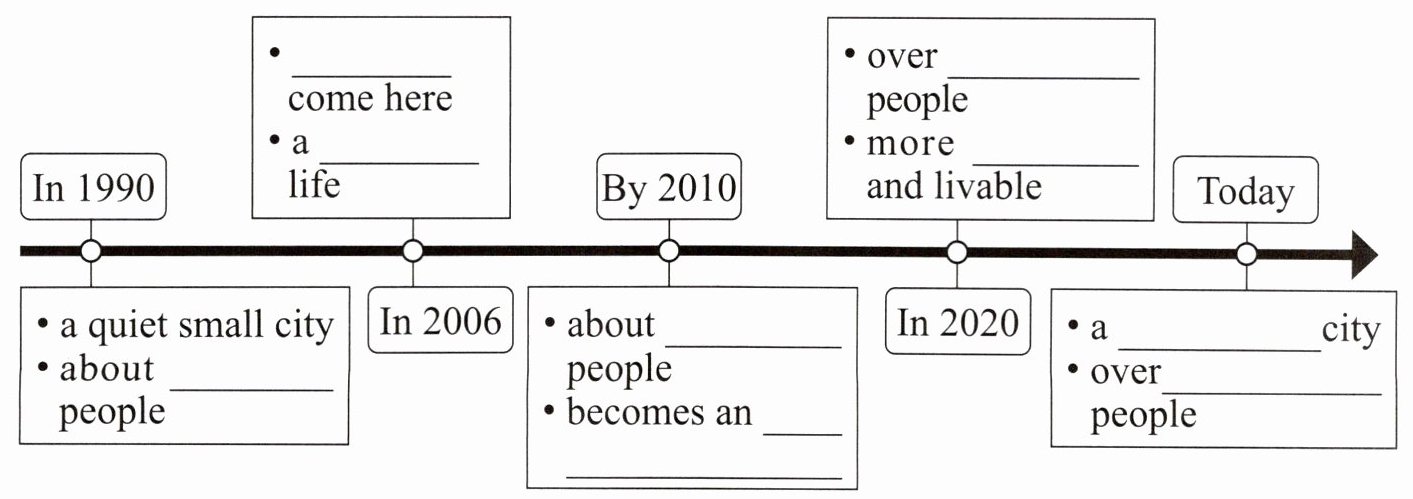
二、阅读短文,按照时间轴,在文中找关键词填空,了解合肥的发展。
From small town to modern city—Hefei
The year is 1990. Hefei is a quiet small city by the Fei River and Chaohu Lake. It has low buildings and narrow roads, and only about 1.2 million people live here.
It is 2006, many workers come here to build roads, bridges and tall buildings. They have a better life in Hefei.
By 2010, about 5.7 million people live in Hefei. New tech companies(科技公司)and factories open here. High-speed rail connects it to big cities, and Hefei becomes an innovation(创新)centre.
Ten years later, over 9 million people live here. Metro(地铁)lines run through the city, and there are more than 1,200 parks and green spaces. Hefei becomes more beautiful and livable(适于居住的).
Today, Hefei is a modern city in the Yangtze River Delta(长江三角洲). Over 12 million people live here, with modern buildings and a good transport network. They make Hefei a great city.
From small town to modern city—Hefei
The year is 1990. Hefei is a quiet small city by the Fei River and Chaohu Lake. It has low buildings and narrow roads, and only about 1.2 million people live here.
It is 2006, many workers come here to build roads, bridges and tall buildings. They have a better life in Hefei.
By 2010, about 5.7 million people live in Hefei. New tech companies(科技公司)and factories open here. High-speed rail connects it to big cities, and Hefei becomes an innovation(创新)centre.
Ten years later, over 9 million people live here. Metro(地铁)lines run through the city, and there are more than 1,200 parks and green spaces. Hefei becomes more beautiful and livable(适于居住的).
Today, Hefei is a modern city in the Yangtze River Delta(长江三角洲). Over 12 million people live here, with modern buildings and a good transport network. They make Hefei a great city.
答案
In 1990: 1.2 million
In 2006: many workers, better
By 2010: 5.7 million, innovation center
In 2020: 9 million, beautiful
Today: modern/ great, 12 million
In 2006: many workers, better
By 2010: 5.7 million, innovation center
In 2020: 9 million, beautiful
Today: modern/ great, 12 million
解析
【分析】
本题需根据短文给出的时间轴,定位每个时间节点对应的关键信息,提取匹配的关键词填空。首先明确各时间点,再在短文中找到对应时间的描述,提取所需的人口、人物、城市特点等关键词即可。
【解析】
1. In 1990:短文提到“only about 1.2 million people live here”,对应时间轴的人口信息,故填1.2 million;
2. In 2006:短文提到“many workers come here... They have a better life”,对应时间轴的人物和生活状态,故填many workers、better;
3. By 2010:短文提到“about 5.7 million people live in Hefei... Hefei becomes an innovation centre”,对应时间轴的人口和城市定位,故填5.7 million、innovation center;
4. In 2020(2010的十年后):短文提到“over 9 million people live here... Hefei becomes more beautiful and livable”,对应时间轴的人口和城市特点,故填9 million、beautiful;
5. Today:短文提到“Hefei is a modern city... Over 12 million people live here”,对应时间轴的城市类型和人口,故填modern(或great)、12 million。
【答案】
In 1990: 1.2 million;In 2006: many workers, better;By 2010: 5.7 million, innovation center;In 2020: 9 million, beautiful;Today: modern/great, 12 million
【知识点】
英语阅读信息提取,时间定位
【点评】
本题为基础阅读信息提取题,要求学生根据时间轴快速定位短文中对应时间的关键内容,难度较低,主要考查学生的信息查找能力。
【难度系数】
0.7
本题需根据短文给出的时间轴,定位每个时间节点对应的关键信息,提取匹配的关键词填空。首先明确各时间点,再在短文中找到对应时间的描述,提取所需的人口、人物、城市特点等关键词即可。
【解析】
1. In 1990:短文提到“only about 1.2 million people live here”,对应时间轴的人口信息,故填1.2 million;
2. In 2006:短文提到“many workers come here... They have a better life”,对应时间轴的人物和生活状态,故填many workers、better;
3. By 2010:短文提到“about 5.7 million people live in Hefei... Hefei becomes an innovation centre”,对应时间轴的人口和城市定位,故填5.7 million、innovation center;
4. In 2020(2010的十年后):短文提到“over 9 million people live here... Hefei becomes more beautiful and livable”,对应时间轴的人口和城市特点,故填9 million、beautiful;
5. Today:短文提到“Hefei is a modern city... Over 12 million people live here”,对应时间轴的城市类型和人口,故填modern(或great)、12 million。
【答案】
In 1990: 1.2 million;In 2006: many workers, better;By 2010: 5.7 million, innovation center;In 2020: 9 million, beautiful;Today: modern/great, 12 million
【知识点】
英语阅读信息提取,时间定位
【点评】
本题为基础阅读信息提取题,要求学生根据时间轴快速定位短文中对应时间的关键内容,难度较低,主要考查学生的信息查找能力。
【难度系数】
0.7
