

 登录
登录
I Listen and match. Review 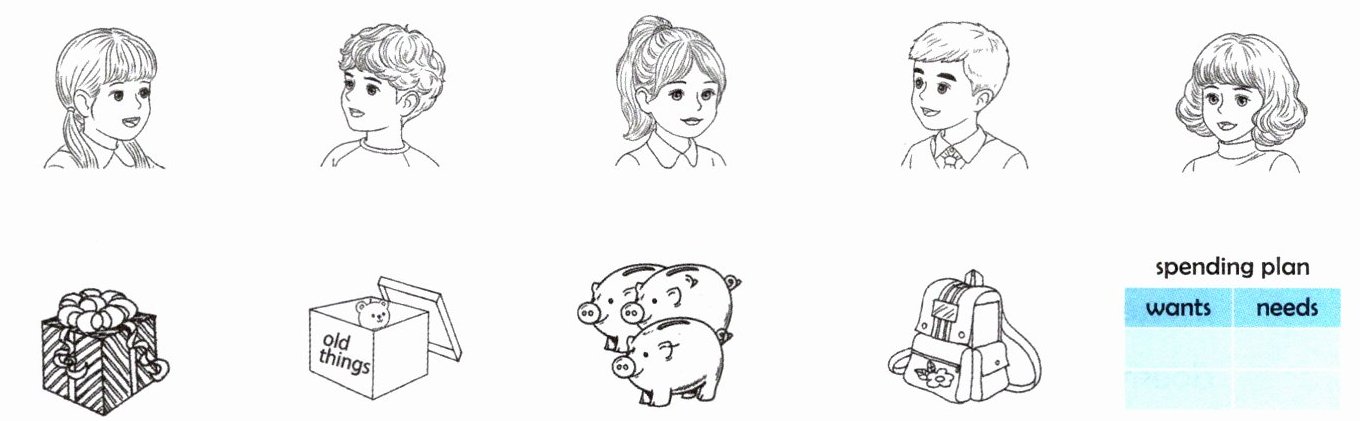 old things spending plan wants needs
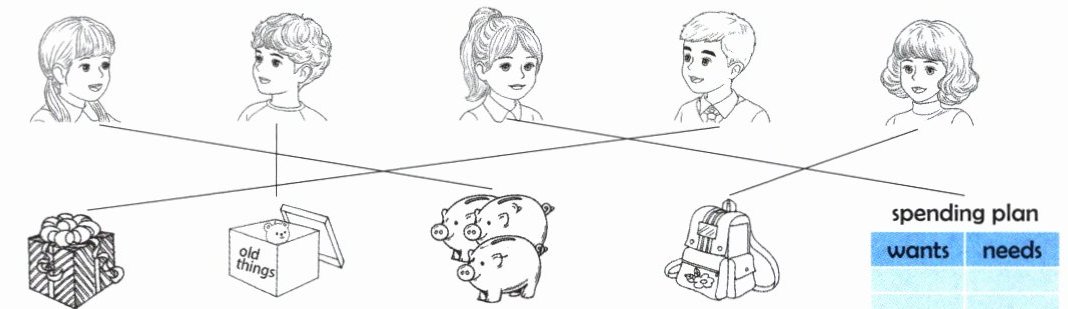
old things spending plan wants needs答案
Ⅱ.Listen and number.

答案
3 4 2 1
Ⅲ.Think, choose and tick or cross.
读一读本单元的“Reading time”,你能完成货币演变流程图,并判断对错吗?
A. paying by mobile phones B. paper money
C. exchanging goods or services D. different metal coins
E. bankbooks and cards
(
(
(
(
(
读一读本单元的“Reading time”,你能完成货币演变流程图,并判断对错吗?
A. paying by mobile phones B. paper money
C. exchanging goods or services D. different metal coins
E. bankbooks and cards
(
×
)1. Long long ago, people used money to buy things.(
×
)2. Shell money, knife money and copper coins are metal coins.(
×
)3. People used paper money because metal coins were light.(
√
)4. We have paper money, bankbooks and cards today.(
×
)5. Paying by mobile phones is slow and difficult.答案
C→D→B→E→A 1. × 2. × 3. × 4. √ 5. ×
解析
【分析】首先梳理货币演变的时间顺序:最早的货币形式是物物交换(C),之后出现不同的金属硬币(D),接着发明纸币(B),再发展出存折和银行卡(E),现在是移动支付(A),因此流程为C→D→B→E→A。判断句子对错时,结合货币常识和句子含义:1. 很久以前人们以物换物而非用钱购物,故错误;2. 贝壳货币不属于金属硬币,故错误;3. 金属硬币太重,人们才用纸币,故错误;4. 现在确实有纸币、存折和银行卡,故正确;5. 移动支付快速便捷,并非缓慢困难,故错误。
【解析】1. 货币演变流程:按时间先后依次为物物交换(C)→金属硬币(D)→纸币(B)→存折和银行卡(E)→移动支付(A),故流程为C→D→B→E→A。2. 句子判断:(1) 很久以前人们以物换物,不是用钱购物,打×;(2) 贝壳货币不是金属硬币,打×;(3) 金属硬币太重,所以用纸币,打×;(4) 现在有纸币、存折、卡,打√;(5) 移动支付快且方便,打×。
【答案】C→D→B→E→A;1.×;2.×;3.×;4.√;5.×
【知识点】货币演变常识、英语阅读理解判断、词汇应用
【点评】本题结合单元阅读内容,考查货币发展历程梳理及英语句子正误判断,属于基础题型,认真阅读单元材料并理解句子含义即可完成,难度不大。
【难度系数】0.7
【解析】1. 货币演变流程:按时间先后依次为物物交换(C)→金属硬币(D)→纸币(B)→存折和银行卡(E)→移动支付(A),故流程为C→D→B→E→A。2. 句子判断:(1) 很久以前人们以物换物,不是用钱购物,打×;(2) 贝壳货币不是金属硬币,打×;(3) 金属硬币太重,所以用纸币,打×;(4) 现在有纸币、存折、卡,打√;(5) 移动支付快且方便,打×。
【答案】C→D→B→E→A;1.×;2.×;3.×;4.√;5.×
【知识点】货币演变常识、英语阅读理解判断、词汇应用
【点评】本题结合单元阅读内容,考查货币发展历程梳理及英语句子正误判断,属于基础题型,认真阅读单元材料并理解句子含义即可完成,难度不大。
【难度系数】0.7
Ⅳ.Task reading.
Many students get pocket money from their parents every month. They spend it in different ways. Some use it well, but some waste it on things they don't need.
Simon uses all his pocket money to buy an expensive computer. He doesn't need it for his school study. Mary has three pencil boxes, but she still buys two more. David buys a red bike, but he cannot ride it. No one uses it now. These are big wastes of money.
However, Anna, Chen Jie and Tom have good habits. Anna opens a bank account and keeps most of her pocket money there for future use. Chen Jie keeps her pocket money in three jars for daily use, family gifts and future big things. Tom makes a clear plan for his pocket money every month. He spends part on school things and healthy snacks, and saves the rest in his piggy bank.
We should not buy useless things. We should make a good plan before we spend our pocket money and learn to save money. These are good habits for all students.
Task 1: Read and tick or cross.
(
(
(
(
(
Task 2: Read and choose.
(
A. Two.
B. Three.
C. Five.
(
A. She puts money in three jars for different uses.
B. She saves all her money in a bank.
C. She only buys daily things.
(
A. School things.
B. Healthy snacks.
C. Expensive computers.
(
A. Buy all the expensive things you like.
B. Make plans and save money.
C. Never spend any pocket money.
Many students get pocket money from their parents every month. They spend it in different ways. Some use it well, but some waste it on things they don't need.
Simon uses all his pocket money to buy an expensive computer. He doesn't need it for his school study. Mary has three pencil boxes, but she still buys two more. David buys a red bike, but he cannot ride it. No one uses it now. These are big wastes of money.
However, Anna, Chen Jie and Tom have good habits. Anna opens a bank account and keeps most of her pocket money there for future use. Chen Jie keeps her pocket money in three jars for daily use, family gifts and future big things. Tom makes a clear plan for his pocket money every month. He spends part on school things and healthy snacks, and saves the rest in his piggy bank.
We should not buy useless things. We should make a good plan before we spend our pocket money and learn to save money. These are good habits for all students.
Task 1: Read and tick or cross.
(
×
)1. All students use their pocket money in good ways.(
√
)2. Simon's new expensive computer is not useful for his school study.(
×
)3. David's new red bike is always used by him after buying it.(
√
)4. Anna saves most of her pocket money in a bank account.(
√
)5. Saving pocket money is a good habit for students.Task 2: Read and choose.
(
B
)1. How many pencil boxes did Mary have before buying new ones?A. Two.
B. Three.
C. Five.
(
A
)2. How does Chen Jie manage her pocket money?A. She puts money in three jars for different uses.
B. She saves all her money in a bank.
C. She only buys daily things.
(
C
)3. What does Tom NOT spend his pocket money on?A. School things.
B. Healthy snacks.
C. Expensive computers.
(
B
)4. What is a good way to use pocket money according to the passage?A. Buy all the expensive things you like.
B. Make plans and save money.
C. Never spend any pocket money.
答案
Task 1: 1. × 2. √ 3. × 4. √ 5. √
Task 2: 1. B 2. A 3. C 4. B
Task 2: 1. B 2. A 3. C 4. B
解析
【分析】
本题为任务型阅读理解题,解题核心是定位原文对应细节信息,逐题对比题目表述与原文内容:Task1需判断题目说法是否与原文一致,Task2需根据原文匹配对应选项,需仔细查找原文中关于人物零花钱使用的描述,避免主观臆断。
【解析】
Task 1(判断正误)
1. 原文第一段提到“Some use it well, but some waste it on things they don't need”,说明并非所有学生都用零花钱的方式正确,故打×;
2. 原文第二段明确写“Simon... buy an expensive computer. He doesn't need it for his school study”,与题目表述一致,故打√;
3. 原文第二段提到“David buys a red bike... No one uses it now”,说明没人使用这辆车,故打×;
4. 原文第三段写“Anna opens a bank account and keeps most of her pocket money there”,与题目表述一致,故打√;
5. 原文最后一段指出“learn to save money. These are good habits for all students”,与题目表述一致,故打√。
Task 2(单项选择)
1. 原文第二段“Mary has three pencil boxes, but she still buys two more”,说明买新铅笔盒前已有3个,选B;
2. 原文第三段“Chen Jie keeps her pocket money in three jars for daily use, family gifts and future big things”,对应选项A;
3. 原文第三段“Tom spends part on school things and healthy snacks”,未提及买昂贵电脑,选C;
4. 原文最后一段“We should make a good plan before we spend our pocket money and learn to save money”,对应选项B。
【答案】
Task 1: 1. × 2. √ 3. × 4. √ 5. √
Task 2: 1. B 2. A 3. C 4. B
【知识点】
英语任务型阅读、细节理解题
【点评】
本题围绕学生零花钱使用的话题展开,题型为基础的判断和选择,主要考查学生快速定位原文细节的能力,内容贴近学生生活,易于理解。
【难度系数】
0.8
本题为任务型阅读理解题,解题核心是定位原文对应细节信息,逐题对比题目表述与原文内容:Task1需判断题目说法是否与原文一致,Task2需根据原文匹配对应选项,需仔细查找原文中关于人物零花钱使用的描述,避免主观臆断。
【解析】
Task 1(判断正误)
1. 原文第一段提到“Some use it well, but some waste it on things they don't need”,说明并非所有学生都用零花钱的方式正确,故打×;
2. 原文第二段明确写“Simon... buy an expensive computer. He doesn't need it for his school study”,与题目表述一致,故打√;
3. 原文第二段提到“David buys a red bike... No one uses it now”,说明没人使用这辆车,故打×;
4. 原文第三段写“Anna opens a bank account and keeps most of her pocket money there”,与题目表述一致,故打√;
5. 原文最后一段指出“learn to save money. These are good habits for all students”,与题目表述一致,故打√。
Task 2(单项选择)
1. 原文第二段“Mary has three pencil boxes, but she still buys two more”,说明买新铅笔盒前已有3个,选B;
2. 原文第三段“Chen Jie keeps her pocket money in three jars for daily use, family gifts and future big things”,对应选项A;
3. 原文第三段“Tom spends part on school things and healthy snacks”,未提及买昂贵电脑,选C;
4. 原文最后一段“We should make a good plan before we spend our pocket money and learn to save money”,对应选项B。
【答案】
Task 1: 1. × 2. √ 3. × 4. √ 5. √
Task 2: 1. B 2. A 3. C 4. B
【知识点】
英语任务型阅读、细节理解题
【点评】
本题围绕学生零花钱使用的话题展开,题型为基础的判断和选择,主要考查学生快速定位原文细节的能力,内容贴近学生生活,易于理解。
【难度系数】
0.8
