

 登录
登录
五、阅读理解
Schools around the world:
Let’s find out the differences!
Schools in different countries are quite different. Let's take a look at how schools work in China, Japan, Italy, Russia, and Australia!
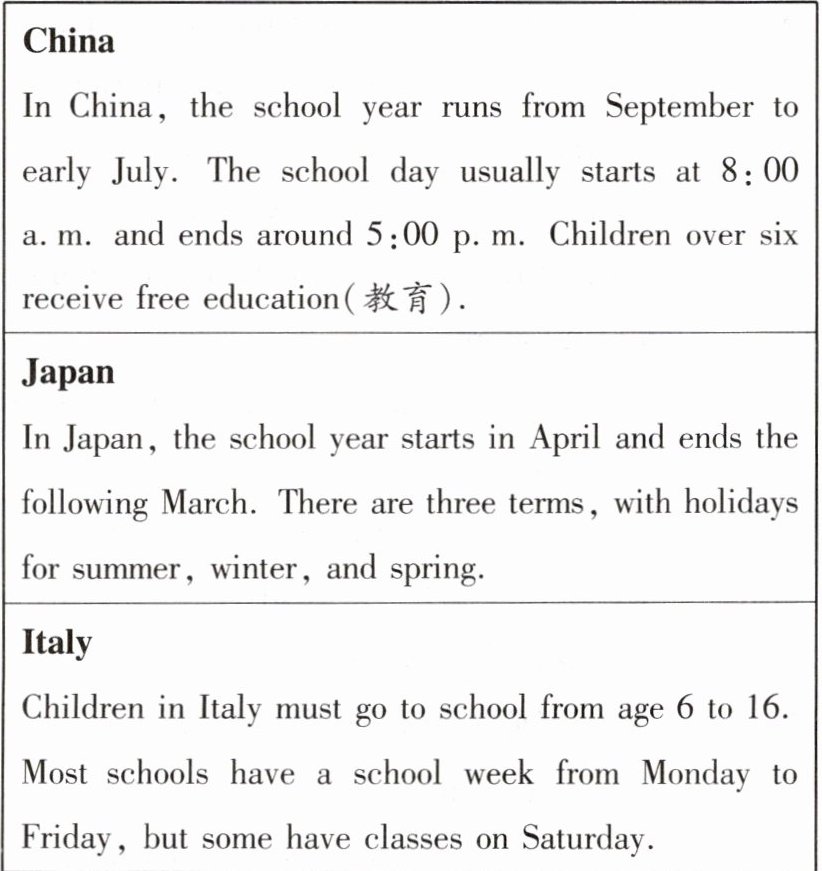

1. What time does a school day usually start in China?
A. $7:30$ a. m.
B. $8:00$ a. m.
C. $8:30$ a. m.
D. $9:00$ a. m.
2. How many terms does a school year have in Japan?
A. One.
B. Two.
C. Three.
D. Four.
3. When can Li Lei, a Chinese student, go on a ten-day holiday with his friend in Russia?
A. In June.
B. In August.
C. In April.
D. In December.
4. What can we learn from the passage above?
A. Students always stay in the same class in Russia until age 12.
B. All the children can receive free education in China.
C. The summer holiday lasts about a month in Australia.
D. Most children in Italy have lessons from Monday to Saturday.
5. In which part of a newspaper can we read about the passage above?
A. Travel.
B. Life.
C. Art.
D. Education.
六、信息还原(七选五)
Andy: Hi, Lily. Glad to see you! Do you like your new school?
Lily: 1
Andy: What is your school like?
Lily: 2
Andy: That’s great. 3
Lily: I often play tennis with my friends in the tennis club after class.
Andy: I also like tennis! 4
Lily: Yes, I am good at swimming. I am a member of the school swimming team.
Andy: You are great. 5
Lily: You are right. Doing sports can make us strong.
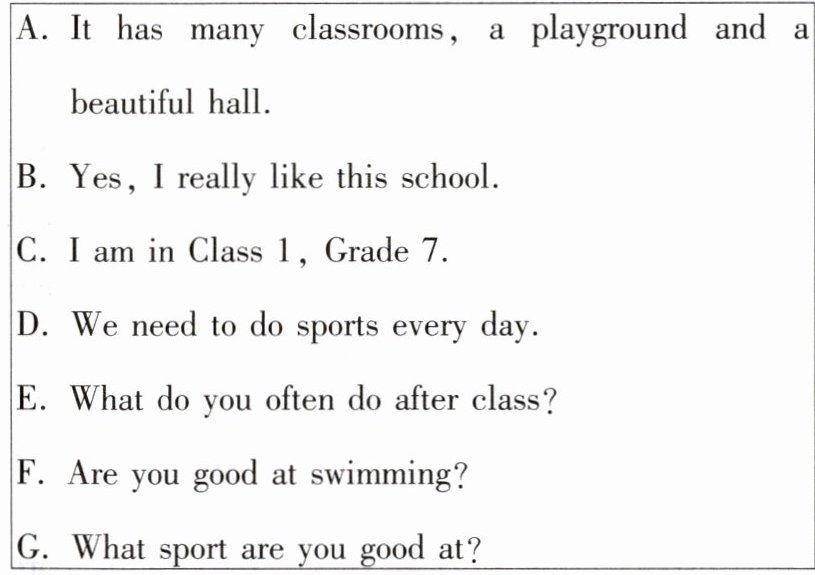
1. 2. 3.
4. 5.
Schools around the world:
Let’s find out the differences!
Schools in different countries are quite different. Let's take a look at how schools work in China, Japan, Italy, Russia, and Australia!
1. What time does a school day usually start in China?
A. $7:30$ a. m.
B. $8:00$ a. m.
C. $8:30$ a. m.
D. $9:00$ a. m.
2. How many terms does a school year have in Japan?
A. One.
B. Two.
C. Three.
D. Four.
3. When can Li Lei, a Chinese student, go on a ten-day holiday with his friend in Russia?
A. In June.
B. In August.
C. In April.
D. In December.
4. What can we learn from the passage above?
A. Students always stay in the same class in Russia until age 12.
B. All the children can receive free education in China.
C. The summer holiday lasts about a month in Australia.
D. Most children in Italy have lessons from Monday to Saturday.
5. In which part of a newspaper can we read about the passage above?
A. Travel.
B. Life.
C. Art.
D. Education.
六、信息还原(七选五)
Andy: Hi, Lily. Glad to see you! Do you like your new school?
Lily: 1
Andy: What is your school like?
Lily: 2
Andy: That’s great. 3
Lily: I often play tennis with my friends in the tennis club after class.
Andy: I also like tennis! 4
Lily: Yes, I am good at swimming. I am a member of the school swimming team.
Andy: You are great. 5
Lily: You are right. Doing sports can make us strong.
1. 2. 3.
4. 5.
答案
五、【语篇导读】本文介绍了中国、日本、意大利、俄罗斯、澳大利亚五个国家的学校制度差异,包括学年时间、学期安排、上学时长等内容。
1. B 提示:细节理解题。根据表格中China部分的“The school day usually starts at 8:00 a. m. ”可知,中国的学校通常早上8:00开始上课。
2. C 提示:细节理解题。根据表格中Japan部分的“There are three terms”可知,日本一学年有3个学期。
3. B 提示:推理判断题。根据表格中China部分的“In China, the school year runs from September to early July. ”和表格中Russia部分的“In Russia, the school year starts on September 1st and ends in late May or early June. ”可知,八月是中国学生和俄罗斯学生共同的假期。
4. C 提示:细节理解题。根据表格中Australia部分的“In Australia, summer holidays run from late December to late January. ”可知,澳大利亚学生的暑假持续大概一个月。
5. D 提示:推理判断题。本文介绍了不同国家的学校制度,属于教育类内容,因此会出现在报纸的“教育”版块。
六、【语篇导读】本文是一段关于新学校的生活的对话。
1. B 2. A 3. E 4. F 5. D
1. B 提示:细节理解题。根据表格中China部分的“The school day usually starts at 8:00 a. m. ”可知,中国的学校通常早上8:00开始上课。
2. C 提示:细节理解题。根据表格中Japan部分的“There are three terms”可知,日本一学年有3个学期。
3. B 提示:推理判断题。根据表格中China部分的“In China, the school year runs from September to early July. ”和表格中Russia部分的“In Russia, the school year starts on September 1st and ends in late May or early June. ”可知,八月是中国学生和俄罗斯学生共同的假期。
4. C 提示:细节理解题。根据表格中Australia部分的“In Australia, summer holidays run from late December to late January. ”可知,澳大利亚学生的暑假持续大概一个月。
5. D 提示:推理判断题。本文介绍了不同国家的学校制度,属于教育类内容,因此会出现在报纸的“教育”版块。
六、【语篇导读】本文是一段关于新学校的生活的对话。
1. B 2. A 3. E 4. F 5. D
解析
【分析】
本题包含阅读理解和信息还原两大题型。做阅读理解时,需先通读语篇把握主旨(不同国家学校制度的差异),再根据问题类型(细节理解、推理判断)定位原文对应信息,逐一比对选项得出答案;做信息还原时,需通读对话,梳理上下文的问答逻辑与语境,结合选项语义匹配空缺处内容。
【解析】
五、1. 本题为细节理解题,根据语篇中China部分的“The school day usually starts at 8:00 a. m. ”,可知中国学校通常早上8:00开始上课,故选B。2. 本题为细节理解题,根据Japan部分的“There are three terms”,可知日本一学年有3个学期,故选C。3. 本题为推理判断题,中国学年为9月至7月初,俄罗斯学年为9月1日至5月底或6月初,八月是两国学生的共同假期,因此中国学生李雷可在八月去俄罗斯度假,故选B。4. 本题为细节理解题,根据Australia部分的“In Australia, summer holidays run from late December to late January”,可知澳大利亚暑假持续约一个月,故选C。5. 本题为推理判断题,语篇介绍不同国家的学校制度,属于教育类内容,因此会出现在报纸的“教育”版块,故选D。
六、本题为信息还原题,结合对话语境分析:1. 上文询问是否喜欢新学校,需给出肯定回答,对应选项B;2. 上文询问学校情况,需描述学校特征,对应选项A;3. 下文回答课后打网球,此处需询问课后活动,对应选项E;4. 下文提到擅长游泳,此处需询问游泳相关内容,对应选项F;5. 下文提到运动的好处,此处需呼应运动的作用,对应选项D。
【答案】
五、1.B 2.C 3.B 4.C 5.D;六、1.B 2.A 3.E 4.F 5.D
【知识点】
阅读理解、信息还原
【点评】
本题涵盖阅读理解和信息还原两种常见题型,重点考查学生对语篇细节的查找、推理能力以及对话语境的逻辑理解能力,题型常规,难度适中,适合中等水平学生完成。
【难度系数】
0.6
本题包含阅读理解和信息还原两大题型。做阅读理解时,需先通读语篇把握主旨(不同国家学校制度的差异),再根据问题类型(细节理解、推理判断)定位原文对应信息,逐一比对选项得出答案;做信息还原时,需通读对话,梳理上下文的问答逻辑与语境,结合选项语义匹配空缺处内容。
【解析】
五、1. 本题为细节理解题,根据语篇中China部分的“The school day usually starts at 8:00 a. m. ”,可知中国学校通常早上8:00开始上课,故选B。2. 本题为细节理解题,根据Japan部分的“There are three terms”,可知日本一学年有3个学期,故选C。3. 本题为推理判断题,中国学年为9月至7月初,俄罗斯学年为9月1日至5月底或6月初,八月是两国学生的共同假期,因此中国学生李雷可在八月去俄罗斯度假,故选B。4. 本题为细节理解题,根据Australia部分的“In Australia, summer holidays run from late December to late January”,可知澳大利亚暑假持续约一个月,故选C。5. 本题为推理判断题,语篇介绍不同国家的学校制度,属于教育类内容,因此会出现在报纸的“教育”版块,故选D。
六、本题为信息还原题,结合对话语境分析:1. 上文询问是否喜欢新学校,需给出肯定回答,对应选项B;2. 上文询问学校情况,需描述学校特征,对应选项A;3. 下文回答课后打网球,此处需询问课后活动,对应选项E;4. 下文提到擅长游泳,此处需询问游泳相关内容,对应选项F;5. 下文提到运动的好处,此处需呼应运动的作用,对应选项D。
【答案】
五、1.B 2.C 3.B 4.C 5.D;六、1.B 2.A 3.E 4.F 5.D
【知识点】
阅读理解、信息还原
【点评】
本题涵盖阅读理解和信息还原两种常见题型,重点考查学生对语篇细节的查找、推理能力以及对话语境的逻辑理解能力,题型常规,难度适中,适合中等水平学生完成。
【难度系数】
0.6
