

 登录
登录
Ⅱ. 通过预习课文A部分,判断下列句子的正(√)、误(×)。
1. Katie always gets up at seven o'clock on Monday. (
2. Katie's family often has breakfast at 6:30 a.m. (
3. Katie always gets up early. (
4. Katie always waves goodbye to her father and goes to school. (
1. Katie always gets up at seven o'clock on Monday. (
×
)2. Katie's family often has breakfast at 6:30 a.m. (
×
)3. Katie always gets up early. (
√
)4. Katie always waves goodbye to her father and goes to school. (
×
)答案
1. ×
2. ×
3. √
4. ×
2. ×
3. √
4. ×
解析
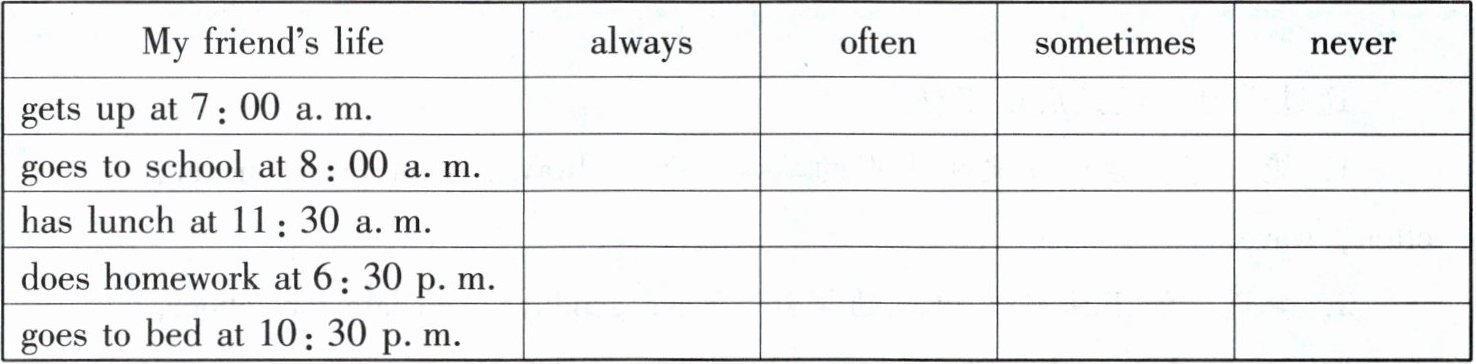
Ⅰ. 做个小调查,根据你朋友的生活作息,在符合的那一项内画。

|My friend's life|always|often|sometimes|never|
|gets up at 7:00 a.m.| | | | |
|goes to school at 8:00 a.m.| | | | |
|has lunch at 11:30 a.m.| | | | |
|does homework at 6:30 p.m.| | | | |
|goes to bed at 10:30 p.m.| | | | |
Say something about your friend's life.
1. He/She
2.
3.
4.
5.
|My friend's life|always|often|sometimes|never|
|gets up at 7:00 a.m.| | | | |
|goes to school at 8:00 a.m.| | | | |
|has lunch at 11:30 a.m.| | | | |
|does homework at 6:30 p.m.| | | | |
|goes to bed at 10:30 p.m.| | | | |
Say something about your friend's life.
1. He/She
always
gets up at 7:00 a.m.2.
He/She often goes to school at 8:00 a.m.
.3.
He/She sometimes has lunch at 11:30 a.m.
.4.
He/She often does homework at 6:30 p.m.
.5.
He/She never goes to bed at 10:30 p.m.
.答案
1. always
2. He/She often goes to school at 8:00 a.m.
3. He/She sometimes has lunch at 11:30 a.m.
4. He/She often does homework at 6:30 p.m.
5. He/She never goes to bed at 10:30 p.m.
2. He/She often goes to school at 8:00 a.m.
3. He/She sometimes has lunch at 11:30 a.m.
4. He/She often does homework at 6:30 p.m.
5. He/She never goes to bed at 10:30 p.m.
解析
1. 首先,需要根据对朋友实际生活作息的了解,在表格相应频率词下画“☺” 。比如如果朋友总是7点起床,就在“gets up at 7:00 a.m.”对应的“always”下画“☺”。
2. 然后,根据表格中所画“☺”的情况,用相应的频率副词完成关于朋友生活的句子描述。
假设调查结果为:朋友总是7点起床,经常8点上学,有时11:30吃午饭,经常6:30做作业,从不10:30睡觉。
1. “He/She always gets up at 7:00 a.m.” ,因为“gets up at 7:00 a.m.”对应“always”画了“☺”。
2. “He/She often goes to school at 8:00 a.m.” ,依据“goes to school at 8:00 a.m.”对应“often”画“☺”。
3. “He/She sometimes has lunch at 11:30 a.m.” ,按照“has lunch at 11:30 a.m.”对应“sometimes”画“☺”。
4. “He/She often does homework at 6:30 p.m.” ,根据“does homework at 6:30 p.m.”对应“often”画“☺”。
5. “He/She never goes to bed at 10:30 p.m.” ,由“goes to bed at 10:30 p.m.”对应“never”画“☺”。
2. 然后,根据表格中所画“☺”的情况,用相应的频率副词完成关于朋友生活的句子描述。
假设调查结果为:朋友总是7点起床,经常8点上学,有时11:30吃午饭,经常6:30做作业,从不10:30睡觉。
1. “He/She always gets up at 7:00 a.m.” ,因为“gets up at 7:00 a.m.”对应“always”画了“☺”。
2. “He/She often goes to school at 8:00 a.m.” ,依据“goes to school at 8:00 a.m.”对应“often”画“☺”。
3. “He/She sometimes has lunch at 11:30 a.m.” ,按照“has lunch at 11:30 a.m.”对应“sometimes”画“☺”。
4. “He/She often does homework at 6:30 p.m.” ,根据“does homework at 6:30 p.m.”对应“often”画“☺”。
5. “He/She never goes to bed at 10:30 p.m.” ,由“goes to bed at 10:30 p.m.”对应“never”画“☺”。
Ⅱ. 请试着说一说,告诉你的朋友你的生活作息。
1. I always
2. I sometimes
3. I often
4. I never
...
1. I always
get up at 7:00 a.m.
.2. I sometimes
watch TV in the evening
.3. I often
play football after school
.4. I never
eat junk food
....
答案
1. I always get up at 7:00 a.m.
2. I sometimes watch TV in the evening.
3. I often play football after school.
4. I never eat junk food.
2. I sometimes watch TV in the evening.
3. I often play football after school.
4. I never eat junk food.
Ⅰ. 听音,用“√”标出相符的时钟。

1.
(
2.
(
3.
(
4.
(

5.
(
1.
(
√
) ( )2.
(
√
) ( )3.
(
√
) ( )4.
(
√
) ( )5.
(
√
) ( )答案
1. 左图 2.左图 3.左图 4.左图 5.左图
解析
