

 登录
登录
新素材素材来源:BusyTeacher
[2026 原创]Have you ever wondered why we have four seasons? The reason is the special relationship between the earth and the sun, especially how our planet is tilted (倾斜).
To understand the seasons, we first need to know two things about our planet. Earth spins around an imaginary line called an axis, which goes from the North Pole to the South Pole. This spinning gives us day and night. There is also an imaginary line called the equator that circles the middle of the earth, dividing it into the Northern hemisphere and Southern hemisphere.
Earth takes a full year to orbit the sun. Its axis is not straight up and down; it is tilted a little. Because of this tilt, different parts of the planet get different amounts of direct sunlight. When one hemisphere is tilted towards the sun, it gets more direct sunlight, creating summer. At the same time, the other hemisphere is tilted away from the sun, getting less direct sunlight and creating winter.
This is why the Northern hemisphere and Southern hemisphere always have opposite seasons. When it is summer in North America, it is winter in Australia. Areas near the equator are not affected much by this tilt. They get about the same amount of direct sunlight all year, so they stay warm and do not have four clear seasons.
The year's longest day in the north is the summer solstice (around 21st June), and the shortest is the winter solstice (around 21st December). There are also two days called the equinoxes, when the day and night are nearly equal in length.
(
A. The tilt of the earth's axis.
B. The location of the earth's equator.
C. The spinning of the earth around its axis.
D. The distance between the earth and the sun.
(
A. It is the reason for the earth's orbit.
B. It divides the earth into two halves.
C. It keeps the earth warm all year long.
D. It is an imaginary line which the earth spins around.
(
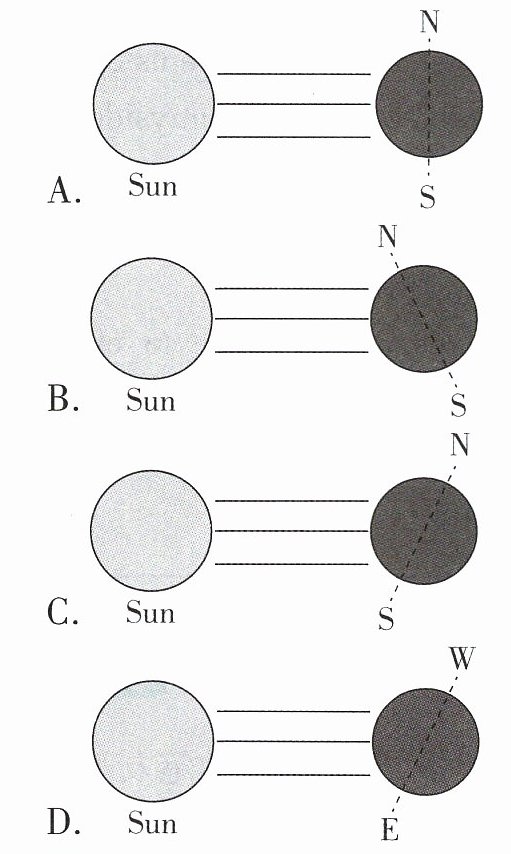
(
A. Around 21st June.
B. Around 21st March.
C. Around 21st September.
D. Around 21st December.
(
A. 至点 B. 昼夜平分时
C. 节气 D. 季节转换日
[2026 原创]Have you ever wondered why we have four seasons? The reason is the special relationship between the earth and the sun, especially how our planet is tilted (倾斜).
To understand the seasons, we first need to know two things about our planet. Earth spins around an imaginary line called an axis, which goes from the North Pole to the South Pole. This spinning gives us day and night. There is also an imaginary line called the equator that circles the middle of the earth, dividing it into the Northern hemisphere and Southern hemisphere.
Earth takes a full year to orbit the sun. Its axis is not straight up and down; it is tilted a little. Because of this tilt, different parts of the planet get different amounts of direct sunlight. When one hemisphere is tilted towards the sun, it gets more direct sunlight, creating summer. At the same time, the other hemisphere is tilted away from the sun, getting less direct sunlight and creating winter.
This is why the Northern hemisphere and Southern hemisphere always have opposite seasons. When it is summer in North America, it is winter in Australia. Areas near the equator are not affected much by this tilt. They get about the same amount of direct sunlight all year, so they stay warm and do not have four clear seasons.
The year's longest day in the north is the summer solstice (around 21st June), and the shortest is the winter solstice (around 21st December). There are also two days called the equinoxes, when the day and night are nearly equal in length.
(
A
)1. What is the main cause of the seasons?A. The tilt of the earth's axis.
B. The location of the earth's equator.
C. The spinning of the earth around its axis.
D. The distance between the earth and the sun.
(
D
)2. According to Paragraph 2, what is the earth's axis?A. It is the reason for the earth's orbit.
B. It divides the earth into two halves.
C. It keeps the earth warm all year long.
D. It is an imaginary line which the earth spins around.
(
B
)3. 新考法图示理解 Which picture best shows why it is summer in the Northern hemisphere?(
D
)4. If a student in Argentina (阿根廷) is celebrating the longest day of the year, what is the most likely date?A. Around 21st June.
B. Around 21st March.
C. Around 21st September.
D. Around 21st December.
(
B
)5. What does the word "equinoxes" in the last paragraph most likely mean in Chinese?A. 至点 B. 昼夜平分时
C. 节气 D. 季节转换日
答案
1. A 细节理解题。根据第一段的"The reason is the special relationship between the earth and the sun, especially how our planet is tilted."以及第三段的"Because of this tilt, different parts of the planet get different amounts of direct sunlight."可知,地球自转轴的倾斜是导致季节变化的主要原因。故选A项。
2. D 细节理解题。根据第二段的Earth spins around an imaginary line called an axis可知,地轴是地球自转所围绕的一条假想线。故选D项。
链接狂K
connect 的详细讲解见狂K重点P32。
知识拓展
季节形成的真正原因是地轴的倾斜,它决定了太阳光直射的角度和日照时间的长短,这才是影响地表接收热量的关键因素。
3. B 推理判断题。根据第三段的"When one hemisphere is tilted towards the sun, it gets more direct sunlight, creating summer."可知,北半球是夏季时,地球的北极(N)一端应该是朝向太阳倾斜的。故选B项。
4. D 推理判断题。根据文章第五段可知,一年中最长的白昼在夏至。阿根廷位于南半球。根据第四段的Northern hemisphere and Southern hemisphere always have opposite seasons可知,南北半球的季节是相反的。第五段提到北半球的夏至是6月21日左右,那么南半球的夏至就应该是北半球的冬至,即12月21日左右。故选D项。
5. B 词义猜测题。根据"There are also two days called the equinoxes, when the day and night are nearly equal in length."可知,文中提到的这两天白昼和夜晚时长几乎相等。结合常识可知,这两天指春分和秋分,故equinoxes意为"昼夜平分时"。故选B项。
2. D 细节理解题。根据第二段的Earth spins around an imaginary line called an axis可知,地轴是地球自转所围绕的一条假想线。故选D项。
链接狂K
connect 的详细讲解见狂K重点P32。
知识拓展
季节形成的真正原因是地轴的倾斜,它决定了太阳光直射的角度和日照时间的长短,这才是影响地表接收热量的关键因素。
3. B 推理判断题。根据第三段的"When one hemisphere is tilted towards the sun, it gets more direct sunlight, creating summer."可知,北半球是夏季时,地球的北极(N)一端应该是朝向太阳倾斜的。故选B项。
4. D 推理判断题。根据文章第五段可知,一年中最长的白昼在夏至。阿根廷位于南半球。根据第四段的Northern hemisphere and Southern hemisphere always have opposite seasons可知,南北半球的季节是相反的。第五段提到北半球的夏至是6月21日左右,那么南半球的夏至就应该是北半球的冬至,即12月21日左右。故选D项。
5. B 词义猜测题。根据"There are also two days called the equinoxes, when the day and night are nearly equal in length."可知,文中提到的这两天白昼和夜晚时长几乎相等。结合常识可知,这两天指春分和秋分,故equinoxes意为"昼夜平分时"。故选B项。
解析
【分析】
本题为科普类英语阅读理解题,共5道小题,分别考查细节理解、推理判断、词义猜测能力。解题思路:1. 第1题定位原文中季节成因的描述,匹配选项;2. 第2题直接定位原文中地轴的定义句,选出对应答案;3. 第3题结合原文“北半球夏季时北极朝向太阳倾斜”的结论,分析图示判断正确选项;4. 第4题利用“南北半球季节相反”的规律,结合北半球夏至时间推导南半球最长白昼的日期;5. 第5题根据原文对equinoxes的解释(昼夜时长几乎相等),结合常识猜测词义。
【解析】
1. 第1题:根据原文第一段“The reason is...especially how our planet is tilted.”及第三段“Because of this tilt...creating summer/winter”,可知季节变化的主因是地轴倾斜,故选A。
2. 第2题:根据第二段“Earth spins around an imaginary line called an axis”,可知地轴是地球自转围绕的假想线,故选D。
3. 第3题:原文提到北半球夏季时,北极(N端)应朝向太阳倾斜。观察图示:A地轴垂直,不符合;B地轴N端朝向太阳,符合;C地轴S端朝向太阳,对应南半球夏季;D标注W/E,非南北极,不符合,故选B。
4. 第4题:阿根廷位于南半球,南北半球季节相反。北半球夏至(6月21日左右)是北半球最长白昼,对应南半球冬至(最短白昼),南半球最长白昼为北半球冬至(12月21日左右),故选D。
5. 第5题:原文说明equinoxes是“when the day and night are nearly equal in length”,即昼夜时长几乎相等,对应“昼夜平分时”,故选B。
【答案】
1. A 2. D 3. B 4. D 5. B
【知识点】
科普类阅读理解、细节理解、推理判断
【点评】
本题围绕地球季节形成的科普知识展开,考查英语阅读的核心能力,题型贴合初中英语考查方向,既巩固了地理常识,也提升了阅读解题技巧。
【难度系数】
0.6
本题为科普类英语阅读理解题,共5道小题,分别考查细节理解、推理判断、词义猜测能力。解题思路:1. 第1题定位原文中季节成因的描述,匹配选项;2. 第2题直接定位原文中地轴的定义句,选出对应答案;3. 第3题结合原文“北半球夏季时北极朝向太阳倾斜”的结论,分析图示判断正确选项;4. 第4题利用“南北半球季节相反”的规律,结合北半球夏至时间推导南半球最长白昼的日期;5. 第5题根据原文对equinoxes的解释(昼夜时长几乎相等),结合常识猜测词义。
【解析】
1. 第1题:根据原文第一段“The reason is...especially how our planet is tilted.”及第三段“Because of this tilt...creating summer/winter”,可知季节变化的主因是地轴倾斜,故选A。
2. 第2题:根据第二段“Earth spins around an imaginary line called an axis”,可知地轴是地球自转围绕的假想线,故选D。
3. 第3题:原文提到北半球夏季时,北极(N端)应朝向太阳倾斜。观察图示:A地轴垂直,不符合;B地轴N端朝向太阳,符合;C地轴S端朝向太阳,对应南半球夏季;D标注W/E,非南北极,不符合,故选B。
4. 第4题:阿根廷位于南半球,南北半球季节相反。北半球夏至(6月21日左右)是北半球最长白昼,对应南半球冬至(最短白昼),南半球最长白昼为北半球冬至(12月21日左右),故选D。
5. 第5题:原文说明equinoxes是“when the day and night are nearly equal in length”,即昼夜时长几乎相等,对应“昼夜平分时”,故选B。
【答案】
1. A 2. D 3. B 4. D 5. B
【知识点】
科普类阅读理解、细节理解、推理判断
【点评】
本题围绕地球季节形成的科普知识展开,考查英语阅读的核心能力,题型贴合初中英语考查方向,既巩固了地理常识,也提升了阅读解题技巧。
【难度系数】
0.6
