

 登录
登录
3 Read the passage.
阅读短文。
How art keeps culture alive
People all over the world create different art forms to pass on culture.
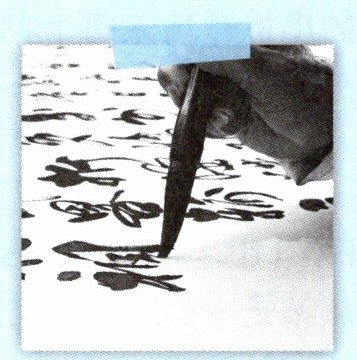
① Chinese calligraphy is the art of beautiful handwriting using brush and ink. It’s more than just writing. People express feelings and thoughts through *brushstrokes* (画笔). Each stroke must be carefully controlled in order to turn simple characters into flowing works of art. Calligraphy is often used for poems, sayings and important papers. It shows the deep connection between writing and Chinese culture. Chinese calligraphy values balance, flow and harmony. It’s not just writing — it’s a *graceful* (优雅的), *timeless* art.
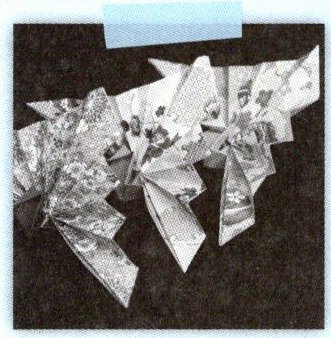
② Japan is famous for its paper art, called origami. Origami involves folding square sheets into shapes like animals or flowers. People make origami for gifts or decorations. This art is very old and important in Japanese culture. Some artists create *complex* (复杂的) shapes, using only one sheet of paper without cutting or gluing. Origami shows how something as simple as paper can become something beautiful.
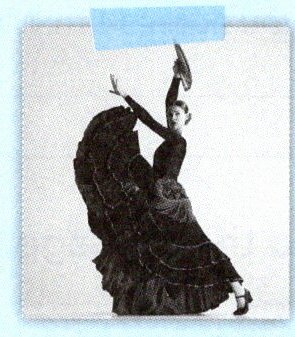
③ Flamenco is a traditional Spanish art that includes singing, guitar playing, dancing and handclaps. It is famous for its fast and exciting style. Flamenco songs are *passionate* (热情的), deep and emotional. Traditional flamenco songs are usually unwritten but passed down from generation to generation.
Art shows us what matters to people. Through calligraphy, origami, flamenco and other art forms, people share their stories, express their values and celebrate their ways of life. Art keeps traditions alive and helps us understand how people see the world.
3 - 1 Complete the diagram according to the passage.
根据短文内容填写图表。
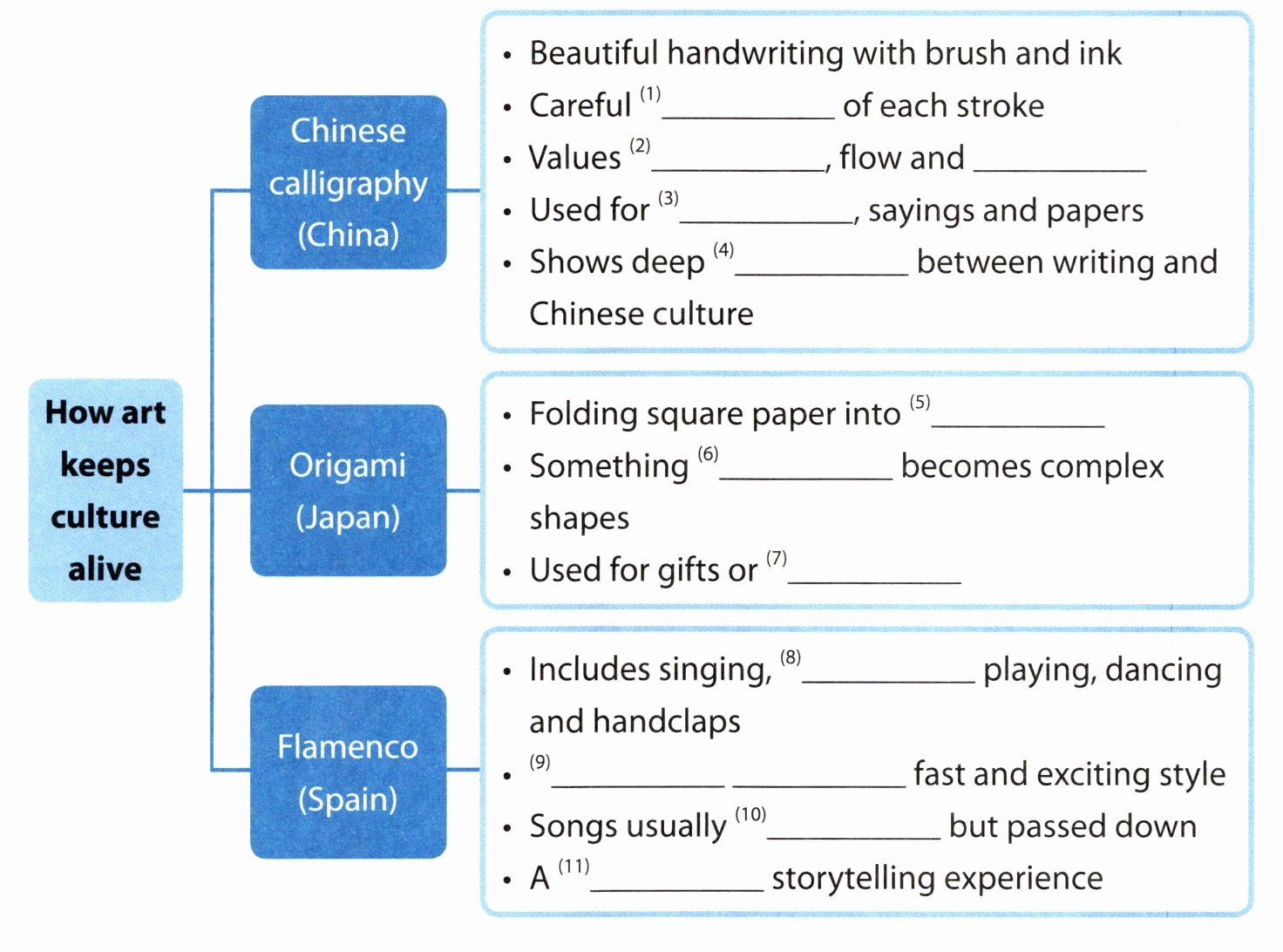
Careful $^{(1)}$ of each stroke
Values $^{(2)}$, flow and
Used for $^{(3)}$, sayings and papers
Something $^{(6)}$ becomes complex shapes
$^{(9)}$ fast and exciting style
Songs usually $^{(10)}$ but passed down
3 - 2 Answer the questions.
回答问题。
(1) Why is Chinese calligraphy more than just writing?
(2) What does calligraphy show about Chinese culture?
(3) What is origami made with?
(4) Why do people make origami?
(5) What makes traditional flamenco songs special?
(6) Which art form impressed you most? Why?
阅读短文。
How art keeps culture alive
People all over the world create different art forms to pass on culture.
① Chinese calligraphy is the art of beautiful handwriting using brush and ink. It’s more than just writing. People express feelings and thoughts through *brushstrokes* (画笔). Each stroke must be carefully controlled in order to turn simple characters into flowing works of art. Calligraphy is often used for poems, sayings and important papers. It shows the deep connection between writing and Chinese culture. Chinese calligraphy values balance, flow and harmony. It’s not just writing — it’s a *graceful* (优雅的), *timeless* art.
② Japan is famous for its paper art, called origami. Origami involves folding square sheets into shapes like animals or flowers. People make origami for gifts or decorations. This art is very old and important in Japanese culture. Some artists create *complex* (复杂的) shapes, using only one sheet of paper without cutting or gluing. Origami shows how something as simple as paper can become something beautiful.
③ Flamenco is a traditional Spanish art that includes singing, guitar playing, dancing and handclaps. It is famous for its fast and exciting style. Flamenco songs are *passionate* (热情的), deep and emotional. Traditional flamenco songs are usually unwritten but passed down from generation to generation.
Art shows us what matters to people. Through calligraphy, origami, flamenco and other art forms, people share their stories, express their values and celebrate their ways of life. Art keeps traditions alive and helps us understand how people see the world.
3 - 1 Complete the diagram according to the passage.
根据短文内容填写图表。
Careful $^{(1)}$ of each stroke
Values $^{(2)}$, flow and
Used for $^{(3)}$, sayings and papers
Something $^{(6)}$ becomes complex shapes
$^{(9)}$ fast and exciting style
Songs usually $^{(10)}$ but passed down
3 - 2 Answer the questions.
回答问题。
(1) Why is Chinese calligraphy more than just writing?
(2) What does calligraphy show about Chinese culture?
(3) What is origami made with?
(4) Why do people make origami?
(5) What makes traditional flamenco songs special?
(6) Which art form impressed you most? Why?
答案
3 - 1:
(1) control
(2) balance; harmony
(3) poems
(4) connection
(5) shapes
(6) simple
(7) decorations
(8) guitar
(9) Famous for its
(10) unwritten
3 - 2:
(1) Because people express feelings and thoughts through brush - strokes.
(2) It shows the deep connection between writing and Chinese culture.
(3) Square sheets of paper.
(4) For gifts or decorations.
(5) They are passionate, deep and emotional.
(6) Open - ended (答案开放,根据个人情况作答).
(1) control
(2) balance; harmony
(3) poems
(4) connection
(5) shapes
(6) simple
(7) decorations
(8) guitar
(9) Famous for its
(10) unwritten
3 - 2:
(1) Because people express feelings and thoughts through brush - strokes.
(2) It shows the deep connection between writing and Chinese culture.
(3) Square sheets of paper.
(4) For gifts or decorations.
(5) They are passionate, deep and emotional.
(6) Open - ended (答案开放,根据个人情况作答).
解析
3-1:
(1) 根据短文关于中国书法部分中“Each stroke must be carefully controlled...”,这里应填"control"。
(2) 依据“Chinese calligraphy values balance, flow and harmony.”可知,这里填"balance"和"harmony"。
(3) 由“Calligraphy is often used for poems, sayings and important papers.”可得,此处填"poems"。
(4) 从“It shows the deep connection between writing and Chinese culture.”可知,应填"connection"。
(5) 依据“Origami involves folding square sheets into shapes...”,这里填"shapes"。
(6) 根据“Some artists create complex (复杂的) shapes, using only one sheet of paper without cutting or gluing.”,此处可填"simple”。
(7) 由“People make origami for gifts or decorations.”可知,填"decorations"。
(8) 根据“Flamenco is a traditional Spanish art that includes singing, guitar playing, dancing and handclaps.”,这里填"guitar”。
(9) 由“It is famous for its fast and exciting style.”,应填"Famous for its”。
(10) 根据“Traditional flamenco songs are usually unwritten but passed down from generation to generation.”,此处填"unwritten”。
3 - 2:
(1) 问题是“为什么中国书法不仅仅是写字?”,从短文“People express feelings and thoughts through brush - strokes (画笔).”可知答案。
(2) 问题是“书法展示了中国文化的什么?”,根据“It shows the deep connection between writing and Chinese culture.”作答。
(3) 问题是“折纸是用什么制作的?”,由“Origami involves folding square sheets...”可知答案。
(4) 问题是“人们为什么制作折纸?”,从“People make origami for gifts or decorations.”可得答案。
(5) 问题是“什么使传统的弗拉门戈歌曲特别?”,依据“Flamenco songs are passionate (热情的), deep and emotional.”回答。
(6) 问题是“哪种艺术形式给你印象最深?为什么?”,可根据个人喜好回答。
(1) 根据短文关于中国书法部分中“Each stroke must be carefully controlled...”,这里应填"control"。
(2) 依据“Chinese calligraphy values balance, flow and harmony.”可知,这里填"balance"和"harmony"。
(3) 由“Calligraphy is often used for poems, sayings and important papers.”可得,此处填"poems"。
(4) 从“It shows the deep connection between writing and Chinese culture.”可知,应填"connection"。
(5) 依据“Origami involves folding square sheets into shapes...”,这里填"shapes"。
(6) 根据“Some artists create complex (复杂的) shapes, using only one sheet of paper without cutting or gluing.”,此处可填"simple”。
(7) 由“People make origami for gifts or decorations.”可知,填"decorations"。
(8) 根据“Flamenco is a traditional Spanish art that includes singing, guitar playing, dancing and handclaps.”,这里填"guitar”。
(9) 由“It is famous for its fast and exciting style.”,应填"Famous for its”。
(10) 根据“Traditional flamenco songs are usually unwritten but passed down from generation to generation.”,此处填"unwritten”。
3 - 2:
(1) 问题是“为什么中国书法不仅仅是写字?”,从短文“People express feelings and thoughts through brush - strokes (画笔).”可知答案。
(2) 问题是“书法展示了中国文化的什么?”,根据“It shows the deep connection between writing and Chinese culture.”作答。
(3) 问题是“折纸是用什么制作的?”,由“Origami involves folding square sheets...”可知答案。
(4) 问题是“人们为什么制作折纸?”,从“People make origami for gifts or decorations.”可得答案。
(5) 问题是“什么使传统的弗拉门戈歌曲特别?”,依据“Flamenco songs are passionate (热情的), deep and emotional.”回答。
(6) 问题是“哪种艺术形式给你印象最深?为什么?”,可根据个人喜好回答。
