

 登录
登录
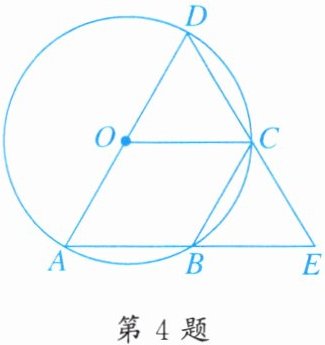
4. 如图,四边形$ABCD内接于\odot O$,且$AD是\odot O$的直径,$DC与AB的延长线相交于点E$,$OC// AB$.
(1)求证:$AD = AE$.
(2)若$OC = AB = 4$,求$\triangle BCE$的面积.
(1)求证:$AD = AE$.
(2)若$OC = AB = 4$,求$\triangle BCE$的面积.
答案
4.
(1)证明:
∵O为AD的中点,$OC// AE,$
∴C为DE的中点,$2OC=AE.$
又
∵AD是$\odot O$的直径,
$\therefore 2OC=AD,$
$\therefore AD=AE.$
(2)解:由已知得四边形ABCO是平行四边形,
$\therefore BC// AD.$
又
∵C为DE的中点,
$\therefore AB=BE=4.$
$\because AD=AE,$
$\therefore BC=BE=4.$
连接BD,
∵点B在$\odot O$上,
$\therefore ∠DBE=90^{\circ },$
$\therefore CE=BC=4,$
即$BE=BC=CE=4,$
∴所求面积为$4\sqrt {3}.$
(1)证明:
∵O为AD的中点,$OC// AE,$
∴C为DE的中点,$2OC=AE.$
又
∵AD是$\odot O$的直径,
$\therefore 2OC=AD,$
$\therefore AD=AE.$
(2)解:由已知得四边形ABCO是平行四边形,
$\therefore BC// AD.$
又
∵C为DE的中点,
$\therefore AB=BE=4.$
$\because AD=AE,$
$\therefore BC=BE=4.$
连接BD,
∵点B在$\odot O$上,
$\therefore ∠DBE=90^{\circ },$
$\therefore CE=BC=4,$
即$BE=BC=CE=4,$
∴所求面积为$4\sqrt {3}.$
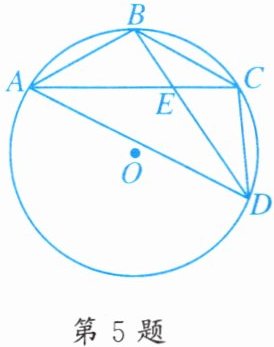
5. 已知:如图,$A$,$B$,$C$,$D是\odot O$上的四个点,$AB = BC$,$BD交AC于点E$,连接$CD$,$AD$.
(1)求证:$DB平分\angle ADC$.
(2)若$BE = 3$,$ED = 6$,求$AB$的长.
(1)求证:$DB平分\angle ADC$.
(2)若$BE = 3$,$ED = 6$,求$AB$的长.
答案
5.
(1)证明:$\because AB=BC,$
$\therefore \widehat {AB}=\widehat {BC},$
$\therefore ∠BDC=∠ADB,$
∴DB平分$∠ADC.$
(2)解:由
(1)可知$\widehat {AB}=\widehat {BC},$
$\therefore ∠BAC=∠ADB.$
$\because ∠ABE=∠ABD,$
$\therefore △ABE\backsim △DBA,$
$\therefore \frac {BE}{AB}=\frac {AB}{BD}.$
$\because BE=3,ED=6,$
$\therefore BD=9,$
$\therefore AB^{2}=BE\cdot BD=3×9=27,$
$\therefore AB=3\sqrt {3}.$
(1)证明:$\because AB=BC,$
$\therefore \widehat {AB}=\widehat {BC},$
$\therefore ∠BDC=∠ADB,$
∴DB平分$∠ADC.$
(2)解:由
(1)可知$\widehat {AB}=\widehat {BC},$
$\therefore ∠BAC=∠ADB.$
$\because ∠ABE=∠ABD,$
$\therefore △ABE\backsim △DBA,$
$\therefore \frac {BE}{AB}=\frac {AB}{BD}.$
$\because BE=3,ED=6,$
$\therefore BD=9,$
$\therefore AB^{2}=BE\cdot BD=3×9=27,$
$\therefore AB=3\sqrt {3}.$
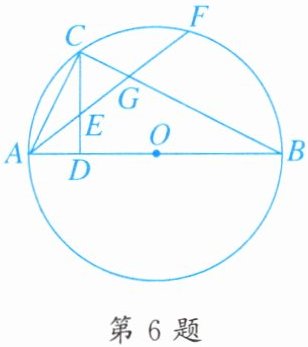
6. 如图,$AB是\odot O$的直径,过圆上一点$C作CD\perp AB于点D$,$C是\overset{\frown}{AF}$的中点,连接$AF交CD于点E$,连接$BC交AF于点G$.
(1)求证:$AE = CE$.
(2)若$AG = 10$,$ED:AD = 3:4$,求$AC$的长.
(1)求证:$AE = CE$.
(2)若$AG = 10$,$ED:AD = 3:4$,求$AC$的长.
答案
6.
(1)证明:
∵C是$\widehat {AF}$的中点,
$\therefore ∠B=∠CAE.$
∵AB是$\odot O$的直径,
$\therefore ∠ACB=90^{\circ },$
即$∠ACE+∠BCD=90^{\circ }.$
$\because CD⊥AB,$
$\therefore ∠B+∠BCD=90^{\circ },$
$\therefore ∠B=∠CAE=∠ACE,$
$\therefore AE=CE.$
(2)解:$\because ∠ACB=90^{\circ },$
$\therefore ∠CAE+∠CGA=90^{\circ }.$
又$\because ∠ACE+∠BCD=90^{\circ },$
$\therefore ∠CGA=∠BCD.$
$\because AG=10,$
$\therefore CE=EG=AE=5.$
$\because ED:AD=3:4,$
$\therefore AD=4,DE=3,$
$\therefore AC=\sqrt {AD^{2}+CD^{2}}=\sqrt {4^{2}+8^{2}}=4\sqrt {5}.$
(1)证明:
∵C是$\widehat {AF}$的中点,
$\therefore ∠B=∠CAE.$
∵AB是$\odot O$的直径,
$\therefore ∠ACB=90^{\circ },$
即$∠ACE+∠BCD=90^{\circ }.$
$\because CD⊥AB,$
$\therefore ∠B+∠BCD=90^{\circ },$
$\therefore ∠B=∠CAE=∠ACE,$
$\therefore AE=CE.$
(2)解:$\because ∠ACB=90^{\circ },$
$\therefore ∠CAE+∠CGA=90^{\circ }.$
又$\because ∠ACE+∠BCD=90^{\circ },$
$\therefore ∠CGA=∠BCD.$
$\because AG=10,$
$\therefore CE=EG=AE=5.$
$\because ED:AD=3:4,$
$\therefore AD=4,DE=3,$
$\therefore AC=\sqrt {AD^{2}+CD^{2}}=\sqrt {4^{2}+8^{2}}=4\sqrt {5}.$
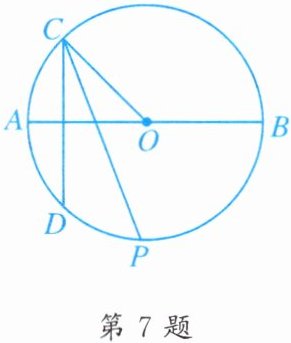
7. 如图,$AB是\odot O$的直径,它把$\odot O$分成上、下两个半圆,自上半圆上一点$C作弦CD\perp AB$($CD$不是直径),$\angle OCD的平分线CP交\odot O于点P$,当点$C$在上半圆(不包括$A$,$B$两点)上移动时,点$P的位置是否随着点C$的移动而发生变化?若不发生变化,请说明理由;若发生变化,请写出变化规律.
答案
7.点P不随点C的移动而变化,因为点P永远是垂直于AB的直径的下端点.
解析
证明:连接OP。
∵OC=OP,
∴∠OCP=∠OPC。
∵CP平分∠OCD,
∴∠OCP=∠DCP。
∴∠OPC=∠DCP,
∴CD//OP。
∵CD⊥AB,
∴OP⊥AB。
∵AB是⊙O的直径,
∴点P为垂直于AB的直径的下端点。
故点P的位置不随点C的移动而变化。
∵OC=OP,
∴∠OCP=∠OPC。
∵CP平分∠OCD,
∴∠OCP=∠DCP。
∴∠OPC=∠DCP,
∴CD//OP。
∵CD⊥AB,
∴OP⊥AB。
∵AB是⊙O的直径,
∴点P为垂直于AB的直径的下端点。
故点P的位置不随点C的移动而变化。
