

 登录
登录
五、阅读下面短文,在空白处填入1个适当的单词或括号内单词的正确形式。
Do you like fashion? Today, we can get 1 (colour) clothes easily. But how about people in old times?
Tie-dyeing(扎染法) is a very old way of dyeing clothes in China. It has a history 2 about 1,500 years. People in the past made it by hand.
Yang Cheng learned tie-dyeing from his mother in the 1980s. Yang continued(继续) the old skill of tie-dyeing. At the same time, he studied new tie-dyeing skills in other 3 (country), such as Japan, India and France. Now he is doing the job all 4 time. He has taught his daughter this technique(技艺).
Yang once made two sets of specially tie-dyed 5 (dress). It took him about two years. He used many skills. Some patterns on the dresses are 6 (tradition), while some are modern. "I want to put all the beautiful things into tie-dyed 7 (work)," he said.
Yang now 8 (teach) tie-dyeing in many places. More than 100,000 people learn from 9 (he). Some people worry that tie-dyeing as an art form may vanish(消失) 10 using machines is fast and cheap. But Yang said, "Machines can't take the place of our creative hands."
1.
2.
3.
4.
5.
6.
7.
8.
9.
10.
Do you like fashion? Today, we can get 1 (colour) clothes easily. But how about people in old times?
Tie-dyeing(扎染法) is a very old way of dyeing clothes in China. It has a history 2 about 1,500 years. People in the past made it by hand.
Yang Cheng learned tie-dyeing from his mother in the 1980s. Yang continued(继续) the old skill of tie-dyeing. At the same time, he studied new tie-dyeing skills in other 3 (country), such as Japan, India and France. Now he is doing the job all 4 time. He has taught his daughter this technique(技艺).
Yang once made two sets of specially tie-dyed 5 (dress). It took him about two years. He used many skills. Some patterns on the dresses are 6 (tradition), while some are modern. "I want to put all the beautiful things into tie-dyed 7 (work)," he said.
Yang now 8 (teach) tie-dyeing in many places. More than 100,000 people learn from 9 (he). Some people worry that tie-dyeing as an art form may vanish(消失) 10 using machines is fast and cheap. But Yang said, "Machines can't take the place of our creative hands."
1.
colourful
2.
of
3.
countries
4.
the
5.
dresses
6.
traditional
7.
works
8.
teaches
9.
him
10.
because
答案
1. colourful 2. of 3. countries 4. the 5. dresses 6. traditional 7. works 8. teaches 9. him 10. because
解析
【分析】
这是一篇关于中国传统扎染技艺的英语语篇填空题,需结合语境、语法规则及固定搭配解题:
1. 空1修饰名词clothes,需用colour的形容词形式;
2. 空2对应固定搭配“have a history of...”;
3. 空3中other后需接可数名词复数;
4. 空4对应固定短语“all the time”;
5. 空5中two sets of后需接可数名词复数;
6. 空6中be动词后需用形容词作表语;
7. 空7中tie-dyed为形容词,后接表示“作品”的名词复数;
8. 空8中主语是第三人称单数,一般现在时谓语动词需用第三人称单数形式;
9. 空9中介词from后需接人称代词宾格;
10. 空10前后为因果关系,需用表原因的连词。
【解析】
1. 空1:修饰名词clothes,colour的形容词为colourful,故填colourful;
2. 空2:固定搭配“have a history of”表示“有……的历史”,故填of;
3. 空3:other后接可数名词复数,country变复数为countries,故填countries;
4. 空4:固定短语“all the time”意为“一直”,故填the;
5. 空5:two sets of后接可数名词复数,dress变复数为dresses,故填dresses;
6. 空6:be动词后需用形容词,tradition的形容词为traditional,故填traditional;
7. 空7:此处指扎染作品,work表“作品”时用复数works,故填works;
8. 空8:主语Yang是第三人称单数,一般现在时谓语动词用teaches,故填teaches;
9. 空9:介词后用人称代词宾格,he的宾格为him,故填him;
10. 空10:前后为因果关系,后句是原因,故填because。
【答案】
1. colourful
2. of
3. countries
4. the
5. dresses
6. traditional
7. works
8. teaches
9. him
10. because
【知识点】
形容词的用法、名词单复数、固定搭配
【点评】
本题为英语语篇填空题,围绕传统扎染技艺展开,考查基础词汇变形、语法规则及固定搭配的运用,需结合语境分析每空的正确形式,难度适中。
【难度系数】
0.6
这是一篇关于中国传统扎染技艺的英语语篇填空题,需结合语境、语法规则及固定搭配解题:
1. 空1修饰名词clothes,需用colour的形容词形式;
2. 空2对应固定搭配“have a history of...”;
3. 空3中other后需接可数名词复数;
4. 空4对应固定短语“all the time”;
5. 空5中two sets of后需接可数名词复数;
6. 空6中be动词后需用形容词作表语;
7. 空7中tie-dyed为形容词,后接表示“作品”的名词复数;
8. 空8中主语是第三人称单数,一般现在时谓语动词需用第三人称单数形式;
9. 空9中介词from后需接人称代词宾格;
10. 空10前后为因果关系,需用表原因的连词。
【解析】
1. 空1:修饰名词clothes,colour的形容词为colourful,故填colourful;
2. 空2:固定搭配“have a history of”表示“有……的历史”,故填of;
3. 空3:other后接可数名词复数,country变复数为countries,故填countries;
4. 空4:固定短语“all the time”意为“一直”,故填the;
5. 空5:two sets of后接可数名词复数,dress变复数为dresses,故填dresses;
6. 空6:be动词后需用形容词,tradition的形容词为traditional,故填traditional;
7. 空7:此处指扎染作品,work表“作品”时用复数works,故填works;
8. 空8:主语Yang是第三人称单数,一般现在时谓语动词用teaches,故填teaches;
9. 空9:介词后用人称代词宾格,he的宾格为him,故填him;
10. 空10:前后为因果关系,后句是原因,故填because。
【答案】
1. colourful
2. of
3. countries
4. the
5. dresses
6. traditional
7. works
8. teaches
9. him
10. because
【知识点】
形容词的用法、名词单复数、固定搭配
【点评】
本题为英语语篇填空题,围绕传统扎染技艺展开,考查基础词汇变形、语法规则及固定搭配的运用,需结合语境分析每空的正确形式,难度适中。
【难度系数】
0.6
六、传统文化阅读理解。
Do you know horse-face skirts? These Chinese skirts are from the Song Dynasty. They have beautiful patterns(图案) and folds(褶)on both sides. And there are openings in the front and back of the skirts.
In the Song Dynasty, women wore horse-face skirts when they rode donkeys. The openings made it convenient for women to get on and off them. It was difficult for them to ride donkeys without these openings. In the next hundreds of years, these skirts became more and more beautiful. In 2022, many hanfu lovers started to spread(传播)the culture of the skirts. This helped more people learn about traditional Chinese clothes. “For us, wearing the skirts is not just for fashion,” said Mao, one of the hanfu lovers. “It also shows our love for Chinese culture.”
Now the skirts become more and more popular. Many famous Chinese people wear them in some international events. People in other countries like these skirts too. Many people in other countries buy the skirts from China. A report shows users from more than 90 countries share something about the skirts on short video apps!
Besides the skirts, the “neo-Chinese style clothing” is also a hot topic. We can see traditional Chinese symbols and modern fashion on these clothes. They win the hearts of many people around the world. All these show that we are becoming more confident(自信的)in our own culture.
(
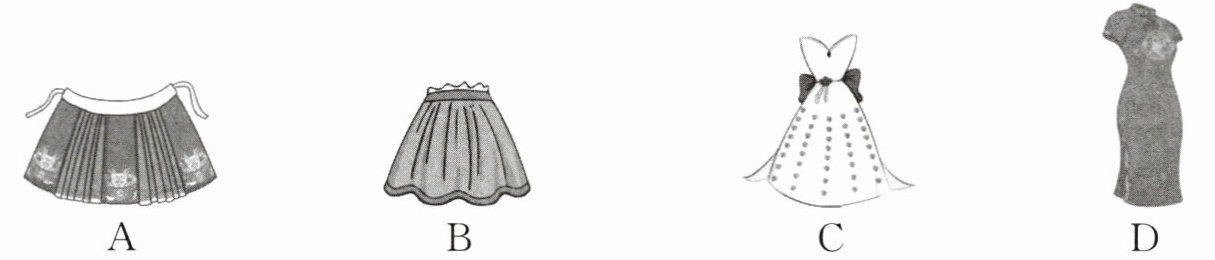
(
A. Easy. B. Happy. C. Comfortable. D. Sad.
(
A. For beauty and fashion. B. For their love for the skirts.
C. For riding donkeys. D. For their love for Chinese culture.
Do you know horse-face skirts? These Chinese skirts are from the Song Dynasty. They have beautiful patterns(图案) and folds(褶)on both sides. And there are openings in the front and back of the skirts.
In the Song Dynasty, women wore horse-face skirts when they rode donkeys. The openings made it convenient for women to get on and off them. It was difficult for them to ride donkeys without these openings. In the next hundreds of years, these skirts became more and more beautiful. In 2022, many hanfu lovers started to spread(传播)the culture of the skirts. This helped more people learn about traditional Chinese clothes. “For us, wearing the skirts is not just for fashion,” said Mao, one of the hanfu lovers. “It also shows our love for Chinese culture.”
Now the skirts become more and more popular. Many famous Chinese people wear them in some international events. People in other countries like these skirts too. Many people in other countries buy the skirts from China. A report shows users from more than 90 countries share something about the skirts on short video apps!
Besides the skirts, the “neo-Chinese style clothing” is also a hot topic. We can see traditional Chinese symbols and modern fashion on these clothes. They win the hearts of many people around the world. All these show that we are becoming more confident(自信的)in our own culture.
(
A
)1. 创新考法—图片理解 Which is the picture of a horse-face skirt according to the passage?(
A
)2. What does the underlined word “convenient” in Paragraph 2 mean?A. Easy. B. Happy. C. Comfortable. D. Sad.
(
C
)3. Why did women in the Song Dynasty wear horse-face skirts?A. For beauty and fashion. B. For their love for the skirts.
C. For riding donkeys. D. For their love for Chinese culture.
答案
1. A 【点拨】根据"They have beautiful patterns(图案)and folds(褶)on both sides. And there are openings in the front and back of the skirts."可知选 A。
2. A 【点拨】根据"It was difficult for them to ride donkeys without these openings."可知,没有这些开口女士们骑驴不方便,convenient 与 easy 意思相近。故选 A。
3. C 【点拨】根据"In the Song Dynasty, women wore horse-face skirts when they rode donkeys."可知,在宋代,妇女骑驴时穿马面裙。故选 C。
2. A 【点拨】根据"It was difficult for them to ride donkeys without these openings."可知,没有这些开口女士们骑驴不方便,convenient 与 easy 意思相近。故选 A。
3. C 【点拨】根据"In the Song Dynasty, women wore horse-face skirts when they rode donkeys."可知,在宋代,妇女骑驴时穿马面裙。故选 C。
解析
【分析】
本题为传统文化主题的英语阅读理解题,包含图片理解、词义猜测、细节理解三类题型。第1题需根据文章对马面裙的特征描述匹配对应图片;第2题需结合上下文语境推断划线词含义;第3题需定位文章中关于宋代妇女穿马面裙原因的关键信息,选出正确答案。
【解析】
1. 根据文章第一段对马面裙的描述:“They have beautiful patterns and folds on both sides. And there are openings in the front and back of the skirts.”,观察图片,A选项的裙子有图案、两侧有褶,且前后有开口,符合马面裙的特征,B、C、D选项不符合,故选A。
2. 文章第二段提到“It was difficult for them to ride donkeys without these openings.”,说明没有开口骑驴会很困难,反过来有开口就很方便,即“easy”,因此“convenient”意为容易的,选A。
3. 文章第二段明确说明“In the Song Dynasty, women wore horse-face skirts when they rode donkeys.”,可知宋代妇女穿马面裙是为了骑驴,故选C。
【答案】
1. A 2. A 3. C
【知识点】
阅读理解(图片理解)、词义猜测、细节理解
【点评】
本题结合中国传统文化中的马面裙,考查学生的图片匹配、词义猜测和细节查找能力,题目设置基础,需要学生仔细阅读文章,定位关键信息即可解答。
【难度系数】
0.6
本题为传统文化主题的英语阅读理解题,包含图片理解、词义猜测、细节理解三类题型。第1题需根据文章对马面裙的特征描述匹配对应图片;第2题需结合上下文语境推断划线词含义;第3题需定位文章中关于宋代妇女穿马面裙原因的关键信息,选出正确答案。
【解析】
1. 根据文章第一段对马面裙的描述:“They have beautiful patterns and folds on both sides. And there are openings in the front and back of the skirts.”,观察图片,A选项的裙子有图案、两侧有褶,且前后有开口,符合马面裙的特征,B、C、D选项不符合,故选A。
2. 文章第二段提到“It was difficult for them to ride donkeys without these openings.”,说明没有开口骑驴会很困难,反过来有开口就很方便,即“easy”,因此“convenient”意为容易的,选A。
3. 文章第二段明确说明“In the Song Dynasty, women wore horse-face skirts when they rode donkeys.”,可知宋代妇女穿马面裙是为了骑驴,故选C。
【答案】
1. A 2. A 3. C
【知识点】
阅读理解(图片理解)、词义猜测、细节理解
【点评】
本题结合中国传统文化中的马面裙,考查学生的图片匹配、词义猜测和细节查找能力,题目设置基础,需要学生仔细阅读文章,定位关键信息即可解答。
【难度系数】
0.6
