

 登录
登录
你是否曾为“零花钱总是不够用”或“不知道该先买什么”而烦恼?本文介绍了一个强大的工具——“金钱金字塔”。阅读文本,完成下列任务。
Manage money like a pyramid(金字塔)
Do you know a pyramid? How can a pyramid help us manage money well? Here's how it works.
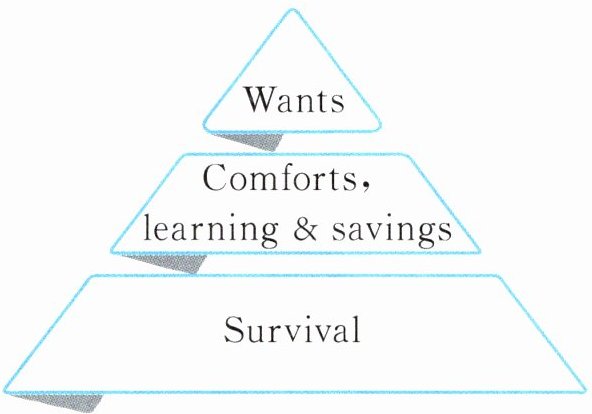
The bottom layer(层): We spend money on survival(生存). We buy food, clothes, a house ... They help us survive.
Sometimes money is left over. Then we can put the money into the second and third layers.
The middle layer: We spend money on comforts and learning. We can spend money on things that make our life easier or better. For example, a bike to go to school, books to read or after-school classes to take. We can live without these, but they help us a lot. We also save money. We can put the money in a bank for future(未来的) use or for a rainy day. That is a really smart idea.
The top layer: We spend money on things we want. These are nice-to-haves. They make us happy. We can spend money on candies, snacks, a holiday trip, a new video game, a toy, or a second winter coat.
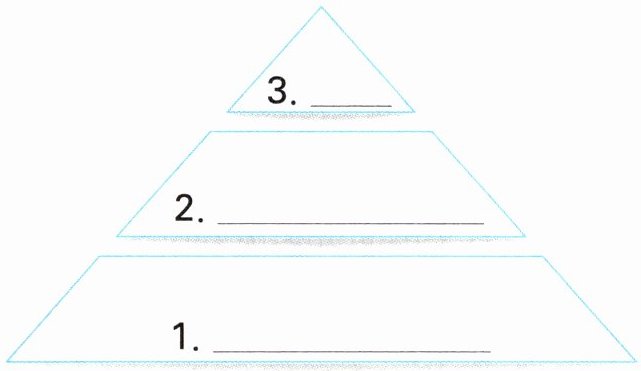
任务一:根据文本内容,将下面的消费项目填入金字塔对应的位置。
A. a car for work B. daily clothes
C. seeing a doctor D. snacks and games
E. a trip to Hong Kong F. piano lessons
任务二:根据文本内容,选择正确的选项。
(
A. Daily needs. B. Things that make us happy. C. Learning and savings.
(
A. It helps solve problems in the future. B. We can have more money.
C. We can buy more things.
(
A. In a storybook. B. In a book about space. C. In a magazine.
任务三:你同意文中的金字塔分类方式吗?你还有其他的分类方式吗?用英文简单写一写。
Manage money like a pyramid(金字塔)
Do you know a pyramid? How can a pyramid help us manage money well? Here's how it works.
The bottom layer(层): We spend money on survival(生存). We buy food, clothes, a house ... They help us survive.
Sometimes money is left over. Then we can put the money into the second and third layers.
The middle layer: We spend money on comforts and learning. We can spend money on things that make our life easier or better. For example, a bike to go to school, books to read or after-school classes to take. We can live without these, but they help us a lot. We also save money. We can put the money in a bank for future(未来的) use or for a rainy day. That is a really smart idea.
The top layer: We spend money on things we want. These are nice-to-haves. They make us happy. We can spend money on candies, snacks, a holiday trip, a new video game, a toy, or a second winter coat.
任务一:根据文本内容,将下面的消费项目填入金字塔对应的位置。
A. a car for work B. daily clothes
C. seeing a doctor D. snacks and games
E. a trip to Hong Kong F. piano lessons
任务二:根据文本内容,选择正确的选项。
(
B
)1. What is the money in the top layer for?A. Daily needs. B. Things that make us happy. C. Learning and savings.
(
A
)2. Why does the author think putting money in a bank is “a really smart idea”?A. It helps solve problems in the future. B. We can have more money.
C. We can buy more things.
(
C
)3. Where can we see the text?A. In a storybook. B. In a book about space. C. In a magazine.
任务三:你同意文中的金字塔分类方式吗?你还有其他的分类方式吗?用英文简单写一写。
I agree. Another way could be dividing money into "Needs", "Wants" and "Savings".
答案
Unit 4 主题联读
任务一:1. BC 2. AF 3. DE
任务二:1. B 2. A 3. C
任务三:
示例:I agree. Another way could be dividing money into "Needs", "Wants" and "Savings".
解析
任务一:
1. 依据:We spend money on survival. We buy food ... They help us survive.
分析:金字塔底层的内容是生存所需,如住所、食物、衣物和看病,选项 B、C 符合。
2. 依据:We spend money on comforts and learning. We can ... go to school, books to read or after-school classes to take.
分析:金字塔中层的内容是把钱用于舒适生活、学习和储蓄,选项 A、F 符合。
3. 依据:We spend money on things we want. ... a toy, or a second winter coat.
分析:金字塔顶层的内容是把钱花在想要的东西上,例如零食、旅行度假或电子游戏,选项 D、E 符合。
任务二:
1. 句意:顶层的钱是用来做什么的?
依据:We spend money on things we want. These are nice-to-haves. They make us happy.
分析:顶层是购买让人快乐的东西,故选 B。
2. 句意:为什么作者认为把钱存入银行是"一个非常聪明的主意"?
依据:We can put the money in a bank for future use or for a rainy day. That is a really smart idea.
分析:"for future use or for a rainy day"意为"以备未来之需或应对不时之需",即解决未来的问题,故选 A。
3. 句意:我们可以在哪里看到这篇文本?
分析:文章主题是"像金字塔一样管理金钱",属于生活技巧或理财知识,最可能出现在杂志上,故选 C。
任务三:
分析:此题为主观题,考查学生的批判性思维和个人见解。同意或不同意均可,需简要说明理由并提出其他分类方式。
任务一:1. BC 2. AF 3. DE
任务二:1. B 2. A 3. C
任务三:
示例:I agree. Another way could be dividing money into "Needs", "Wants" and "Savings".
解析
任务一:
1. 依据:We spend money on survival. We buy food ... They help us survive.
分析:金字塔底层的内容是生存所需,如住所、食物、衣物和看病,选项 B、C 符合。
2. 依据:We spend money on comforts and learning. We can ... go to school, books to read or after-school classes to take.
分析:金字塔中层的内容是把钱用于舒适生活、学习和储蓄,选项 A、F 符合。
3. 依据:We spend money on things we want. ... a toy, or a second winter coat.
分析:金字塔顶层的内容是把钱花在想要的东西上,例如零食、旅行度假或电子游戏,选项 D、E 符合。
任务二:
1. 句意:顶层的钱是用来做什么的?
依据:We spend money on things we want. These are nice-to-haves. They make us happy.
分析:顶层是购买让人快乐的东西,故选 B。
2. 句意:为什么作者认为把钱存入银行是"一个非常聪明的主意"?
依据:We can put the money in a bank for future use or for a rainy day. That is a really smart idea.
分析:"for future use or for a rainy day"意为"以备未来之需或应对不时之需",即解决未来的问题,故选 A。
3. 句意:我们可以在哪里看到这篇文本?
分析:文章主题是"像金字塔一样管理金钱",属于生活技巧或理财知识,最可能出现在杂志上,故选 C。
任务三:
分析:此题为主观题,考查学生的批判性思维和个人见解。同意或不同意均可,需简要说明理由并提出其他分类方式。
