

 登录
登录
2. 从方框中选择合适的句子,补全对话,将序号填在横线上。
A: Which season do you like best?
B: (1) I like playing in the snow.
A: Winter is so cold. (2)
B: (3) They’re nice and beautiful.
A: (4) Let’s go boating this afternoon.
B: Good idea! (5)
A: OK! See you!
A. Let’s meet at two.
B. I like the flowers in spring.
C. I like winter best.
D. It’s sunny and warm today.
E. I like spring best.
A: Which season do you like best?
B: (1) I like playing in the snow.
A: Winter is so cold. (2)
B: (3) They’re nice and beautiful.
A: (4) Let’s go boating this afternoon.
B: Good idea! (5)
A: OK! See you!
A. Let’s meet at two.
B. I like the flowers in spring.
C. I like winter best.
D. It’s sunny and warm today.
E. I like spring best.
答案
(1)C (2)E (3)B (4)D (5)A
解析
我们可以根据上下文的逻辑匹配选项:
1. 第(1)空:问句询问“你最喜欢哪个季节?”,后文提到“我喜欢在雪地里玩耍”,雪是冬季的典型特征,对应选项C“我最喜欢冬天”。
2. 第(2)空:前文A表达“冬天太冷了”,接下来要说明自己偏好的季节,对应选项E“我最喜欢春天”,承接对话逻辑。
3. 第(3)空:后文提到“它们又好看又漂亮”,代词They指代春天的花朵,对应选项B“我喜欢春天的花”,语义匹配。
4. 第(4)空:后文A提出“我们今天下午去划船吧”,前文需要铺垫适合划船的天气条件,对应选项D“今天天气晴朗又温暖”,符合场景逻辑。
5. 第(5)空:B赞同划船的提议,后文A回应“好的,再见”,此处是约定见面的时间,对应选项A“我们两点见面吧”。
1. 第(1)空:问句询问“你最喜欢哪个季节?”,后文提到“我喜欢在雪地里玩耍”,雪是冬季的典型特征,对应选项C“我最喜欢冬天”。
2. 第(2)空:前文A表达“冬天太冷了”,接下来要说明自己偏好的季节,对应选项E“我最喜欢春天”,承接对话逻辑。
3. 第(3)空:后文提到“它们又好看又漂亮”,代词They指代春天的花朵,对应选项B“我喜欢春天的花”,语义匹配。
4. 第(4)空:后文A提出“我们今天下午去划船吧”,前文需要铺垫适合划船的天气条件,对应选项D“今天天气晴朗又温暖”,符合场景逻辑。
5. 第(5)空:B赞同划船的提议,后文A回应“好的,再见”,此处是约定见面的时间,对应选项A“我们两点见面吧”。
阅读短文,判断句子正(T)误(F)。
Which season is it?
Tony and I are good friends. Tony likes spring best. It’s warm and rainy. We plant flowers and trees. I like summer best. It’s hot and sunny. We go swimming and eat ice cream. Autumn is cool. We pick fruit and go climbing. The last (最后的) season is very cold. We don’t like the cold weather. But we like playing in the snow. Which season is it?
() 1. Tony and I plant flowers and trees in summer.
() 2. Summer is hot and rainy here.
() 3. Tony and I like playing in the snow.
() 4. Tony likes the cold weather.
() 5. The last season is winter.
Which season is it?
Tony and I are good friends. Tony likes spring best. It’s warm and rainy. We plant flowers and trees. I like summer best. It’s hot and sunny. We go swimming and eat ice cream. Autumn is cool. We pick fruit and go climbing. The last (最后的) season is very cold. We don’t like the cold weather. But we like playing in the snow. Which season is it?
() 1. Tony and I plant flowers and trees in summer.
() 2. Summer is hot and rainy here.
() 3. Tony and I like playing in the snow.
() 4. Tony likes the cold weather.
() 5. The last season is winter.
答案
1.F 2.F 3.T 4.F 5.T
解析
1. 短文中提到Tony最喜欢春天,春天温暖多雨,他们是在春天种花种树,不是夏天,该句表述错误。
2. 短文中说明夏天的天气是炎热且晴朗的,并非炎热多雨,该句表述错误。
3. 短文中提到“我们不喜欢寒冷的天气,但是我们喜欢在雪里玩”,这里的we指代Tony和作者,该句表述正确。
4. 短文中明确说明“我们都不喜欢寒冷的天气”,所以Tony并不喜欢寒冷的天气,该句表述错误。
5. 一年里最后一个季节天气很冷,还会下雪,符合冬天的特征,所以最后一个季节是冬天,该句表述正确。
2. 短文中说明夏天的天气是炎热且晴朗的,并非炎热多雨,该句表述错误。
3. 短文中提到“我们不喜欢寒冷的天气,但是我们喜欢在雪里玩”,这里的we指代Tony和作者,该句表述正确。
4. 短文中明确说明“我们都不喜欢寒冷的天气”,所以Tony并不喜欢寒冷的天气,该句表述错误。
5. 一年里最后一个季节天气很冷,还会下雪,符合冬天的特征,所以最后一个季节是冬天,该句表述正确。
假设现在是一月份,请帮来自澳大利亚(Australia)的南希给迈克写一张明信片。
Dear Mike,
I'm in Australia now. It is not winter here. It is
.
Today is and . I go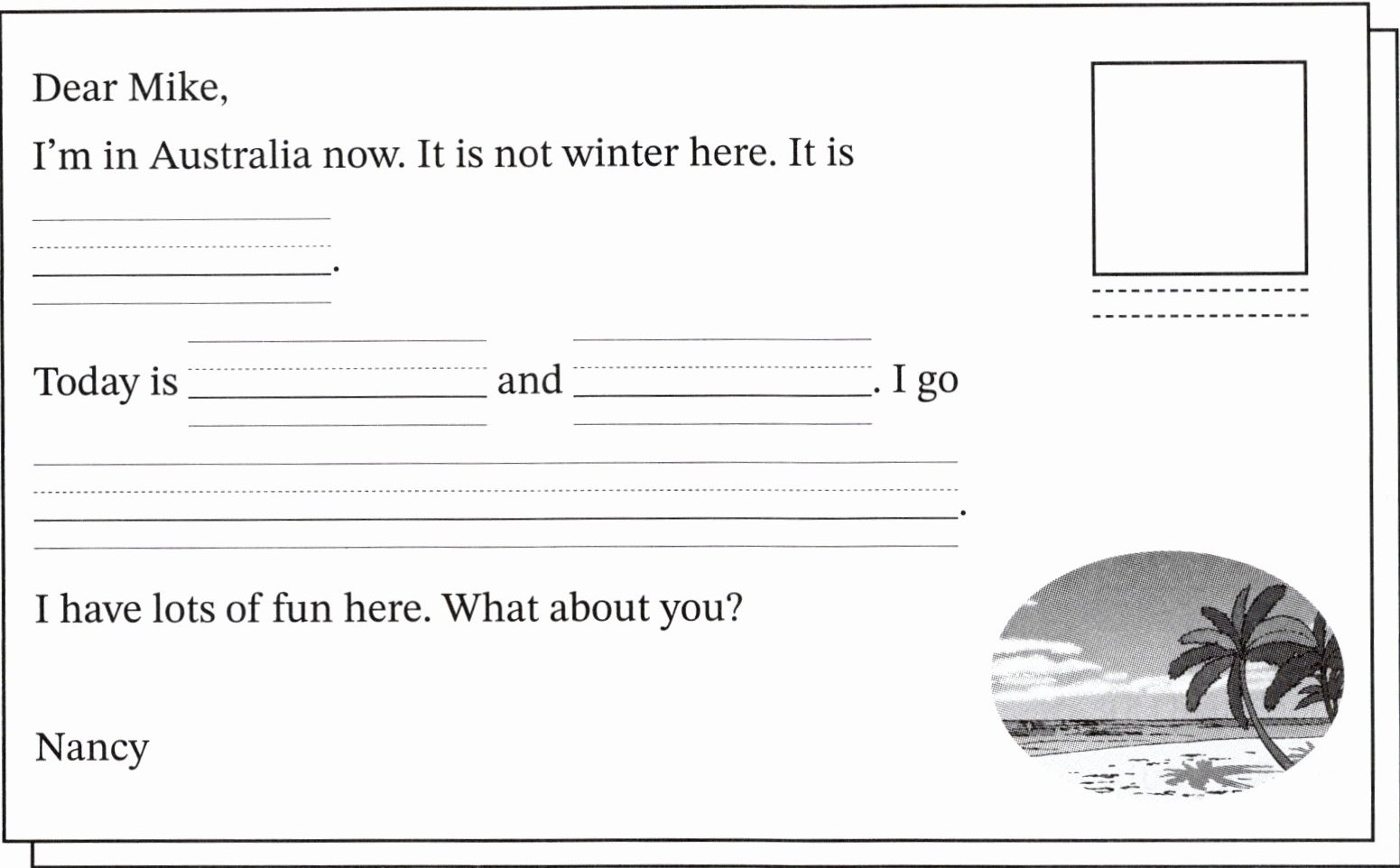
.
I have lots of fun here. What about you?
Nancy
Dear Mike,
I'm in Australia now. It is not winter here. It is
.
Today is and . I go
.
I have lots of fun here. What about you?
Nancy
答案
参考示例(答案不唯一,符合逻辑和词汇难度即可)
第一空:summer
第二空:very hot
第三空:sunny
第四空:hot
第五空:to the beach with my family and play happily
第一空:summer
第二空:very hot
第三空:sunny
第四空:hot
第五空:to the beach with my family and play happily
解析
本题结合生活常识和四年级已学的季节、天气、日常活动相关英语词汇完成明信片创作:1. 澳大利亚地处南半球,1月份的季节和北半球相反,不属于冬季而是夏季,因此第一处横线填写表示季节的单词summer;2. 第二处横线补充描述澳大利亚1月的气候特点,用简单的形容词短语very hot,符合夏日特征;3. 第三、第四处横线填写描述当日天气的两个形容词,选sunny和hot都是四年级已学的天气类词汇;4. 最后一处横线结合明信片右下角的海滩配图,填写简单的日常活动表达,符合该年级词汇难度要求。
