

 登录
登录
升 3. 读小诗,完成任务。
Task 1:选择下列方框中的词,填入横线空白处,将小诗补充完整。
hello sing gifts Fireworks
A.
B.
The tree is tall and bright,
Shining through the night.
Santa(圣诞老人) comes with a sleigh,
Giving (1) all the way.
We (2)
Eat cookies, yum, yum, yum.
Friends and family, near and dear,
Happy Christmas, full of cheer!
Dumplings in the pot,
Laughter never stops.
Lanterns shine, like little suns.
(3)
We stay up late, laugh and play.
The new year brings happy days.
Say (4)
And goodbye to the old.
Task 2:这两首小诗分别描述的是哪两个节日?请在Task 1中两首小诗前的云朵A和B里写出该节日名称。
Task 3:结合小诗和生活常识,比较庆祝以上两个节日时举办的相同和不同的活动,补充描述活动的语块,写在下面的韦恩图里。(可以不止一个答案)
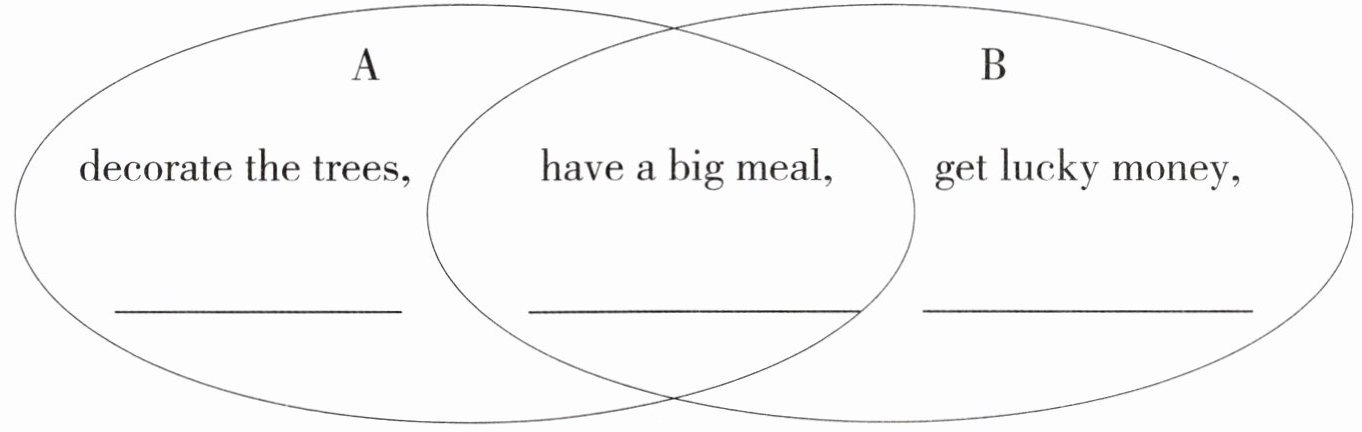
A
decorate the trees,
have a big meal,
B
get lucky money,
Task 1:选择下列方框中的词,填入横线空白处,将小诗补充完整。
hello sing gifts Fireworks
A.
B.
The tree is tall and bright,
Shining through the night.
Santa(圣诞老人) comes with a sleigh,
Giving (1)
gifts
all the way.We (2)
sing
songs, la, la, la,Eat cookies, yum, yum, yum.
Friends and family, near and dear,
Happy Christmas, full of cheer!
Dumplings in the pot,
Laughter never stops.
Lanterns shine, like little suns.
(3)
Fireworks
light up the fun.We stay up late, laugh and play.
The new year brings happy days.
Say (4)
hello
to the new year,And goodbye to the old.
Task 2:这两首小诗分别描述的是哪两个节日?请在Task 1中两首小诗前的云朵A和B里写出该节日名称。
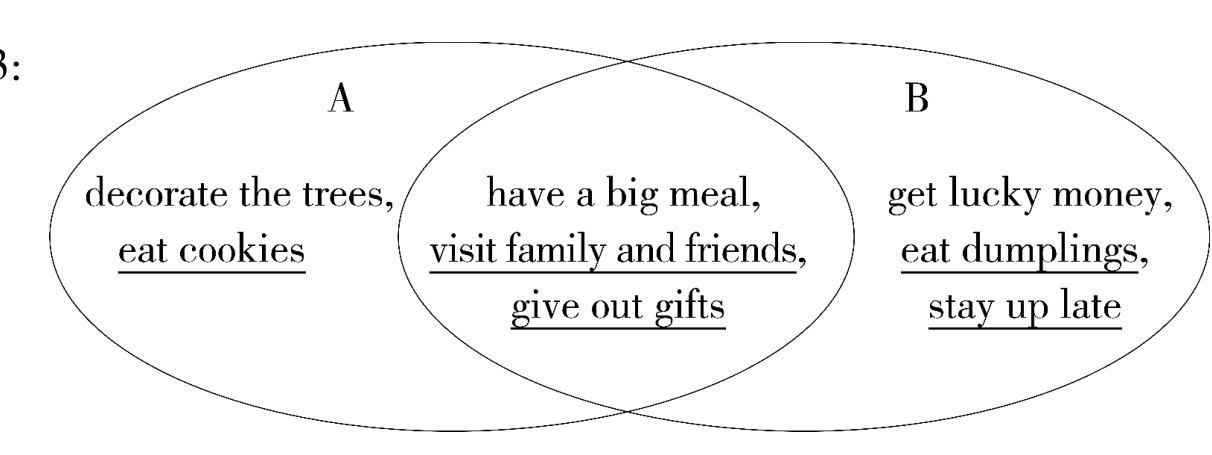
Task 3:结合小诗和生活常识,比较庆祝以上两个节日时举办的相同和不同的活动,补充描述活动的语块,写在下面的韦恩图里。(可以不止一个答案)
A
decorate the trees,
eat cookies
have a big meal,
visit family and friends, give out gifts
B
get lucky money,
eat dumplings, stay up late
答案
3. Task 1: (1) gifts (2) sing (3) Fireworks (4) hello
Task 2: A. Christmas B. Spring Festival / The Spring Festival
Task 3:
(答案不唯一,合理即可)
解析
【分析】
1. Task1解题思路:根据小诗语境和给出的词汇(hello、sing、gifts、Fireworks),结合节日常识匹配空格:(1)处圣诞老人带来礼物,对应gifts;(2)处搭配songs的动词是sing;(3)处对应春节的烟花,选Fireworks;(4)处对新年的问候用hello。
2. Task2解题思路:根据小诗关键元素判断节日:A有圣诞树、圣诞老人,是圣诞节;B有饺子、压岁钱,是春节。
3. Task3解题思路:结合生活常识,区分两个节日的不同活动,补充到韦恩图对应区域,答案合理即可。
【解析】
Task1:
(1) 句意:圣诞老人带着雪橇,一路送礼物,填gifts;
(2) 句意:我们唱歌,填sing;
(3) 句意:烟花点亮欢乐,填Fireworks;
(4) 句意:对新年说你好,填hello。
Task2:
A小诗含圣诞树、圣诞老人,对应节日为Christmas;B小诗含饺子、压岁钱,对应节日为Spring Festival。
Task3:韦恩图A(圣诞节)可补充如eat cookies等;B(春节)可补充如set off fireworks等,答案不唯一,合理即可。
【答案】
3. Task 1: (1) gifts (2) sing (3) Fireworks (4) hello
Task 2: A. Christmas B. Spring Festival
Task 3:
(答案不唯一,合理即可)
【知识点】
英语节日词汇,节日文化常识,信息整理
【点评】
本题结合英语词汇运用与中西方节日文化,考查学生对常见节日的认知、词汇语境运用能力及信息分类整理能力,贴近生活实际,易于理解。
【难度系数】
0.5
1. Task1解题思路:根据小诗语境和给出的词汇(hello、sing、gifts、Fireworks),结合节日常识匹配空格:(1)处圣诞老人带来礼物,对应gifts;(2)处搭配songs的动词是sing;(3)处对应春节的烟花,选Fireworks;(4)处对新年的问候用hello。
2. Task2解题思路:根据小诗关键元素判断节日:A有圣诞树、圣诞老人,是圣诞节;B有饺子、压岁钱,是春节。
3. Task3解题思路:结合生活常识,区分两个节日的不同活动,补充到韦恩图对应区域,答案合理即可。
【解析】
Task1:
(1) 句意:圣诞老人带着雪橇,一路送礼物,填gifts;
(2) 句意:我们唱歌,填sing;
(3) 句意:烟花点亮欢乐,填Fireworks;
(4) 句意:对新年说你好,填hello。
Task2:
A小诗含圣诞树、圣诞老人,对应节日为Christmas;B小诗含饺子、压岁钱,对应节日为Spring Festival。
Task3:韦恩图A(圣诞节)可补充如eat cookies等;B(春节)可补充如set off fireworks等,答案不唯一,合理即可。
【答案】
3. Task 1: (1) gifts (2) sing (3) Fireworks (4) hello
Task 2: A. Christmas B. Spring Festival
Task 3:
(答案不唯一,合理即可)
【知识点】
英语节日词汇,节日文化常识,信息整理
【点评】
本题结合英语词汇运用与中西方节日文化,考查学生对常见节日的认知、词汇语境运用能力及信息分类整理能力,贴近生活实际,易于理解。
【难度系数】
0.5
