

 登录
三、补全对话
A: Hello, Lin Tao. You visited your hometown last weekend, didn't you?
B: Yes. 1.
A: 2.
B: Ten years ago, there were narrow muddy roads and dirty rivers.
A: 3.
B: Villagers worked together to plant trees and build wider roads.
A: What can we see there nowadays?
B: The environment is much better. 4.
A: It's really wonderful. Are there any big hospitals in your hometown now?
B: 5.
A: Hello, Lin Tao. You visited your hometown last weekend, didn't you?
B: Yes. 1.
Great changes have taken place in my hometown these years
. It's completely different.A: 2.
What did your hometown use to look like
?B: Ten years ago, there were narrow muddy roads and dirty rivers.
A: 3.
How did local people make such great changes
?B: Villagers worked together to plant trees and build wider roads.
A: What can we see there nowadays?
B: The environment is much better. 4.
Thousands of green trees cover the hills all around
. The hills are green and beautiful.A: It's really wonderful. Are there any big hospitals in your hometown now?
B: 5.
Yes, there are
. We can also find big supermarkets easily. Life there becomes much more comfortable.答案
1. Great changes have taken place in my hometown these years
2. What did your hometown use to look like
3. How did local people make such great changes
4. Thousands of green trees cover the hills all around
5. Yes, there are
2. What did your hometown use to look like
3. How did local people make such great changes
4. Thousands of green trees cover the hills all around
5. Yes, there are
解析
【分析】
本题为补全对话题型,需结合对话上下文的逻辑关系、语境及英语日常交际用语的表达习惯补全空缺。第一空根据后文“完全不同”可推断是提及家乡的巨大变化;第二空根据B回答的过去家乡状况,可知A在询问家乡过去的样子;第三空根据B回答的村民行动,可知A在询问变化的方式;第四空结合前后文的环境描述,需补充与绿树相关的内容;第五空针对there be句型的一般疑问句,需用对应回答。
【解析】
1. 由后文“It's completely different.”可知,此处应说明家乡发生了巨大变化,对应答案“Great changes have taken place in my hometown these years”;
2. B回答的是十年前家乡的状况,因此A询问家乡过去的样子,对应答案“What did your hometown use to look like”;
3. B回答的是村民为变化采取的行动,因此A询问变化的方式,对应答案“How did local people make such great changes”;
4. 前文提及环境变好,后文提到山绿,此处补充绿树覆盖山的内容,对应答案“Thousands of green trees cover the hills all around”;
5. A是there be句型的一般疑问句,肯定回答用“Yes, there are”,对应答案。
【答案】
1. Great changes have taken place in my hometown these years
2. What did your hometown use to look like
3. How did local people make such great changes
4. Thousands of green trees cover the hills all around
5. Yes, there are
【知识点】
补全对话(日常交际);现在完成时;there be句型
【点评】
本题围绕“家乡变化”的日常话题展开补全对话,考查学生对英语日常交际用语、时态运用的掌握,需结合上下文逻辑推导答案,难度适中。
【难度系数】
0.6
CHANGES IN CHINESE SMALL TOWNS
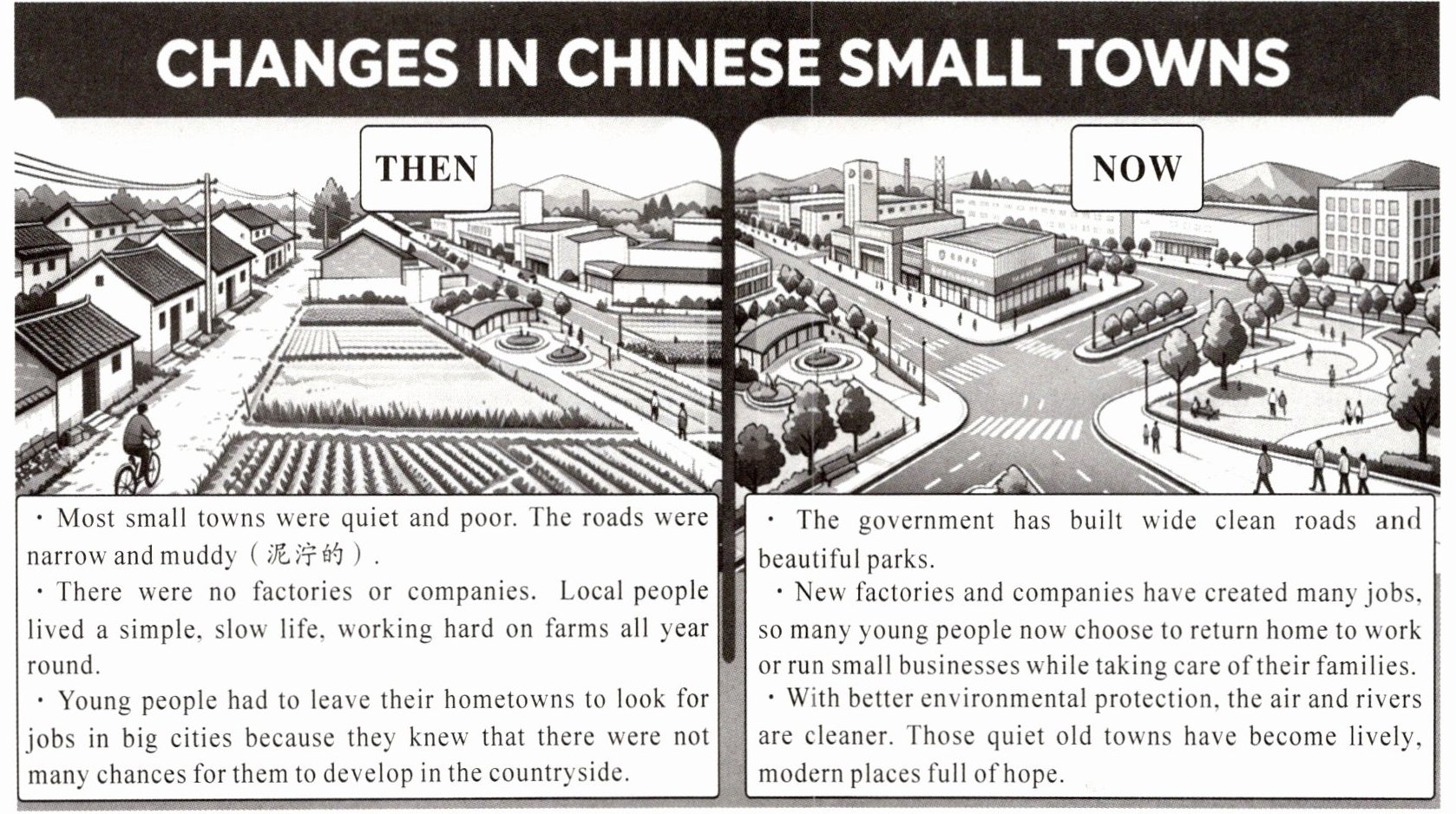
THEN
• Most small towns were quiet and poor. The roads were narrow and muddy(泥泞的).
• There were no factories or companies. Local people lived a simple, slow life, working hard on farms all year round.
• Young people had to leave their hometowns to look for jobs in big cities because they knew that there were not many chances for them to develop in the countryside.
NOW
• The government has built wide clean roads and beautiful parks.
• New factories and companies have created many jobs, so many young people now choose to return home to work or run small businesses while taking care of their families.
• With better environmental protection, the air and rivers are cleaner. Those quiet old towns have become lively, modern places full of hope.
1. Many young people left small towns to work in big cities because .
A. they disliked the quiet life in towns
B. there were not many development chances in the countryside
C. they wanted to buy more daily things
D. the environment in towns was terrible
2. Which of the following is NOT the change?
A. Wide and clean roads were built.
B. The air and rivers are cleaner.
C. More factories offer young people jobs.
D. People no longer work on farms at all.
3. What can we learn from the passage?
A. There were lots of factories in small towns long ago.
B. Young people can only work in big cities now.
C. Small towns are becoming lively and modern places now.
D. People still live a slow life on farms without changes.
4. What is the main idea of the passage?
A. The great changes of small towns.
B. Why young people used to leave their hometowns.
C. Different kinds of public activities in small towns.
D. How to protect the environment in the countryside.
答案
1. B
2. D
3. C
4. A
2. D
3. C
4. A
解析
【分析】
本题为英语阅读理解题,围绕中国小城镇的过去与现在的变化展开。解题时需先梳理原文中“过去(THEN)”和“现在(NOW)”的关键信息,再针对每道题的题干,定位原文对应内容,逐一分析选项正误,选出正确答案。
【解析】
1. 第1题:定位原文THEN部分第三点“because they knew that there were not many chances for them to develop in the countryside”,可知年轻人离开家乡去大城市的原因是乡村发展机会少,对应选项B,故选B。
2. 第2题:原文THEN部分提到当地人“working hard on farms all year round”,NOW部分说明年轻人可回家工作或创业,但并非“完全不再务农”,D选项表述错误;A、B、C均为原文提及的变化,故选D。
3. 第3题:定位原文NOW部分最后一句“Those quiet old towns have become lively, modern places full of hope”,对应选项C;A选项“过去有很多工厂”与原文“过去没有工厂”矛盾,B选项“现在只能在大城市工作”与原文“年轻人可回家工作”矛盾,D选项“生活无变化”与原文矛盾,故选C。
4. 第4题:文章标题为“CHANGES IN CHINESE SMALL TOWNS”,内容围绕小城镇的过去与现在的变化展开,主旨是小城镇的巨大变化,对应选项A,故选A。
【答案】
1.B 2.D 3.C 4.A
【知识点】
阅读理解细节理解,主旨大意
【点评】
本题通过对比小城镇的今昔变化,考查学生对文章细节的提取能力和主旨概括能力,需仔细对照原文内容分析选项,整体难度不大。
【难度系数】
0.3
