

 登录
2. 形容词的分类
| 类别 | 举例 |
| ---- | ---- |
| 品质形容词 | brave, clever, kind, clean |
| 类属形容词 | local, real, plastic, daily |
| 颜色形容词 | grey, blue, red, yellow,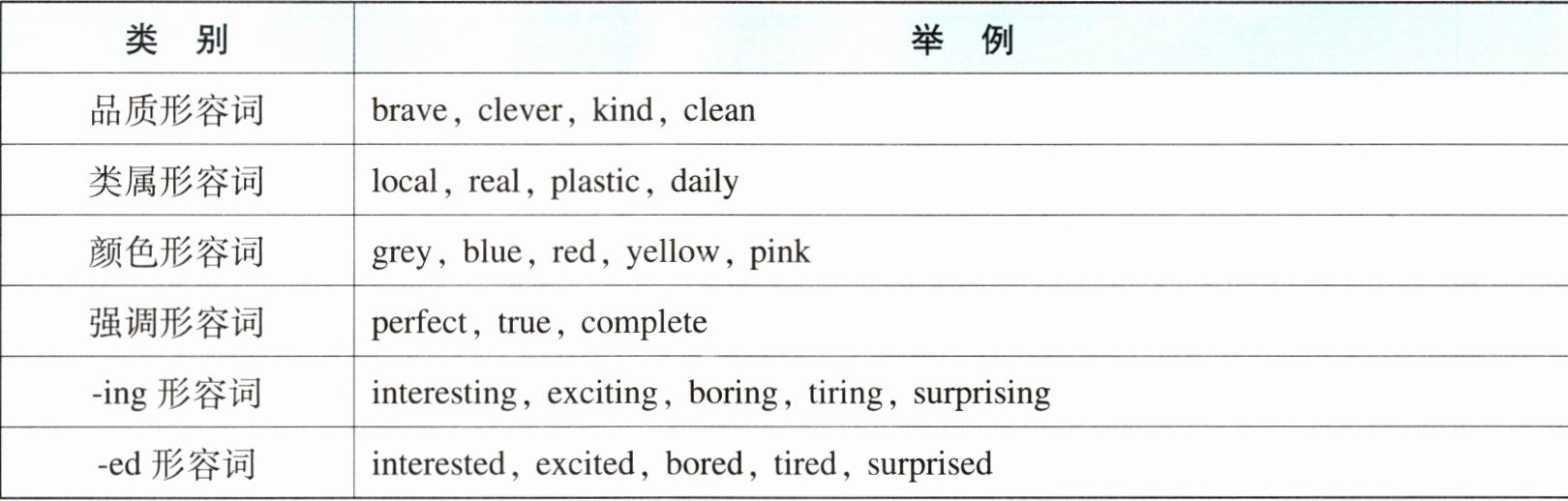 |
| 强调形容词 | perfect, true, complete |
| -ing 形容词 | interesting, exciting, boring, tiring, surprising |
| -ed 形容词 | interested, excited, bored, tired, surprised |
【注意】以-ing结尾的形容词,常用于修饰物;以-ed结尾的形容词,常用于修饰人。如:
The football match is exciting. 这场足球比赛令人激动。
My little sister is excited about this new film. 我妹妹对这部新电影感到很兴奋。
3. 形容词的形式
(1)在英语中,大部分形容词用三种形式来表达事物的等级差别,分别是原级、比较级和最高级。在对两者(人或事物)进行比较时,形容词要用比较级形式。在对三者或三者以上(人或事物)进行比较时,形容词要用最高级形式。如:
This room is big. 这个房间很大。
This room is bigger than the one next door. 这个房间比隔壁的那个要大。
This room is the biggest on this floor. 这个房间是这层楼里最大的。
(2)形容词比较级和最高级的变化规则:
| 规则 | 举例 |
| ---- | ---- |
| 单音节词和部分双音节词 | 一般情况下,直接在形容词词尾加-er或-est | tall→taller→tallest, short→shorter→shortest |
| | 以不发音的字母e结尾的形容词,在词尾加-r或-st | large→larger→largest, nice→nicer→nicest |
| | 以辅音字母+y结尾的双音节词,变y为i,再加-er或-est | easy→easier→easiest, funny→funnier→funniest |
| | 以重读闭音节结尾,且末尾只有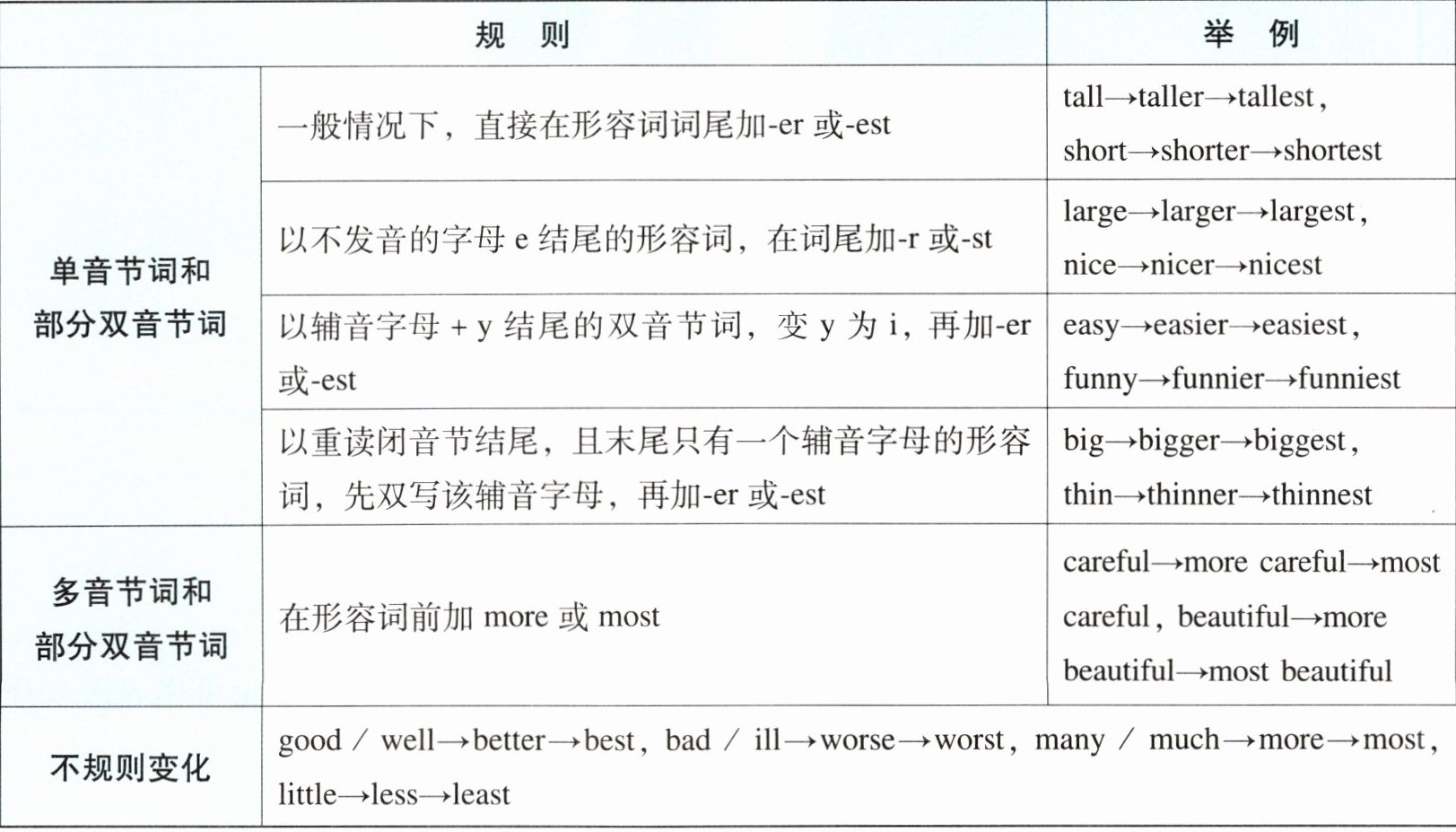 一个辅音字母的形容词,先双写该辅音字母,再加-er或-est | big→bigger→biggest, thin→thinner→thinnest |
| 多音节词和部分双音节词 | 在形容词前加more或most | careful→more careful→most careful, beautiful→more beautiful→most beautiful |
| 不规则变化 | good / well→better→best, bad / ill→worse→worst, many / much→more→most, little→less→least |
专练
(
A. long B. longer C. the longest
(
A. young B. younger C. the youngest
(
A. interesting; interesting B. interesting; interested C. interested; interesting
4. 写出下列形容词的比较级和最高级。
(1) hot→
(3) good→
(5) delicious→
| 类别 | 举例 |
| ---- | ---- |
| 品质形容词 | brave, clever, kind, clean |
| 类属形容词 | local, real, plastic, daily |
| 颜色形容词 | grey, blue, red, yellow,
|| 强调形容词 | perfect, true, complete |
| -ing 形容词 | interesting, exciting, boring, tiring, surprising |
| -ed 形容词 | interested, excited, bored, tired, surprised |
【注意】以-ing结尾的形容词,常用于修饰物;以-ed结尾的形容词,常用于修饰人。如:
The football match is exciting. 这场足球比赛令人激动。
My little sister is excited about this new film. 我妹妹对这部新电影感到很兴奋。
3. 形容词的形式
(1)在英语中,大部分形容词用三种形式来表达事物的等级差别,分别是原级、比较级和最高级。在对两者(人或事物)进行比较时,形容词要用比较级形式。在对三者或三者以上(人或事物)进行比较时,形容词要用最高级形式。如:
This room is big. 这个房间很大。
This room is bigger than the one next door. 这个房间比隔壁的那个要大。
This room is the biggest on this floor. 这个房间是这层楼里最大的。
(2)形容词比较级和最高级的变化规则:
| 规则 | 举例 |
| ---- | ---- |
| 单音节词和部分双音节词 | 一般情况下,直接在形容词词尾加-er或-est | tall→taller→tallest, short→shorter→shortest |
| | 以不发音的字母e结尾的形容词,在词尾加-r或-st | large→larger→largest, nice→nicer→nicest |
| | 以辅音字母+y结尾的双音节词,变y为i,再加-er或-est | easy→easier→easiest, funny→funnier→funniest |
| | 以重读闭音节结尾,且末尾只有
一个辅音字母的形容词,先双写该辅音字母,再加-er或-est | big→bigger→biggest, thin→thinner→thinnest || 多音节词和部分双音节词 | 在形容词前加more或most | careful→more careful→most careful, beautiful→more beautiful→most beautiful |
| 不规则变化 | good / well→better→best, bad / ill→worse→worst, many / much→more→most, little→less→least |
专练
(
B
)1. —Is that Tom? —No, that is Peter. Tom has longer
hair than Peter.A. long B. longer C. the longest
(
C
)2. Katie is the youngest
of the three girls in her family.A. young B. younger C. the youngest
(
B
)3. This book is interesting
. The students are very interested
in it.A. interesting; interesting B. interesting; interested C. interested; interesting
4. 写出下列形容词的比较级和最高级。
(1) hot→
hotter
→hottest
(2) large→larger
→largest
(3) good→
better
→best
(4) heavy→heavier
→heaviest
(5) delicious→
more delicious
→most delicious
答案
1. B 2. C 3. B
4. (1) hotter; hottest (2) larger; largest (3) better; best (4) heavier; heaviest (5) more delicious; most delicious
4. (1) hotter; hottest (2) larger; largest (3) better; best (4) heavier; heaviest (5) more delicious; most delicious
解析
【分析】本题考查英语形容词的核心知识点,包括形容词分类、比较级/最高级用法及变化规则、-ing与-ed形容词的区别。解题时需先判断每道题的考查方向:1题通过than判断是两者比较,需用比较级;2题通过of the three girls判断是三者及以上比较,需用最高级;3题需区分修饰物的-ing形容词和修饰人的-ed形容词;4题需根据形容词变化规则写出对应形式。
【解析】
1. 第1题:句中出现than,表两者比较,需用形容词比较级。选项A为原级,C为最高级,仅B为比较级,故选B。
2. 第2题:句中出现of the three girls,表三者及以上范围比较,需用形容词最高级(最高级前通常加the)。选项A为原级,B为比较级,仅C为最高级,故选C。
3. 第3题:第一个空修饰物(book),用-ing形容词interesting;第二个空修饰人(students),用-ed形容词interested,故选B。
4. 第4题:根据形容词比较级/最高级变化规则:
(1) hot是重读闭音节,双写末尾辅音字母加-er/-est,故为hotter;hottest;
(2) large以不发音的e结尾,加-r/-st,故为larger;largest;
(3) good为不规则变化,故为better;best;
(4) heavy以辅音字母+y结尾,变y为i加-er/-est,故为heavier;heaviest;
(5) delicious为多音节词,前加more/most,故为more delicious;most delicious。
【答案】1.B 2.C 3.B;4.(1)hotter; hottest (2)larger; largest (3)better; best (4)heavier; heaviest (5)more delicious; most delicious
【知识点】形容词的分类、形容词比较级和最高级、-ing与-ed形容词用法
【点评】本题为初中英语形容词基础知识点的专项练习,覆盖核心考点,题型典型,适合巩固形容词相关基础用法。
【难度系数】0.7
