

 登录
登录
二、语篇训练
Ⅱ.图表阅读
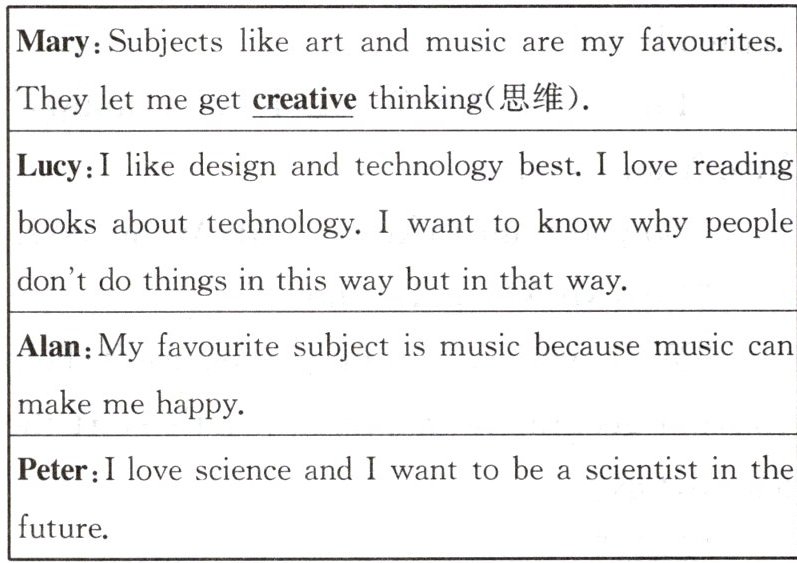
In Britain(英国), all students from the age of 5 to 16 must learn the National Curriculum(国家课程). The subjects are English, maths, religion, science, design and technology(设计与技术), computer science, history, geography, music, art, PE and French or German. There are some differences(差异) between Britain and China in school subjects. What are the favourite subjects for students in Britain?
Larry: History is my favourite subject. I like to know the history of a country because I think it is interesting.
续表
(
A. Maths.
B. Geography.
C. Chinese.
(
A. Interesting.
B. Useful.
C. Easy.
(
A. 传统的
B. 创造性的
C. 简便的
Ⅱ.图表阅读
In Britain(英国), all students from the age of 5 to 16 must learn the National Curriculum(国家课程). The subjects are English, maths, religion, science, design and technology(设计与技术), computer science, history, geography, music, art, PE and French or German. There are some differences(差异) between Britain and China in school subjects. What are the favourite subjects for students in Britain?
Larry: History is my favourite subject. I like to know the history of a country because I think it is interesting.
续表
(
C
)21. Which subject don't students from the age of five to sixteen in Britain learn?A. Maths.
B. Geography.
C. Chinese.
(
A
)22. What does Larry think of history?A. Interesting.
B. Useful.
C. Easy.
(
B
)23. What does the underlined word "creative" mean in Chinese?A. 传统的
B. 创造性的
C. 简便的
答案
21. C 22. A 23. B
解析
【分析】
本题为英语语篇阅读题,包含3道选择题,需结合原文内容逐一分析:
1. 第21题:题干问英国5-16岁学生不学的科目,需定位原文列举的英国学生学习科目,对比选项找出未出现的科目。
2. 第22题:题干问Larry对历史的看法,需找到Larry关于历史的表述,提取关键形容词判断。
3. 第23题:题干猜测“creative”的中文意思,需结合前文艺术、音乐的作用,推断该词含义。
【解析】
21题:根据原文第一段“The subjects are English, maths, religion, science, design and technology, computer science, history, geography, music, art, PE and French or German.”可知,英国5-16岁学生学习的科目中没有Chinese,因此选C。
22题:根据Larry的表述“History is my favourite subject. I like to know the history of a country because I think it is interesting.”可知,Larry认为历史是有趣的,因此选A。
23题:原文Mary提到艺术和音乐能让她获得“creative thinking”,艺术、音乐属于培养创造性的学科,可推断“creative”意为“创造性的”,因此选B。
【答案】21.C 22.A 23.B
【知识点】阅读理解、细节理解、词义猜测
【点评】本题考查基础语篇阅读能力,侧重细节查找和词义推断,难度较低,学生认真阅读原文即可正确解答。
【难度系数】0.8
本题为英语语篇阅读题,包含3道选择题,需结合原文内容逐一分析:
1. 第21题:题干问英国5-16岁学生不学的科目,需定位原文列举的英国学生学习科目,对比选项找出未出现的科目。
2. 第22题:题干问Larry对历史的看法,需找到Larry关于历史的表述,提取关键形容词判断。
3. 第23题:题干猜测“creative”的中文意思,需结合前文艺术、音乐的作用,推断该词含义。
【解析】
21题:根据原文第一段“The subjects are English, maths, religion, science, design and technology, computer science, history, geography, music, art, PE and French or German.”可知,英国5-16岁学生学习的科目中没有Chinese,因此选C。
22题:根据Larry的表述“History is my favourite subject. I like to know the history of a country because I think it is interesting.”可知,Larry认为历史是有趣的,因此选A。
23题:原文Mary提到艺术和音乐能让她获得“creative thinking”,艺术、音乐属于培养创造性的学科,可推断“creative”意为“创造性的”,因此选B。
【答案】21.C 22.A 23.B
【知识点】阅读理解、细节理解、词义猜测
【点评】本题考查基础语篇阅读能力,侧重细节查找和词义推断,难度较低,学生认真阅读原文即可正确解答。
【难度系数】0.8
Ⅲ.短文阅读
This term, Xiao Yang has a new subject—geography, but he doesn't like it. "It's not useful at all," he thinks. So he always plays games in class.
Mr Wang is his geography teacher. He is nice to the students in his class. One day, he finds Xiao Yang isn't interested in his class. He comes to Xiao Yang's desk and asks, "Hi, Xiao Yang. Where are you from?"
"I'm from Sichuan, Mr Wang."
"Oh, that's a nice place! Can I ask you some questions?"
"Sure."
"Why does E'mei have mountains? Where does the Jialing River start? And why is it so hot in Chengdu from July to September?"
"I'm sorry, Mr Wang. I don't know," Xiao Yang says.
"Do you want to know?" Mr Wang asks.
"Yes, Mr Wang. But how?"
"Well, you see, your games can't help you, but geography can. So now let's start the lesson, OK?"
"OK."
(
A. He listens to the teacher.
B. He answers questions.
C. He plays games.
(
A. In March.
B. In August.
C. In October.
(
A. He is nice to his students.
B. He wants Xiao Yang to like geography.
C. He wants Xiao Yang to do his homework carefully.
(
A. Useful.
B. Easy.
C. Boring.
This term, Xiao Yang has a new subject—geography, but he doesn't like it. "It's not useful at all," he thinks. So he always plays games in class.
Mr Wang is his geography teacher. He is nice to the students in his class. One day, he finds Xiao Yang isn't interested in his class. He comes to Xiao Yang's desk and asks, "Hi, Xiao Yang. Where are you from?"
"I'm from Sichuan, Mr Wang."
"Oh, that's a nice place! Can I ask you some questions?"
"Sure."
"Why does E'mei have mountains? Where does the Jialing River start? And why is it so hot in Chengdu from July to September?"
"I'm sorry, Mr Wang. I don't know," Xiao Yang says.
"Do you want to know?" Mr Wang asks.
"Yes, Mr Wang. But how?"
"Well, you see, your games can't help you, but geography can. So now let's start the lesson, OK?"
"OK."
(
C
)24. What does Xiao Yang always do in his geography class?A. He listens to the teacher.
B. He answers questions.
C. He plays games.
(
B
)25. When is it very hot in Chengdu?A. In March.
B. In August.
C. In October.
(
B
)26. Why does Mr Wang ask Xiao Yang questions?A. He is nice to his students.
B. He wants Xiao Yang to like geography.
C. He wants Xiao Yang to do his homework carefully.
(
A
)27. What does Xiao Yang think of geography at last?A. Useful.
B. Easy.
C. Boring.
答案
24. C 25. B 26. B 27. A
解析
【分析】
本题为英语阅读理解的细节理解题,解题思路是带着每个小题的问题,在原文中定位对应信息,将原文内容与选项对比,选出匹配的答案。具体需分别定位小杨地理课的行为、成都炎热的时间、老师提问的原因、小杨最后对地理的看法这四处原文内容。
【解析】
24题:根据原文第一段最后一句“So he always plays games in class.”可知,小杨在地理课上总是玩游戏,对应选项C,故选C。
25题:根据原文中老师的问题“why is it so hot in Chengdu from July to September?”,August(八月)属于7-9月的时间段,对应选项B,故选B。
26题:根据原文,老师发现小杨对地理课不感兴趣,通过提问引导小杨,最后指出“your games can't help you, but geography can”,目的是让小杨喜欢地理,对应选项B,故选B。
27题:根据原文最后小杨同意上课,结合老师强调地理有用,可知最后小杨觉得地理有用,对应选项A,故选A。
【答案】
24.C 25.B 26.B 27.A
【知识点】
英语阅读理解,细节理解题
【点评】
本题是贴近学生校园生活的英语短文阅读,题目均为细节查找类,主要考查学生快速定位原文信息的能力,难度较低。
【难度系数】
0.2
本题为英语阅读理解的细节理解题,解题思路是带着每个小题的问题,在原文中定位对应信息,将原文内容与选项对比,选出匹配的答案。具体需分别定位小杨地理课的行为、成都炎热的时间、老师提问的原因、小杨最后对地理的看法这四处原文内容。
【解析】
24题:根据原文第一段最后一句“So he always plays games in class.”可知,小杨在地理课上总是玩游戏,对应选项C,故选C。
25题:根据原文中老师的问题“why is it so hot in Chengdu from July to September?”,August(八月)属于7-9月的时间段,对应选项B,故选B。
26题:根据原文,老师发现小杨对地理课不感兴趣,通过提问引导小杨,最后指出“your games can't help you, but geography can”,目的是让小杨喜欢地理,对应选项B,故选B。
27题:根据原文最后小杨同意上课,结合老师强调地理有用,可知最后小杨觉得地理有用,对应选项A,故选A。
【答案】
24.C 25.B 26.B 27.A
【知识点】
英语阅读理解,细节理解题
【点评】
本题是贴近学生校园生活的英语短文阅读,题目均为细节查找类,主要考查学生快速定位原文信息的能力,难度较低。
【难度系数】
0.2
