

 登录
Ⅵ. 中考趋势 短文还原
从方框中选出能填入空白处的最佳选项。选项中有两项多余。
文化意识 跨文化交流 Cultural dining manners might surprise you with some of their important rules. 1. . Knowing some tips will help ensure that you have an enjoyable meal with friends or family—no matter where you are in the world.
Chopstick Rules The way you hold chopsticks is important to avoid annoying your companions. When you put them down between bites, always put them down together so they are parallel with the edge of the table in front of you. 2. .
Hands or Utensils(餐具) In India and the Middle East, it's considered very rude to eat with your left hand. People in France expect you to eat with a utensil in each hand. 3. , instead preferring to use their hands. In Chile, you may never touch any food with your fingers. People in Thailand generally use their forks only to push food onto their spoons.
Making Requests 4. . In Portugal, this would be a serious mistake, because it shows the chefs that you don't like their seasoning skills. Similarly, in Italy, never ask for extra cheese to add to your food.
Some of these cultural dining manners may seem accidental and strange, but they are important in different countries. 5. ______ , the more comfortable you'll begin to feel with its foreign cultural practices.
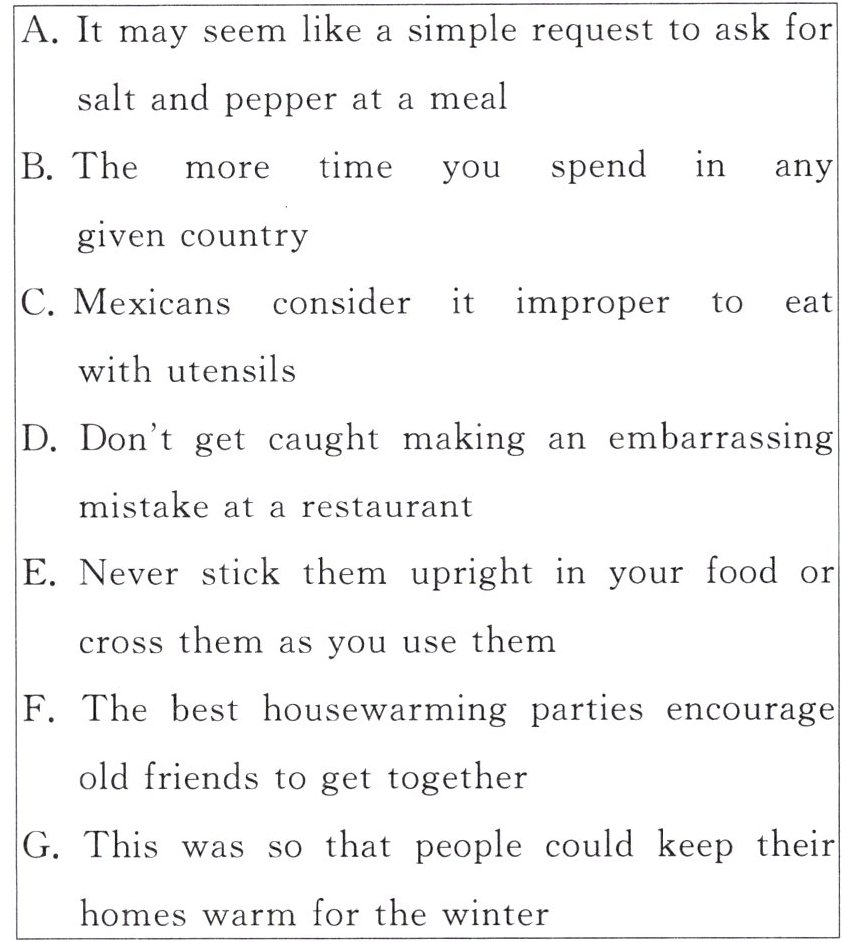
A. It may seem like a simple request to ask for salt and pepper at a meal
B. The more time you spend in any given country
C. Mexicans consider it improper to eat with utensils
D. Don't get caught making an embarrassing mistake at a restaurant
E. Never stick them upright in your food or cross them as you use them
F. The best housewarming parties encourage old friends to get together
G. This was so that people could keep their homes warm for the winter
Ⅶ.首字母填空
根据短文内容及首字母提示,在空格处填入一个适当的词使短文完整。
文化意识 跨文化交流 When I first set foot on Mexican soil, I could speak Spanish well. So when I asked a local taco seller for a taco, and he said “ahorita”, which is directly 1. t as “right now”, I took him at his word, believing that 2. i arrival was immediate.
I sat near his shop and waited. Half an hour passed and 3. s no taco arrived, so I asked again about it. “Ahorita,” he told me again. His face was a mix of confusion and maybe even embarrassment.
I was torn(犹豫的). Waiting longer wasn't pleasant, but I felt it was 4. i to just walk away, especially if the taco was now being delivered just for me. But finally, after 5. w too long, I made a dash for the nearest bus to take me home. As I left, I pointed at my wrist and shrugged(耸肩) to the taco seller. Obviously I couldn't wait any longer and it really wasn't my fault. His face was, once again, one of total confusion.
This experience faded(褪去) from my memory 6. u years later when I came back to live in Mexico. I discovered that understanding “ahorita” took not fluency(流利) in the language, but rather fluency in the 7. c. When someone from Mexico says “ahorita”, it should almost 8. n be taken literally; its meaning 9. c greatly with context. As a linguist(语言学家) told me, “Ahorita could mean tomorrow, in an hour, within five years or never.” It is even used as a polite way of saying “no, thanks” when 10. r an offer.
“Ahorita Time” is a reflection of different cultural understandings of time. Since I moved to Mexico, my attitude towards time has changed dramatically. “Ahorita Time” has actually allowed me to live far more in the “right now” than I ever did before.
从方框中选出能填入空白处的最佳选项。选项中有两项多余。
文化意识 跨文化交流 Cultural dining manners might surprise you with some of their important rules. 1. . Knowing some tips will help ensure that you have an enjoyable meal with friends or family—no matter where you are in the world.
Chopstick Rules The way you hold chopsticks is important to avoid annoying your companions. When you put them down between bites, always put them down together so they are parallel with the edge of the table in front of you. 2. .
Hands or Utensils(餐具) In India and the Middle East, it's considered very rude to eat with your left hand. People in France expect you to eat with a utensil in each hand. 3. , instead preferring to use their hands. In Chile, you may never touch any food with your fingers. People in Thailand generally use their forks only to push food onto their spoons.
Making Requests 4. . In Portugal, this would be a serious mistake, because it shows the chefs that you don't like their seasoning skills. Similarly, in Italy, never ask for extra cheese to add to your food.
Some of these cultural dining manners may seem accidental and strange, but they are important in different countries. 5. ______ , the more comfortable you'll begin to feel with its foreign cultural practices.
A. It may seem like a simple request to ask for salt and pepper at a meal
B. The more time you spend in any given country
C. Mexicans consider it improper to eat with utensils
D. Don't get caught making an embarrassing mistake at a restaurant
E. Never stick them upright in your food or cross them as you use them
F. The best housewarming parties encourage old friends to get together
G. This was so that people could keep their homes warm for the winter
Ⅶ.首字母填空
根据短文内容及首字母提示,在空格处填入一个适当的词使短文完整。
文化意识 跨文化交流 When I first set foot on Mexican soil, I could speak Spanish well. So when I asked a local taco seller for a taco, and he said “ahorita”, which is directly 1. t as “right now”, I took him at his word, believing that 2. i arrival was immediate.
I sat near his shop and waited. Half an hour passed and 3. s no taco arrived, so I asked again about it. “Ahorita,” he told me again. His face was a mix of confusion and maybe even embarrassment.
I was torn(犹豫的). Waiting longer wasn't pleasant, but I felt it was 4. i to just walk away, especially if the taco was now being delivered just for me. But finally, after 5. w too long, I made a dash for the nearest bus to take me home. As I left, I pointed at my wrist and shrugged(耸肩) to the taco seller. Obviously I couldn't wait any longer and it really wasn't my fault. His face was, once again, one of total confusion.
This experience faded(褪去) from my memory 6. u years later when I came back to live in Mexico. I discovered that understanding “ahorita” took not fluency(流利) in the language, but rather fluency in the 7. c. When someone from Mexico says “ahorita”, it should almost 8. n be taken literally; its meaning 9. c greatly with context. As a linguist(语言学家) told me, “Ahorita could mean tomorrow, in an hour, within five years or never.” It is even used as a polite way of saying “no, thanks” when 10. r an offer.
“Ahorita Time” is a reflection of different cultural understandings of time. Since I moved to Mexico, my attitude towards time has changed dramatically. “Ahorita Time” has actually allowed me to live far more in the “right now” than I ever did before.
答案
Ⅵ. 1.D 2.E 3.C 4.A 5.B
【语篇解读】本文是一篇说明文,介绍了不同国家的用餐礼仪。
Ⅶ.【语篇解读】本文是一篇记叙文,主要讲述了作者在墨西哥买墨西哥卷饼时,老板告诉他“ahorita”,作者等了很久都等不到墨西哥卷饼之后离开的一次经历,多年后,作者再次回到墨西哥生活时,才真正理解“ahorita”的含义。
1. translated 2. its 3. still 4. impolite 5. waiting 6. until 7. culture 8. never 9. changes 10. refusing
【语篇解读】本文是一篇说明文,介绍了不同国家的用餐礼仪。
Ⅶ.【语篇解读】本文是一篇记叙文,主要讲述了作者在墨西哥买墨西哥卷饼时,老板告诉他“ahorita”,作者等了很久都等不到墨西哥卷饼之后离开的一次经历,多年后,作者再次回到墨西哥生活时,才真正理解“ahorita”的含义。
1. translated 2. its 3. still 4. impolite 5. waiting 6. until 7. culture 8. never 9. changes 10. refusing
