

 登录
登录
三、补全对话。
A)请阅读下面对话,根据对话内容从下面方框内的七个选项中选择五个填入空白处,使对话通顺、合理,意思完整。一空一句。
(Li Dan and Wei Hai are talking in the classroom. Li Dan=L, Wei Hai=W)
W: Good morning, Li Dan. 1.
L: A story named The Frog in the Well.
W: Oh, I heard about it. 2.
L: Yeah, but this is a new version(版本). And the frog changed a lot in this one.
W: Oh, really? 3.
L: He decided to jump out of the well to see the world outside. And he kept trying over and over again, even though it was really hard.
W: 4.
L: Of course. But that's not the end of the story.
W: What happened next?
L: The frog was surprised by the beautiful world. He started travelling around, visiting new places and exploring many wonderful things.
W: Wow! 5. If we step out of our comfort zone(舒适区), we can enjoy a wonderful world!
L: Exactly! The world is waiting for us to explore!
A. How did he change?
B. What a great story!
C. Did he succeed at last?
D. What are you reading?
E. It's quite an old story, right?
F. Was it easy for the frog to jump out?
G. I don't think the new version is interesting.
B)根据对话内容回答问题。
6. What story is Li Dan reading?
7. Why did the frog keep trying to jump out of the well again and again?
8. What can we learn from the story?
A)请阅读下面对话,根据对话内容从下面方框内的七个选项中选择五个填入空白处,使对话通顺、合理,意思完整。一空一句。
(Li Dan and Wei Hai are talking in the classroom. Li Dan=L, Wei Hai=W)
W: Good morning, Li Dan. 1.
L: A story named The Frog in the Well.
W: Oh, I heard about it. 2.
L: Yeah, but this is a new version(版本). And the frog changed a lot in this one.
W: Oh, really? 3.
L: He decided to jump out of the well to see the world outside. And he kept trying over and over again, even though it was really hard.
W: 4.
L: Of course. But that's not the end of the story.
W: What happened next?
L: The frog was surprised by the beautiful world. He started travelling around, visiting new places and exploring many wonderful things.
W: Wow! 5. If we step out of our comfort zone(舒适区), we can enjoy a wonderful world!
L: Exactly! The world is waiting for us to explore!
A. How did he change?
B. What a great story!
C. Did he succeed at last?
D. What are you reading?
E. It's quite an old story, right?
F. Was it easy for the frog to jump out?
G. I don't think the new version is interesting.
B)根据对话内容回答问题。
6. What story is Li Dan reading?
7. Why did the frog keep trying to jump out of the well again and again?
8. What can we learn from the story?
答案
1. D
2. E
3. A
4. C
5. B
6. She is reading a new version of the story named *The Frog in the Well*.
7. Because he wanted to jump out of the well to see the world outside.
8. If we step out of our comfort zone, we can enjoy a wonderful world.
2. E
3. A
4. C
5. B
6. She is reading a new version of the story named *The Frog in the Well*.
7. Because he wanted to jump out of the well to see the world outside.
8. If we step out of our comfort zone, we can enjoy a wonderful world.
解析
【分析】
做本题时,先通读对话内容和选项,明确对话场景为教室中两人讨论阅读的故事。补全对话需结合上下文问答逻辑选择合适选项:第1空根据李丹的答语(故事名称),确定魏海询问的是“读什么”;第2空结合李丹提到的“新版本”,魏海应确认故事是否为老版本;第3空对应李丹说的“青蛙变了”,需问变化的方式;第4空根据答语“Of course”,确定是问是否成功;第5空结合后文的感悟,魏海应感叹故事。回答问题时,直接从对话中提取对应信息即可。
【解析】
A部分(补全对话):
1. 由李丹的答语“A story named The Frog in the Well”可知,魏海询问的是“你在读什么”,对应选项D。
2. 李丹提到“这是新版本”,魏海应确认“这是个老故事,对吗”,对应选项E。
3. 李丹说“青蛙在这个版本里变了很多”,魏海问“他怎么变的”,对应选项A。
4. 李丹答“Of course”,对应魏海问“他最后成功了吗”,对应选项C。
5. 结合后文“如果走出舒适区能享受精彩世界”的感悟,魏海感叹“多棒的故事啊”,对应选项B。
B部分(回答问题):
6. 从对话中李丹的表述提取答案:She is reading a new version of the story named *The Frog in the Well*.
7. 从李丹说的“He decided to jump out of the well to see the world outside”提取原因:Because he wanted to jump out of the well to see the world outside.
8. 从对话最后两人的感悟提取道理:If we step out of our comfort zone, we can enjoy a wonderful world.
【答案】
1. D
2. E
3. A
4. C
5. B
6. She is reading a new version of the story named *The Frog in the Well*.
7. Because he wanted to jump out of the well to see the world outside.
8. If we step out of our comfort zone, we can enjoy a wonderful world.
【知识点】
情景交际补全对话、对话细节理解
【点评】
本题为英语情景交际补全对话及对话细节理解题,需结合上下文语境匹配选项,从对话中精准提取关键信息回答问题,考查学生的语境把握和信息提取能力,难度适中。
【难度系数】
0.6
做本题时,先通读对话内容和选项,明确对话场景为教室中两人讨论阅读的故事。补全对话需结合上下文问答逻辑选择合适选项:第1空根据李丹的答语(故事名称),确定魏海询问的是“读什么”;第2空结合李丹提到的“新版本”,魏海应确认故事是否为老版本;第3空对应李丹说的“青蛙变了”,需问变化的方式;第4空根据答语“Of course”,确定是问是否成功;第5空结合后文的感悟,魏海应感叹故事。回答问题时,直接从对话中提取对应信息即可。
【解析】
A部分(补全对话):
1. 由李丹的答语“A story named The Frog in the Well”可知,魏海询问的是“你在读什么”,对应选项D。
2. 李丹提到“这是新版本”,魏海应确认“这是个老故事,对吗”,对应选项E。
3. 李丹说“青蛙在这个版本里变了很多”,魏海问“他怎么变的”,对应选项A。
4. 李丹答“Of course”,对应魏海问“他最后成功了吗”,对应选项C。
5. 结合后文“如果走出舒适区能享受精彩世界”的感悟,魏海感叹“多棒的故事啊”,对应选项B。
B部分(回答问题):
6. 从对话中李丹的表述提取答案:She is reading a new version of the story named *The Frog in the Well*.
7. 从李丹说的“He decided to jump out of the well to see the world outside”提取原因:Because he wanted to jump out of the well to see the world outside.
8. 从对话最后两人的感悟提取道理:If we step out of our comfort zone, we can enjoy a wonderful world.
【答案】
1. D
2. E
3. A
4. C
5. B
6. She is reading a new version of the story named *The Frog in the Well*.
7. Because he wanted to jump out of the well to see the world outside.
8. If we step out of our comfort zone, we can enjoy a wonderful world.
【知识点】
情景交际补全对话、对话细节理解
【点评】
本题为英语情景交际补全对话及对话细节理解题,需结合上下文语境匹配选项,从对话中精准提取关键信息回答问题,考查学生的语境把握和信息提取能力,难度适中。
【难度系数】
0.6
四、任务型阅读。
Long ago, there was a man travelling from the State of Wei(魏国) to the State of Chu(楚国). After taking a lot of money and food, he found a good coachman(马车夫) and a horse, and then he began his trip.
Chu was to the south of Wei, but this man couldn't tell the difference when the coachman rode away to the north. On the way, he met a traveller. When the traveller knew that he was going to Chu, the traveller said, "Chu is in the south. When can you arrive there if you go north?" The man didn't care because he thought his horse was the best and could run quickly. The traveller said, "Your horse is fast, but it will be farther and farther away from Chu in this direction(方向). You will never reach Chu."
The man still didn't worry about that, because he had enough money and food. Then the traveller said, "But you're still going the wrong way." The man said, "It doesn't matter. My coachman is very skilled!" After hearing that, the traveller didn't say anything and watched helplessly as the man went away.
任务一:根据短文内容选择正确的答案。
()1. Which direction did the man ride to?
A. The south. B. The north. C. The east. D. The west.
()2. Why didn't the man care about the traveller's words?
A. Because he thought he could run quickly.
B. Because he thought he could ride his horse well.
C. Because he thought he knew the best way to Chu very well.
D. Because he thought he had the best horse that could run quickly.
()3. How did the traveller feel after the man refused to change his way?
A. Helpless. B. Hopeful. C. Cheerful. D. Excited.
()4. What's the writer's purpose of writing the passage?
A. To tell us not to believe in strangers.
B. To teach us to travel with a true friend.
C. To tell us to accept others' correct advice.
D. To tell us to follow our own ideas without help.
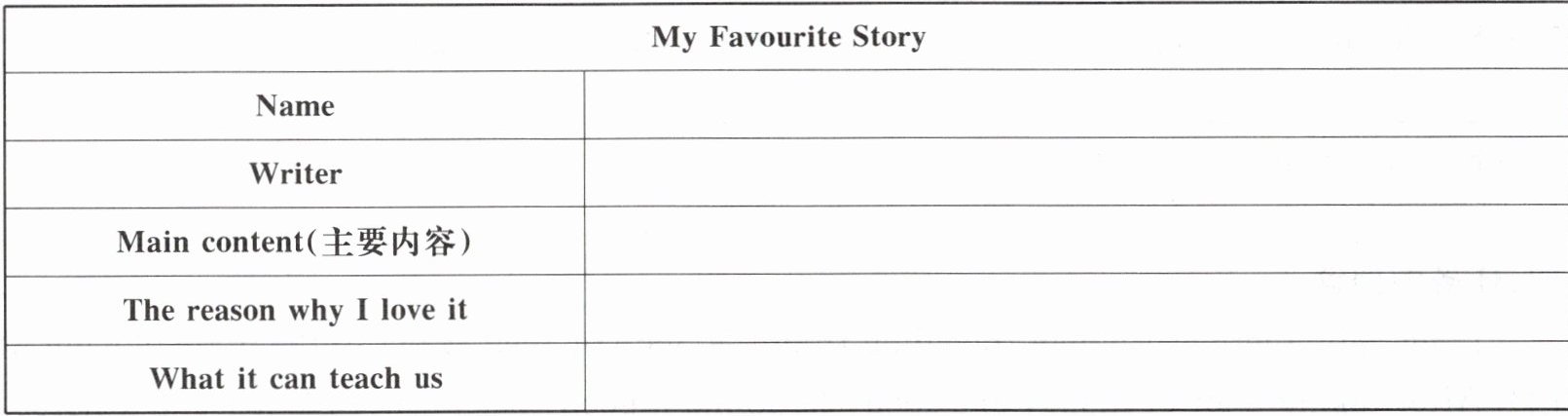
任务二:制作一张关于“My Favourite Story”的卡片。
Long ago, there was a man travelling from the State of Wei(魏国) to the State of Chu(楚国). After taking a lot of money and food, he found a good coachman(马车夫) and a horse, and then he began his trip.
Chu was to the south of Wei, but this man couldn't tell the difference when the coachman rode away to the north. On the way, he met a traveller. When the traveller knew that he was going to Chu, the traveller said, "Chu is in the south. When can you arrive there if you go north?" The man didn't care because he thought his horse was the best and could run quickly. The traveller said, "Your horse is fast, but it will be farther and farther away from Chu in this direction(方向). You will never reach Chu."
The man still didn't worry about that, because he had enough money and food. Then the traveller said, "But you're still going the wrong way." The man said, "It doesn't matter. My coachman is very skilled!" After hearing that, the traveller didn't say anything and watched helplessly as the man went away.
任务一:根据短文内容选择正确的答案。
()1. Which direction did the man ride to?
A. The south. B. The north. C. The east. D. The west.
()2. Why didn't the man care about the traveller's words?
A. Because he thought he could run quickly.
B. Because he thought he could ride his horse well.
C. Because he thought he knew the best way to Chu very well.
D. Because he thought he had the best horse that could run quickly.
()3. How did the traveller feel after the man refused to change his way?
A. Helpless. B. Hopeful. C. Cheerful. D. Excited.
()4. What's the writer's purpose of writing the passage?
A. To tell us not to believe in strangers.
B. To teach us to travel with a true friend.
C. To tell us to accept others' correct advice.
D. To tell us to follow our own ideas without help.
任务二:制作一张关于“My Favourite Story”的卡片。
答案
任务一:
1. B
2. D
3. A
4. C
任务二:
Name: *Going South by Driving the Chariot North*
Writer: Ancient Chinese Fable
Main content: A man from the State of Wei wanted to visit the State of Chu which is in the south. But he went in the wrong direction to the north. He refused others' useful advice, and believed his fast horse, enough money and food, and good driver could take him to Chu smoothly.
The reason why I love it: The story is interesting and it makes me think a lot about my daily actions.
What it can teach us: When we do something, we need to make sure we are on the right direction first, and we should listen to others' correct advice.
1. B
2. D
3. A
4. C
任务二:
Name: *Going South by Driving the Chariot North*
Writer: Ancient Chinese Fable
Main content: A man from the State of Wei wanted to visit the State of Chu which is in the south. But he went in the wrong direction to the north. He refused others' useful advice, and believed his fast horse, enough money and food, and good driver could take him to Chu smoothly.
The reason why I love it: The story is interesting and it makes me think a lot about my daily actions.
What it can teach us: When we do something, we need to make sure we are on the right direction first, and we should listen to others' correct advice.
解析
【分析】
本题分为任务一的选择题和任务二的卡片填写,解题思路如下:
1. 任务一的选择题:均围绕短文细节和主旨展开,需先通读短文,定位每个问题的关键词,找到原文对应语句,对比选项选出正确答案;
2. 任务二的卡片:需根据短文内容提取故事的名称、作者、主要内容,再结合故事特点说明喜欢的原因和传达的道理,确保信息准确贴合原文。
【解析】
任务一:
1. 关键词为direction,定位原文第二段“this man couldn't tell the difference when the coachman rode away to the north”,可知男子向北走,选B;
2. 关键词为why didn't care,定位原文第二段“because he thought his horse was the best and could run quickly”,对应选项D;
3. 关键词为how did traveller feel,定位原文最后“watched helplessly”,可知旅行者感到无助,选A;
4. 为主旨大意题,故事通过男子南辕北辙的经历,传达要听取他人正确建议的道理,选C。
任务二:
根据短文内容及经典故事背景,卡片填写如下:
Name: *Going South by Driving the Chariot North*
Writer: Ancient Chinese Fable
Main content: A man from the State of Wei wanted to visit the State of Chu which is in the south. But he went in the wrong direction to the north. He refused others' useful advice, and believed his fast horse, enough money and food, and good driver could take him to Chu smoothly.
The reason why I love it: The story is interesting and it makes me think a lot about my daily actions.
What it can teach us: When we do something, we need to make sure we are on the right direction first, and we should listen to others' correct advice.
【答案】
任务一:1.B 2.D 3.A 4.C
任务二:
Name: *Going South by Driving the Chariot North*
Writer: Ancient Chinese Fable
Main content: A man from the State of Wei wanted to visit the State of Chu which is in the south. But he went in the wrong direction to the north. He refused others' useful advice, and believed his fast horse, enough money and food, and good driver could take him to Chu smoothly.
The reason why I love it: The story is interesting and it makes me think a lot about my daily actions.
What it can teach us: When we do something, we need to make sure we are on the right direction first, and we should listen to others' correct advice.
【知识点】
细节理解题、主旨大意题、故事类阅读
【点评】
本题结合选择题与卡片填写,考查学生对短文细节的提取、主旨的理解及信息整理能力,选用经典寓言故事,内容贴近学生认知,易于理解。
【难度系数】
0.6
本题分为任务一的选择题和任务二的卡片填写,解题思路如下:
1. 任务一的选择题:均围绕短文细节和主旨展开,需先通读短文,定位每个问题的关键词,找到原文对应语句,对比选项选出正确答案;
2. 任务二的卡片:需根据短文内容提取故事的名称、作者、主要内容,再结合故事特点说明喜欢的原因和传达的道理,确保信息准确贴合原文。
【解析】
任务一:
1. 关键词为direction,定位原文第二段“this man couldn't tell the difference when the coachman rode away to the north”,可知男子向北走,选B;
2. 关键词为why didn't care,定位原文第二段“because he thought his horse was the best and could run quickly”,对应选项D;
3. 关键词为how did traveller feel,定位原文最后“watched helplessly”,可知旅行者感到无助,选A;
4. 为主旨大意题,故事通过男子南辕北辙的经历,传达要听取他人正确建议的道理,选C。
任务二:
根据短文内容及经典故事背景,卡片填写如下:
Name: *Going South by Driving the Chariot North*
Writer: Ancient Chinese Fable
Main content: A man from the State of Wei wanted to visit the State of Chu which is in the south. But he went in the wrong direction to the north. He refused others' useful advice, and believed his fast horse, enough money and food, and good driver could take him to Chu smoothly.
The reason why I love it: The story is interesting and it makes me think a lot about my daily actions.
What it can teach us: When we do something, we need to make sure we are on the right direction first, and we should listen to others' correct advice.
【答案】
任务一:1.B 2.D 3.A 4.C
任务二:
Name: *Going South by Driving the Chariot North*
Writer: Ancient Chinese Fable
Main content: A man from the State of Wei wanted to visit the State of Chu which is in the south. But he went in the wrong direction to the north. He refused others' useful advice, and believed his fast horse, enough money and food, and good driver could take him to Chu smoothly.
The reason why I love it: The story is interesting and it makes me think a lot about my daily actions.
What it can teach us: When we do something, we need to make sure we are on the right direction first, and we should listen to others' correct advice.
【知识点】
细节理解题、主旨大意题、故事类阅读
【点评】
本题结合选择题与卡片填写,考查学生对短文细节的提取、主旨的理解及信息整理能力,选用经典寓言故事,内容贴近学生认知,易于理解。
【难度系数】
0.6
