

 登录
登录
第二节 阅读短文,从方框内所给的A、B、C、D、E、F六个选项中选出能填入空白处的最佳选项,使短文通顺、连贯。选项中有一项是多余的。
Every day, we use a lot of water. 31 We use a lot of water to take a shower, too.
32 It is called the RainStick Shower. It saves about 80% of water when we take a shower. And while showering, the machine collects and sterilizes (消毒) the water we used and then we can use it again. 33 In this way, a family of two people can save a lot of water at a time. And day by day, a swimming pool will be full in a year.
34 For example, when you wash dishes, don't let the water run. And only do some washing when there are a lot of clothes to wash. Because if the washing machine isn't full, you will waste water. 35 Just do it right now, dear guys! To save the natural resource(自然资源) is to save ourselves.
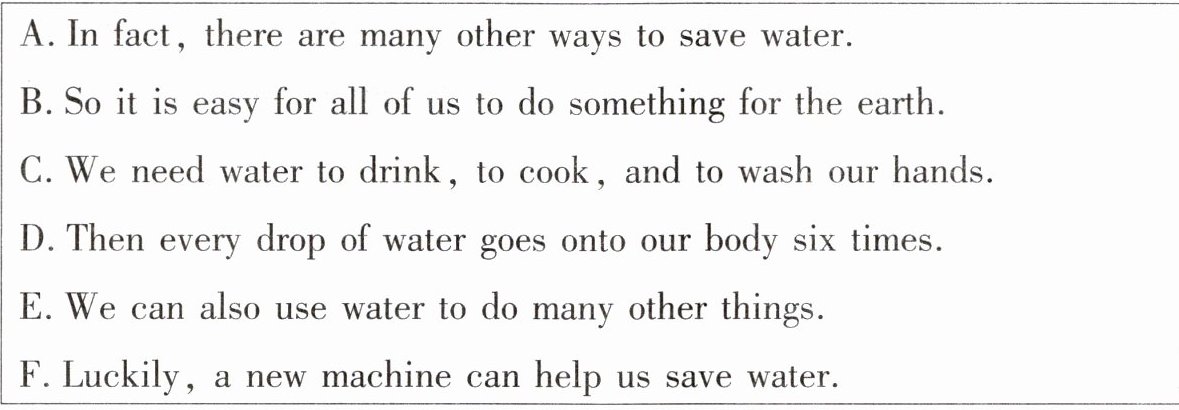
31. 32. 33. 34. 35.
Every day, we use a lot of water. 31 We use a lot of water to take a shower, too.
32 It is called the RainStick Shower. It saves about 80% of water when we take a shower. And while showering, the machine collects and sterilizes (消毒) the water we used and then we can use it again. 33 In this way, a family of two people can save a lot of water at a time. And day by day, a swimming pool will be full in a year.
34 For example, when you wash dishes, don't let the water run. And only do some washing when there are a lot of clothes to wash. Because if the washing machine isn't full, you will waste water. 35 Just do it right now, dear guys! To save the natural resource(自然资源) is to save ourselves.
31. 32. 33. 34. 35.
答案
31. C
32. F
33. D
34. A
35. B
32. F
33. D
34. A
35. B
解析
我们可以根据上下文逻辑逐一匹配选项:
31. 空前句提到我们每天使用大量水,空后句说明我们也会用大量水洗澡,此处需要列举日常用水的常见场景,C选项“我们需要水来饮用、做饭和洗手”符合语境,和后文的“too”呼应,共同说明水在生活中的广泛使用。
32. 空后介绍了一款名为RainStick Shower的节水淋浴设备,此处需要引出这款节水新设备,F选项“幸运的是,一款新机器可以帮助我们节水”可以自然衔接下文内容。
33. 空前提到这款机器会收集并消毒我们用过的水,之后我们可以再次使用这些水,D选项“之后每一滴水都可以在我们身上循环使用六次”是对水循环使用过程的补充说明,符合逻辑。
34. 空后列举了洗碗时不让水一直流、攒够多衣服再用洗衣机洗等其他节水小方法,A选项“事实上,还有很多其他的节水方法”可以总领本段内容,引出下文的举例。
35. 空前介绍了各类简单可行的节水方法,空后呼吁大家立刻行动起来保护水资源,B选项“所以我们所有人都可以很轻松地为地球做些力所能及的事”起到承上启下的作用,自然衔接后文的号召。
多余选项为E。
31. 空前句提到我们每天使用大量水,空后句说明我们也会用大量水洗澡,此处需要列举日常用水的常见场景,C选项“我们需要水来饮用、做饭和洗手”符合语境,和后文的“too”呼应,共同说明水在生活中的广泛使用。
32. 空后介绍了一款名为RainStick Shower的节水淋浴设备,此处需要引出这款节水新设备,F选项“幸运的是,一款新机器可以帮助我们节水”可以自然衔接下文内容。
33. 空前提到这款机器会收集并消毒我们用过的水,之后我们可以再次使用这些水,D选项“之后每一滴水都可以在我们身上循环使用六次”是对水循环使用过程的补充说明,符合逻辑。
34. 空后列举了洗碗时不让水一直流、攒够多衣服再用洗衣机洗等其他节水小方法,A选项“事实上,还有很多其他的节水方法”可以总领本段内容,引出下文的举例。
35. 空前介绍了各类简单可行的节水方法,空后呼吁大家立刻行动起来保护水资源,B选项“所以我们所有人都可以很轻松地为地球做些力所能及的事”起到承上启下的作用,自然衔接后文的号召。
多余选项为E。
Ⅳ. 短文填空。
阅读短文,从方框中选出恰当的单词并用其适当形式填空,使短文通顺、意义完整。每空仅填一词,每词仅用一次。
month exciting live hard two after think worry she but
Do you think people all over the world can drink and use clean water? Well, it's not true. Let's look at Nya's story.
Nya is an eleven-year-old girl and she 36 in South Sudan. She walks to the pond near her village 37 a day to get water for her family. It's a long walk, so Nya doesn't have time to go to school. Nya 38 about her sister Akeer. Akeer is ill (生病的) from the poor water, 39 there is little Nya's family can do about it.
One day, two men came to Nya's village. 40 talking with the elders, they began to work in the ground between two big trees. Getting water from a well in South Sudan is 41. So, when Nya learned they were going to dig a well, she 42 it was impossible.
But after two 43 of hard work, water finally comes out from the well now. People bring their bottles to taste the water. It is clear and fresh. Everyone is 44.
I feel happy for Nya and 45 village. The story opens my eyes and teaches me to save water as much as I can in my daily life.
36. 37. 38. 39. 40.
41. 42. 43. 44. 45.
阅读短文,从方框中选出恰当的单词并用其适当形式填空,使短文通顺、意义完整。每空仅填一词,每词仅用一次。
month exciting live hard two after think worry she but
Do you think people all over the world can drink and use clean water? Well, it's not true. Let's look at Nya's story.
Nya is an eleven-year-old girl and she 36 in South Sudan. She walks to the pond near her village 37 a day to get water for her family. It's a long walk, so Nya doesn't have time to go to school. Nya 38 about her sister Akeer. Akeer is ill (生病的) from the poor water, 39 there is little Nya's family can do about it.
One day, two men came to Nya's village. 40 talking with the elders, they began to work in the ground between two big trees. Getting water from a well in South Sudan is 41. So, when Nya learned they were going to dig a well, she 42 it was impossible.
But after two 43 of hard work, water finally comes out from the well now. People bring their bottles to taste the water. It is clear and fresh. Everyone is 44.
I feel happy for Nya and 45 village. The story opens my eyes and teaches me to save water as much as I can in my daily life.
36. 37. 38. 39. 40.
41. 42. 43. 44. 45.
答案
36. lives 37. twice 38. worries 39. but 40. After 41. hard 42. thought 43. months 44. excited 45. her
解析
我们结合方框词汇和上下文语境逐一分析:
36. 此处表达“她住在南苏丹”,主语she是第三人称单数,句子为一般现在时,动词live要变为第三人称单数形式lives。
37. 此处表达“一天两次”去取水,two要变为副词twice,构成固定搭配twice a day。
38. 此处是固定搭配worry about表示“担心”,主语Nya是第三人称单数,句子为一般现在时,worry变为worries。
39. 前半句说妹妹因为脏水生病,后半句说Nya的家人对此几乎无能为力,前后是转折关系,填连词but。
40. 此处表达“和长老们交谈之后,他们开始干活”,填介词after,句首首字母大写为After。
41. 根据后文Nya觉得挖井不可能,可知在南苏丹从井里取水是很困难的,填形容词hard。
42. 此处表达“她认为这是不可能的”,前文的learned是一般过去时,所以think要变为过去式thought。
43. 数词two后面接可数名词复数,month的复数形式是months,表示“两个月的辛苦劳作”。
44. 井水出来了,水清澈新鲜,所有人都很兴奋,修饰人表示“感到兴奋的”,exciting要变为excited。
45. 此处修饰名词village,要把主格she变为形容词性物主代词her,表示“她的村庄”。
36. 此处表达“她住在南苏丹”,主语she是第三人称单数,句子为一般现在时,动词live要变为第三人称单数形式lives。
37. 此处表达“一天两次”去取水,two要变为副词twice,构成固定搭配twice a day。
38. 此处是固定搭配worry about表示“担心”,主语Nya是第三人称单数,句子为一般现在时,worry变为worries。
39. 前半句说妹妹因为脏水生病,后半句说Nya的家人对此几乎无能为力,前后是转折关系,填连词but。
40. 此处表达“和长老们交谈之后,他们开始干活”,填介词after,句首首字母大写为After。
41. 根据后文Nya觉得挖井不可能,可知在南苏丹从井里取水是很困难的,填形容词hard。
42. 此处表达“她认为这是不可能的”,前文的learned是一般过去时,所以think要变为过去式thought。
43. 数词two后面接可数名词复数,month的复数形式是months,表示“两个月的辛苦劳作”。
44. 井水出来了,水清澈新鲜,所有人都很兴奋,修饰人表示“感到兴奋的”,exciting要变为excited。
45. 此处修饰名词village,要把主格she变为形容词性物主代词her,表示“她的村庄”。
