

 登录
登录
一、这是小猫米粒的情绪图鉴。请根据图意及首字母提示,写出单词补全图鉴。
Its tail stands up.
It's 1. e
Its hair stands up.
It's 3. a

It hides(躲)under the table. It's 2. w
It doesn't want to play.
It's 4. s
Its tail stands up.
It's 1. e
excited
.Its hair stands up.
It's 3. a
angry
.It hides(躲)under the table. It's 2. w
worried
.It doesn't want to play.
It's 4. s
sad
.答案
1. excited
2. worried
3. angry
4. sad
解析
1.“尾巴竖起来”是兴奋的表现,应填 excited。
2.“躲在桌子下”是担忧的表现,应填 worried。
3.“毛发竖起来”是生气的表现,应填 angry。
4.“不想玩耍”是伤心的表现,应填 sad。
2. worried
3. angry
4. sad
解析
1.“尾巴竖起来”是兴奋的表现,应填 excited。
2.“躲在桌子下”是担忧的表现,应填 worried。
3.“毛发竖起来”是生气的表现,应填 angry。
4.“不想玩耍”是伤心的表现,应填 sad。
二、天天记录了开学第一周的情绪。请帮他梳理不同情绪对应的事件,完成情绪日记。
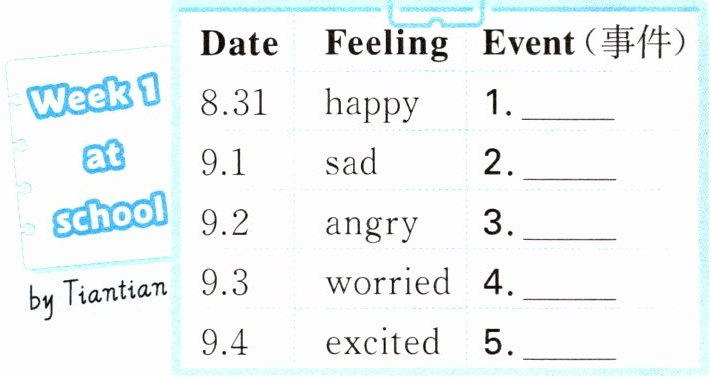
A. I join the school football team. Amazing!
B. I'm sick. I can't finish my homework.
C. Mia makes my book wet and doesn't say sorry.
D. It's rainy today. I can't fly a kite.
E. I make a new friend. We play together.
A. I join the school football team. Amazing!
B. I'm sick. I can't finish my homework.
C. Mia makes my book wet and doesn't say sorry.
D. It's rainy today. I can't fly a kite.
E. I make a new friend. We play together.
答案
1. E 2. D 3. C 4. B 5. A
解析
选项:
A. 我加入了学校足球队。太棒了!
B. 我生病了。我没法完成作业。
C. Mia 把我的书弄湿了,还不道歉。
D. 今天下雨。我不能放风筝了。
E. 我交了一个新朋友。我们一起玩。
分析:
1. happy(开心)对应一件让人愉快的事,故选 E。
2. sad(难过)对应一件让人失落的事,故选 D。
3. angry(生气)对应一件让人恼火的事,故选 C。
4. worried(担心)对应一件让人焦虑的事,故选 B。
5. excited(兴奋)对应一件让人激动的事,故选 A。
解析
选项:
A. 我加入了学校足球队。太棒了!
B. 我生病了。我没法完成作业。
C. Mia 把我的书弄湿了,还不道歉。
D. 今天下雨。我不能放风筝了。
E. 我交了一个新朋友。我们一起玩。
分析:
1. happy(开心)对应一件让人愉快的事,故选 E。
2. sad(难过)对应一件让人失落的事,故选 D。
3. angry(生气)对应一件让人恼火的事,故选 C。
4. worried(担心)对应一件让人焦虑的事,故选 B。
5. excited(兴奋)对应一件让人激动的事,故选 A。
三、校广播站开设了情绪科普栏目,向同学们传递情绪调节方法。请选词补全播音稿。
A. easy B. angry C. worried D. wrong E. sad
Today I want to talk about feelings. Our feelings often change. Don't think it's 1.
A. easy B. angry C. worried D. wrong E. sad
Today I want to talk about feelings. Our feelings often change. Don't think it's 1.
D
to have bad feelings. We can't always be happy. It's OK to feel 2. E
. Talk to our family or friends. If we keep thinking about unfinished(未完成的) things, we may be 3. C
. Stop thinking and just do it. When we feel 4. B
, our faces may feel hot. Count to ten first, and then talk. It's not always 5. A
to talk about feelings, but it can help us feel better.答案
1. D 2. E 3. C 4. B 5. A
解析
1. 句意:不要认为有坏情绪是________。
分析:下文说“我们不会总是开心。感到________也没关系”,说明这里是在纠正“有坏情绪是不对的”这种想法,故选 D。
2. 句意:感到________也没关系。和我们的家人、朋友聊一聊。
分析:前文提到“我们不会总是开心”,因此感到伤心是很正常的事情。这里指的是难过、低落的情绪,故选 E。
3. 句意:如果我们一直想着未完成的事,我们可能会________。
分析:一直想未完成的事会让人焦虑、担心,故选 C。
4. 句意:当我们感到________时,脸可能会发烫。先数到十,然后再说话。
分析:“脸发烫”是生气时的典型反应,故选 B。
5. 句意:谈论情绪并不总是________,但它能让我们感觉好一些。
分析:结合语境和转折词 but 可知,此处说谈论情绪并不总是容易的,故选 A。
解析
1. 句意:不要认为有坏情绪是________。
分析:下文说“我们不会总是开心。感到________也没关系”,说明这里是在纠正“有坏情绪是不对的”这种想法,故选 D。
2. 句意:感到________也没关系。和我们的家人、朋友聊一聊。
分析:前文提到“我们不会总是开心”,因此感到伤心是很正常的事情。这里指的是难过、低落的情绪,故选 E。
3. 句意:如果我们一直想着未完成的事,我们可能会________。
分析:一直想未完成的事会让人焦虑、担心,故选 C。
4. 句意:当我们感到________时,脸可能会发烫。先数到十,然后再说话。
分析:“脸发烫”是生气时的典型反应,故选 B。
5. 句意:谈论情绪并不总是________,但它能让我们感觉好一些。
分析:结合语境和转折词 but 可知,此处说谈论情绪并不总是容易的,故选 A。
四、你是“浓人”还是“淡人”?阅读文本,完成任务。
Everyone has the same feelings, like being happy, excited, sad, worried or angry. But we show them in two different ways. Some people have big reactions(反应). When they're excited, they jump and shout. You can see their feelings on their faces. Other people have small reactions. They keep their feelings inside. When they're hap- py, they smile a little. Even when they're angry, they just keep quiet. Both ways are OK. It's good to understand yourself and how others feel. Quiet doesn't mean sad!
任务一:判断句子正(T)误(F)。
(
(
(
任务二:你是如何表达情绪的?
I have
Everyone has the same feelings, like being happy, excited, sad, worried or angry. But we show them in two different ways. Some people have big reactions(反应). When they're excited, they jump and shout. You can see their feelings on their faces. Other people have small reactions. They keep their feelings inside. When they're hap- py, they smile a little. Even when they're angry, they just keep quiet. Both ways are OK. It's good to understand yourself and how others feel. Quiet doesn't mean sad!
任务一:判断句子正(T)误(F)。
(
T
)1. People show their feelings in different ways.(
F
)2. We can see all people's feelings on their faces.(
F
)3. It's better to show feelings with big reactions.任务二:你是如何表达情绪的?
I have
small
(big/small) reac- tions. When I'm happy
, I smile a little
.答案
任务一:1. T 2. F 3. F
任务二:
示例:small, happy, smile a little
解析
任务一:
1. 句意:人们用不同的方式表现情绪。
依据:But we show them in two different ways.
分析:原文明确提到我们用两种不同的方式表现情绪,故填 T。
2. 句意:我们能在脸上看出所有人的情绪。
依据:Some people have big reactions. ... You can see their feelings on their faces. Other people have small reactions. They keep their feelings inside.
分析:文中提到有些人情绪反应大,表现在脸上;但也有些人反应小,会把情绪藏在心里。因此,我们无法从所有人的脸上都看出情绪,故填 F。
3. 句意:用激烈的反应表达情绪更好。
依据:Both ways are OK.
分析:原文明确说明两种方式都可以,并没有说哪种方式更好,故填 F。
任务二:
这是一道开放性表达题,核心是结合文本内容,描述自己表达情绪的方式。先选 big 或 small,确定自己是“浓人”还是“淡人”;再选一种具体的情绪写出对应的行为反应,要和你选的 big/small 对应。
任务二:
示例:small, happy, smile a little
解析
任务一:
1. 句意:人们用不同的方式表现情绪。
依据:But we show them in two different ways.
分析:原文明确提到我们用两种不同的方式表现情绪,故填 T。
2. 句意:我们能在脸上看出所有人的情绪。
依据:Some people have big reactions. ... You can see their feelings on their faces. Other people have small reactions. They keep their feelings inside.
分析:文中提到有些人情绪反应大,表现在脸上;但也有些人反应小,会把情绪藏在心里。因此,我们无法从所有人的脸上都看出情绪,故填 F。
3. 句意:用激烈的反应表达情绪更好。
依据:Both ways are OK.
分析:原文明确说明两种方式都可以,并没有说哪种方式更好,故填 F。
任务二:
这是一道开放性表达题,核心是结合文本内容,描述自己表达情绪的方式。先选 big 或 small,确定自己是“浓人”还是“淡人”;再选一种具体的情绪写出对应的行为反应,要和你选的 big/small 对应。
