

 登录
登录
一、阅读短文,判断句子正(T)误(F)。
I'm Wu Binbin, a Grade Six student. I get 20 yuan pocket money every week. I write a spending plan every Sunday. I put my money in two boxes: one for spending and one for saving. I use some of the money to buy school things and snacks. I save the other money for a new storybook about the Monkey King. I never spend money on unnecessary toys. I think I manage money well.
(
(
(
(
(
I'm Wu Binbin, a Grade Six student. I get 20 yuan pocket money every week. I write a spending plan every Sunday. I put my money in two boxes: one for spending and one for saving. I use some of the money to buy school things and snacks. I save the other money for a new storybook about the Monkey King. I never spend money on unnecessary toys. I think I manage money well.
(
F
)1.Wu Binbin gets 20 yuan pocket money every month.(
T
)2.He writes a spending plan every Sunday.(
F
)3.He puts his money in three boxes.(
T
)4.He saves money for a new storybook about the Monkey King.(
T
)5.He never spends money on unnecessary toys.答案
1.F 2.T 3.F 4.T 5.T
解析
【分析】
本题为英语阅读判断正误题,解题思路是:先通读短文把握主旨,再针对每个小题的句子,定位短文中对应的关键信息,将句子与原文内容逐一比对,若完全一致则判断为正(T),若不一致则判断为误(F)。
【解析】
1. 定位原文“I get 20 yuan pocket money every week.”,题目中时间为“every month”,与原文不符,故判断为F。
2. 定位原文“I write a spending plan every Sunday.”,与题目表述一致,故判断为T。
3. 定位原文“I put my money in two boxes”,题目中数量为“three boxes”,与原文不符,故判断为F。
4. 定位原文“I save the other money for a new storybook about the Monkey King.”,与题目表述一致,故判断为T。
5. 定位原文“I never spend money on unnecessary toys.”,与题目表述一致,故判断为T。
【答案】
1.F 2.T 3.F 4.T 5.T
【知识点】
英语阅读理解、细节理解题
【点评】
本题是基础的英语阅读细节判断题,主要考查学生快速定位原文关键信息的能力,难度较低,只要仔细比对原文与题目内容即可准确判断。
【难度系数】
0.8
本题为英语阅读判断正误题,解题思路是:先通读短文把握主旨,再针对每个小题的句子,定位短文中对应的关键信息,将句子与原文内容逐一比对,若完全一致则判断为正(T),若不一致则判断为误(F)。
【解析】
1. 定位原文“I get 20 yuan pocket money every week.”,题目中时间为“every month”,与原文不符,故判断为F。
2. 定位原文“I write a spending plan every Sunday.”,与题目表述一致,故判断为T。
3. 定位原文“I put my money in two boxes”,题目中数量为“three boxes”,与原文不符,故判断为F。
4. 定位原文“I save the other money for a new storybook about the Monkey King.”,与题目表述一致,故判断为T。
5. 定位原文“I never spend money on unnecessary toys.”,与题目表述一致,故判断为T。
【答案】
1.F 2.T 3.F 4.T 5.T
【知识点】
英语阅读理解、细节理解题
【点评】
本题是基础的英语阅读细节判断题,主要考查学生快速定位原文关键信息的能力,难度较低,只要仔细比对原文与题目内容即可准确判断。
【难度系数】
0.8
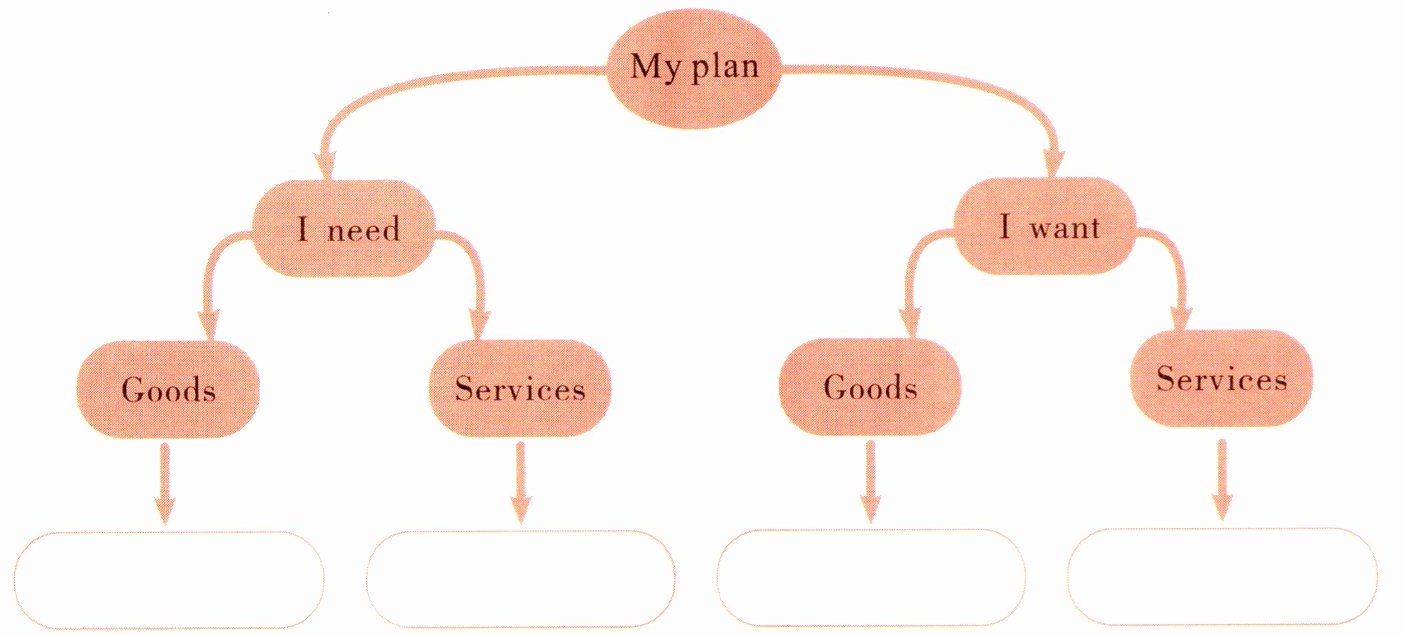
二、假如你有 150 元零花钱,你打算如何使用?请结合自身实际,完成导图,并写下你的使用计划。
I have 150 yuan. I put 50 yuan into my piggy bank.
Now I still have 100 yuan.
I'm going to buy ...
答案
导图填充内容(结合100元剩余预算分配)
1. I need分支下的Goods框:a set of stationery for my daily study, which costs 30 yuan
2. I need分支下的Services框:the bus fare to school for the next month, which costs 20 yuan
3. I want分支下的Goods框:a lovely comic book that I have been looking forward to for a long time, which costs 25 yuan
4. I want分支下的Services框:the admission ticket of the city science and technology museum, which costs 25 yuan
完整使用计划
I have 150 yuan. I put 50 yuan into my piggy bank.
Now I still have 100 yuan.
I'm going to spend the 100 yuan in a reasonable way: First, I will spend 30 yuan to buy a set of practical stationery that I need for my daily study, including notebooks and refills. Then I will pay 20 yuan for the bus fare to school for the next month, which is the necessary travel expense. For my personal little wishes, I will use 25 yuan to buy the interesting space-themed comic book I have wanted for a long time, and the remaining 25 yuan will be used to buy the admission ticket of the city science and technology museum, so I can visit the exhibition with my best friend on the weekend. This plan not only covers my necessary daily expenses, but also leaves room for my small hobbies and leisure activities.
1. I need分支下的Goods框:a set of stationery for my daily study, which costs 30 yuan
2. I need分支下的Services框:the bus fare to school for the next month, which costs 20 yuan
3. I want分支下的Goods框:a lovely comic book that I have been looking forward to for a long time, which costs 25 yuan
4. I want分支下的Services框:the admission ticket of the city science and technology museum, which costs 25 yuan
完整使用计划
I have 150 yuan. I put 50 yuan into my piggy bank.
Now I still have 100 yuan.
I'm going to spend the 100 yuan in a reasonable way: First, I will spend 30 yuan to buy a set of practical stationery that I need for my daily study, including notebooks and refills. Then I will pay 20 yuan for the bus fare to school for the next month, which is the necessary travel expense. For my personal little wishes, I will use 25 yuan to buy the interesting space-themed comic book I have wanted for a long time, and the remaining 25 yuan will be used to buy the admission ticket of the city science and technology museum, so I can visit the exhibition with my best friend on the weekend. This plan not only covers my necessary daily expenses, but also leaves room for my small hobbies and leisure activities.
解析
【分析】首先明确导图结构:总计划My plan分为“必要需求(I need)”和“想要的需求(I want)”,两类需求下分别对应“物品(Goods)”和“服务(Services)”。解题时需结合150元零花钱的实际使用,先预留部分储蓄,再为必要需求的物品、服务,以及想要需求的物品、服务分配合理金额,确保计划符合生活实际,兼顾必需支出和个人兴趣。
【解析】1. 导图填充:①I need分支Goods框填日常学习所需的一套实用文具(30元);②I need分支Services框填下月上学的公交费(20元);③I want分支Goods框填期待已久的主题漫画书(25元);④I want分支Services框填城市科技馆门票(25元)。2. 使用计划:先将150元中的50元存入储蓄罐,剩余100元按上述分配,兼顾必需支出和休闲需求。
【答案】导图填充内容:1. I need分支Goods:a set of stationery for my daily study, which costs 30 yuan;2. I need分支Services:the bus fare to school for the next month, which costs 20 yuan;3. I want分支Goods:a lovely comic book that I have been looking forward to for a long time, which costs 25 yuan;4. I want分支Services:the admission ticket of the city science and technology museum, which costs 25 yuan。完整使用计划:I have 150 yuan. I put 50 yuan into my piggy bank. Now I still have 100 yuan. I'm going to spend the 100 yuan in a reasonable way: First, I will spend 30 yuan to buy a set of practical stationery that I need for my daily study, including notebooks and refills. Then I will pay 20 yuan for the bus fare to school for the next month, which is the necessary travel expense. For my personal little wishes, I will use 25 yuan to buy the interesting space-themed comic book I have wanted for a long time, and the remaining 25 yuan will be used to buy the admission ticket of the city science and technology museum, so I can visit the exhibition with my best friend on the weekend. This plan not only covers my necessary daily expenses, but also leaves room for my small hobbies and leisure activities.
【知识点】合理消费规划、需求分类
【点评】本题结合学生日常零花钱使用场景,引导学生区分必要需求与想要需求,培养合理理财和规划能力,贴近生活实际,易于学生理解完成。
【难度系数】0.6
【解析】1. 导图填充:①I need分支Goods框填日常学习所需的一套实用文具(30元);②I need分支Services框填下月上学的公交费(20元);③I want分支Goods框填期待已久的主题漫画书(25元);④I want分支Services框填城市科技馆门票(25元)。2. 使用计划:先将150元中的50元存入储蓄罐,剩余100元按上述分配,兼顾必需支出和休闲需求。
【答案】导图填充内容:1. I need分支Goods:a set of stationery for my daily study, which costs 30 yuan;2. I need分支Services:the bus fare to school for the next month, which costs 20 yuan;3. I want分支Goods:a lovely comic book that I have been looking forward to for a long time, which costs 25 yuan;4. I want分支Services:the admission ticket of the city science and technology museum, which costs 25 yuan。完整使用计划:I have 150 yuan. I put 50 yuan into my piggy bank. Now I still have 100 yuan. I'm going to spend the 100 yuan in a reasonable way: First, I will spend 30 yuan to buy a set of practical stationery that I need for my daily study, including notebooks and refills. Then I will pay 20 yuan for the bus fare to school for the next month, which is the necessary travel expense. For my personal little wishes, I will use 25 yuan to buy the interesting space-themed comic book I have wanted for a long time, and the remaining 25 yuan will be used to buy the admission ticket of the city science and technology museum, so I can visit the exhibition with my best friend on the weekend. This plan not only covers my necessary daily expenses, but also leaves room for my small hobbies and leisure activities.
【知识点】合理消费规划、需求分类
【点评】本题结合学生日常零花钱使用场景,引导学生区分必要需求与想要需求,培养合理理财和规划能力,贴近生活实际,易于学生理解完成。
【难度系数】0.6
