

 登录
登录
Ⅰ. 选择与单词意思相符的图片,将序号填入括号内。
A
B
C
D

(
A
B
C
D
(
B
) 1. forest (D
) 2. river (C
) 3. lake (A
) 4. mountains答案
1. B 2. D 3. C 4. A
解析
1. “forest”意为森林,图片B展示的是一片有树木的区域,符合森林的特征。
2. “river”意为河流,图片D中有蜿蜒流动的水流,是河流的样子。
3. “lake”意为湖泊,图片C中有一大片水域,是湖泊的形态。
4. “mountains”意为山脉,图片A展示的是连绵的山峰,符合山脉的特点。
2. “river”意为河流,图片D中有蜿蜒流动的水流,是河流的样子。
3. “lake”意为湖泊,图片C中有一大片水域,是湖泊的形态。
4. “mountains”意为山脉,图片A展示的是连绵的山峰,符合山脉的特点。
1. ______ there ______ ______ in the park?
2. — Is there a river in the village? (作否定回答)
— ______.
3. There ______ a ______ over the lake.
Is
a
lake
2. — Is there a river in the village? (作否定回答)
— ______.
No, there isn't
3. There ______ a ______ over the lake.
is
bridge
答案
1. Is;a;lake
2. No;there;isn't
3. is;bridge
2. No;there;isn't
3. is;bridge
解析
1. 对于第一题,我们需要将陈述句改为一般疑问句。在英语中,将“There is”开头的句子改为一般疑问句时,我们需要将“is”提到“there”前面,其他部分保持不变。
2. 对于第二题,我们需要对一般疑问句进行否定回答。在英语中,对“Is there...?”的一般疑问句进行否定回答时,我们通常用“No, there isn't.”。
3. 对于第三题,我们需要用“there be”句型改写原句。原句中的“A bridge is over the lake”可以改写为“There is a bridge over the lake”,因为“there be”句型用于描述某处存在某物,且“a bridge”是单数,所以“be”动词用“is”。
2. 对于第二题,我们需要对一般疑问句进行否定回答。在英语中,对“Is there...?”的一般疑问句进行否定回答时,我们通常用“No, there isn't.”。
3. 对于第三题,我们需要用“there be”句型改写原句。原句中的“A bridge is over the lake”可以改写为“There is a bridge over the lake”,因为“there be”句型用于描述某处存在某物,且“a bridge”是单数,所以“be”动词用“is”。
Ⅲ. 看图,判断句子与图片提示是"T"否"F"相符。
(
(
(
(
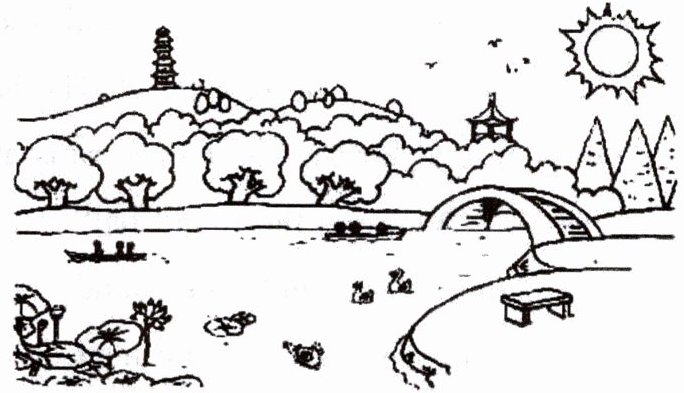
(
T
) 1. There is a lake in the park.(
F
) 2. There aren't any trees in the park.(
T
) 3. There are some boats in the park.(
T
) 4. There is a bridge in the park.答案
1. T
2. F
3. T
4. T
2. F
3. T
4. T
解析
1. 图中公园里有一个湖,与句子“There is a lake in the park.”相符,所以答案为T。
2. 图中公园里有很多树,与句子“There aren't any trees in the park.”不相符,所以答案为F。
3. 图中湖上有一些船,与句子“There are some boats in the park.”相符,所以答案为T。
4. 图中公园里有一座桥,与句子“There is a bridge in the park.”相符,所以答案为T。
2. 图中公园里有很多树,与句子“There aren't any trees in the park.”不相符,所以答案为F。
3. 图中湖上有一些船,与句子“There are some boats in the park.”相符,所以答案为T。
4. 图中公园里有一座桥,与句子“There is a bridge in the park.”相符,所以答案为T。
