

 登录
登录
四、Read and choose.(读一读,选择正确的答案。)
(
—Yes,
A. buying; I'd like to
B. to buy; I'd love to
(
A. get
B. got
(
A. have a big dinner
B. eat yuanxiao
(
—
A. Yes, we did.
B. No, we didn't.
(
B
)1. —Would you like to buy
flowers with us?—Yes,
I'd love to
.A. buying; I'd like to
B. to buy; I'd love to
(
B
)2. We got
lucky money from our relatives last Spring Festival.A. get
B. got
(
A
)3. People usually have a big dinner
at Christmas.A. have a big dinner
B. eat yuanxiao
(
B
)4. —Did you watch fireworks last Spring Festival Eve?—
No, we didn't.
We watched the Spring Festival Gala(春晚) at home.A. Yes, we did.
B. No, we didn't.
答案
1. B 2. B 3. A 4. B
解析
【分析】
1. 第1题:先回忆固定搭配“would like to do sth”(想要做某事),确定第一空用动词不定式;再牢记“Would you like...?”的常用肯定回答是“I'd love to”,据此选答案。
2. 第2题:看到时间状语“last Spring Festival(去年春节)”,判断句子需用一般过去时,动词要变过去式,据此选答案。
3. 第3题:区分节日习俗,明确圣诞节的传统活动,对比元宵对应的节日,结合语境选答案。
4. 第4题:根据问句是Did引导的一般过去时一般疑问句,结合答语“在家看春晚”的逻辑,确定是否定回答,据此选答案。
【解析】
1. 第一空:固定搭配“would like to do sth”要求用动词不定式,故填to buy;第二空:“Would you like...?”的肯定回答为“I'd love to”,因此选B。
2. 时间状语“last Spring Festival”表过去,句子需用一般过去时,get的过去式是got,故选B。
3. 圣诞节的习俗是“have a big dinner(吃大餐)”,yuanxiao是元宵节的特色食物,结合语境选A。
4. 问句是Did引导的一般过去时一般疑问句,答语提到“在家看春晚”,说明未看烟花,故用否定回答“No, we didn't”,选B。
【答案】1.B 2.B 3.A 4.B
【知识点】固定搭配、一般过去时、节日文化
【点评】本题考查英语基础语法和节日文化常识,题型为常见单项选择,侧重基础知识点的应用,难度适中。
【难度系数】0.7
1. 第1题:先回忆固定搭配“would like to do sth”(想要做某事),确定第一空用动词不定式;再牢记“Would you like...?”的常用肯定回答是“I'd love to”,据此选答案。
2. 第2题:看到时间状语“last Spring Festival(去年春节)”,判断句子需用一般过去时,动词要变过去式,据此选答案。
3. 第3题:区分节日习俗,明确圣诞节的传统活动,对比元宵对应的节日,结合语境选答案。
4. 第4题:根据问句是Did引导的一般过去时一般疑问句,结合答语“在家看春晚”的逻辑,确定是否定回答,据此选答案。
【解析】
1. 第一空:固定搭配“would like to do sth”要求用动词不定式,故填to buy;第二空:“Would you like...?”的肯定回答为“I'd love to”,因此选B。
2. 时间状语“last Spring Festival”表过去,句子需用一般过去时,get的过去式是got,故选B。
3. 圣诞节的习俗是“have a big dinner(吃大餐)”,yuanxiao是元宵节的特色食物,结合语境选A。
4. 问句是Did引导的一般过去时一般疑问句,答语提到“在家看春晚”,说明未看烟花,故用否定回答“No, we didn't”,选B。
【答案】1.B 2.B 3.A 4.B
【知识点】固定搭配、一般过去时、节日文化
【点评】本题考查英语基础语法和节日文化常识,题型为常见单项选择,侧重基础知识点的应用,难度适中。
【难度系数】0.7
五、Make sentences.(连词成句。)
1. do, What, you, do, Spring Festival, at, the (?)
2. have, big, We, a, dinner, together (.)
3. visit, I, will, my, grandparents (.)
4. is, the, Mid-Autumn Festival, When (?)
1. do, What, you, do, Spring Festival, at, the (?)
What do you do at the Spring Festival?
2. have, big, We, a, dinner, together (.)
We have a big dinner together.
3. visit, I, will, my, grandparents (.)
I will visit my grandparents.
4. is, the, Mid-Autumn Festival, When (?)
When is the Mid-Autumn Festival?
答案
1. What do you do at the Spring Festival? 2. We have a big dinner together.
3. I will visit my grandparents. 4. When is the Mid-Autumn Festival?
3. I will visit my grandparents. 4. When is the Mid-Autumn Festival?
解析
【分析】英语连词成句需遵循:1. 根据标点判断句子类型(问号为疑问句,句号为陈述句);2. 疑问句先找疑问词放句首,搭配助动词/be动词、主语等;陈述句先确定主语,再按“主语+谓语+宾语/状语”结构排列,注意固定短语搭配,句首单词首字母大写,句末标点正确。
【解析】1. 本题为特殊疑问句,疑问词What放句首,后接助动词do、主语you、谓语do,最后加固定短语at the Spring Festival,组合成句;2. 本题为陈述句,主语We放句首,后接谓语have、宾语a big dinner、状语together,组合成句;3. 本题为一般将来时陈述句,主语I放句首,后接助动词will、谓语visit、宾语my grandparents,组合成句;4. 本题为特殊疑问句,疑问词When放句首,后接be动词is、主语the Mid-Autumn Festival,组合成句。
【答案】1. What do you do at the Spring Festival? 2. We have a big dinner together. 3. I will visit my grandparents. 4. When is the Mid-Autumn Festival?
【知识点】英语连词成句,特殊疑问句,陈述句结构
【点评】本题考查基础英语句子结构与固定搭配,属于英语基础题型,帮助学生巩固句子组成规则,难度较低。
【难度系数】0.8
【解析】1. 本题为特殊疑问句,疑问词What放句首,后接助动词do、主语you、谓语do,最后加固定短语at the Spring Festival,组合成句;2. 本题为陈述句,主语We放句首,后接谓语have、宾语a big dinner、状语together,组合成句;3. 本题为一般将来时陈述句,主语I放句首,后接助动词will、谓语visit、宾语my grandparents,组合成句;4. 本题为特殊疑问句,疑问词When放句首,后接be动词is、主语the Mid-Autumn Festival,组合成句。
【答案】1. What do you do at the Spring Festival? 2. We have a big dinner together. 3. I will visit my grandparents. 4. When is the Mid-Autumn Festival?
【知识点】英语连词成句,特殊疑问句,陈述句结构
【点评】本题考查基础英语句子结构与固定搭配,属于英语基础题型,帮助学生巩固句子组成规则,难度较低。
【难度系数】0.8
六、Read and order.(读一读,给下列句子排序。)
(
(
(
(
(
(
(
2
)Hi, Tom! The Spring Festival is coming. Would you like to come to my home?(
3
)Thank you! I'd love to. What do you usually do at the Spring Festival?(
1
)Hello, Li Ming! What's up?(
5
)Great! See you then!(
4
)We clean the house, eat jiaozi and watch fireworks. We also visit relatives.(
6
)See you!答案
2 3 1 5 4 6
解析
【分析】首先梳理对话逻辑,这是一段关于春节邀请的日常交际对话。第一步,找到开启对话的问候句:“Hello, Li Ming! What's up?”是对话开头,对应排序1;第二步,承接问候并发出春节邀请的句子是“Hi, Tom! The Spring Festival is coming. Would you like to come to my home?”,对应排序2;第三步,对方接受邀请并询问春节活动的句子是“Thank you! I'd love to. What do you usually do at the Spring Festival?”,对应排序3;第四步,回答春节活动内容的句子是“We clean the house, eat jiaozi and watch fireworks. We also visit relatives.”,对应排序4;第五步,双方约定见面的句子是“Great! See you then!”,对应排序5;第六步,最后道别的句子是“See you!”,对应排序6。由此得出排序结果。
【解析】根据日常对话的逻辑顺序,先确定对话起始句为“Hello, Li Ming! What's up?”(排序1);接着承接该句的是发出邀请的“Hi, Tom! The Spring Festival is coming. Would you like to come to my home?”(排序2);然后是接受邀请并提问的“Thank you! I'd love to. What do you usually do at the Spring Festival?”(排序3);再是回答春节活动的“We clean the house, eat jiaozi and watch fireworks. We also visit relatives.”(排序4);之后是约定见面的“Great! See you then!”(排序5);最后是道别的“See you!”(排序6)。因此排序为2 3 1 5 4 6。
【答案】2 3 1 5 4 6
【知识点】英语日常对话排序;情景交际用语
【点评】本题考查英语情景对话的逻辑排序,需要学生掌握日常交际的上下文承接关系,属于基础题型,能帮助学生巩固日常用语的运用。
【难度系数】0.5
【解析】根据日常对话的逻辑顺序,先确定对话起始句为“Hello, Li Ming! What's up?”(排序1);接着承接该句的是发出邀请的“Hi, Tom! The Spring Festival is coming. Would you like to come to my home?”(排序2);然后是接受邀请并提问的“Thank you! I'd love to. What do you usually do at the Spring Festival?”(排序3);再是回答春节活动的“We clean the house, eat jiaozi and watch fireworks. We also visit relatives.”(排序4);之后是约定见面的“Great! See you then!”(排序5);最后是道别的“See you!”(排序6)。因此排序为2 3 1 5 4 6。
【答案】2 3 1 5 4 6
【知识点】英语日常对话排序;情景交际用语
【点评】本题考查英语情景对话的逻辑排序,需要学生掌握日常交际的上下文承接关系,属于基础题型,能帮助学生巩固日常用语的运用。
【难度系数】0.5
七、Read and finish.(读一读,完成表格。)
Last Spring Festival, Li Ming went to his grandparents' home with his parents. They cleaned the house and put up Spring Festival couplets together. On the eve, they had a big dinner. His grandma made jiaozi. They were very delicious! After dinner, they watched fireworks outside. Li Ming got lucky money from his grandparents. He was so happy.
This year, the Spring Festival will be in February. Li Ming will help his mum do some shopping. He will also visit his uncle and aunt with his family. They will eat jiaozi again and watch the Spring Festival Gala on TV. Li Ming thinks they will have a wonderful time.
| | Last Spring Festival | This Spring Festival |
| --- | --- | --- |
| Time | | 1.
| Before the festival | cleaned the house, 2.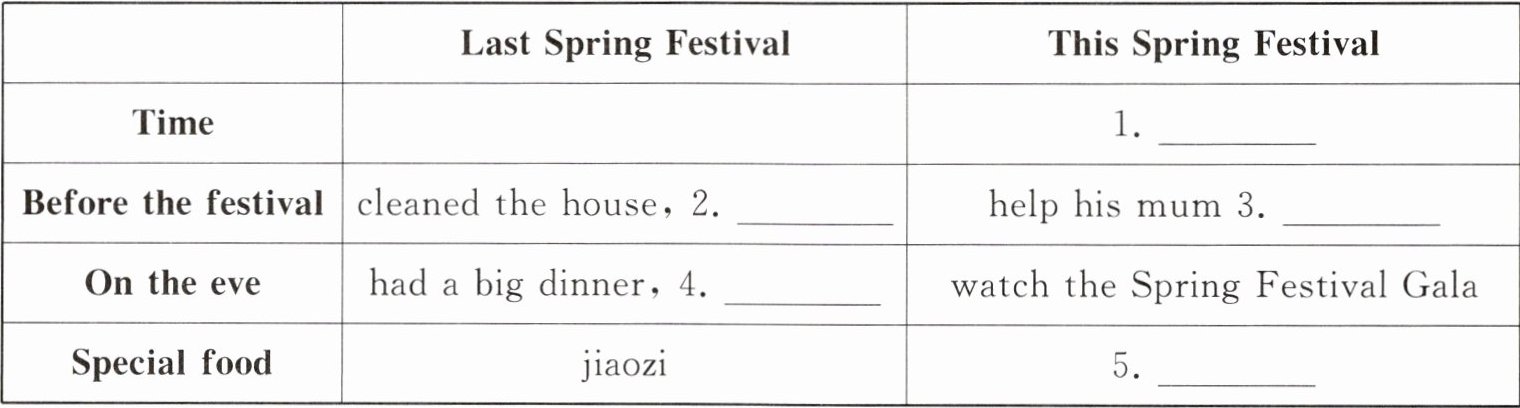 | help his mum 3.
| On the eve | had a big dinner, 4.
| Special food | jiaozi | 5.
Last Spring Festival, Li Ming went to his grandparents' home with his parents. They cleaned the house and put up Spring Festival couplets together. On the eve, they had a big dinner. His grandma made jiaozi. They were very delicious! After dinner, they watched fireworks outside. Li Ming got lucky money from his grandparents. He was so happy.
This year, the Spring Festival will be in February. Li Ming will help his mum do some shopping. He will also visit his uncle and aunt with his family. They will eat jiaozi again and watch the Spring Festival Gala on TV. Li Ming thinks they will have a wonderful time.
| | Last Spring Festival | This Spring Festival |
| --- | --- | --- |
| Time | | 1.
in February
|| Before the festival | cleaned the house, 2.
| help his mum 3. do some shopping
|| On the eve | had a big dinner, 4.
watched fireworks
| watch the Spring Festival Gala || Special food | jiaozi | 5.
jiaozi
|答案
1. in February 2. put up Spring Festival couplets
3. do some shopping 4. watched fireworks 5. jiaozi
3. do some shopping 4. watched fireworks 5. jiaozi
解析
【分析】
本题为阅读理解信息匹配题,需根据短文内容,提取对应Last Spring Festival和This Spring Festival的相关信息,填入表格空缺处。解题时,先明确每个空对应的类别(时间、节前活动、除夕活动、特色食物),再在短文中定位对应节日的相关描述,找到匹配内容即可。
【解析】
1. 对应This Spring Festival的时间,从短文第二段第一句“This year, the Spring Festival will be in February.”提取,故填in February;
2. 对应Last Spring Festival节前的活动,从短文第一段第二句“They cleaned the house and put up Spring Festival couplets together.”提取,故填put up Spring Festival couplets;
3. 对应This Spring Festival帮妈妈做的事,从短文第二段第二句“Li Ming will help his mum do some shopping.”提取,故填do some shopping;
4. 对应Last Spring Festival除夕的活动,从短文第一段第四、五句“On the eve, they had a big dinner... After dinner, they watched fireworks outside.”提取,故填watched fireworks;
5. 对应This Spring Festival的特色食物,从短文第二段最后一句“They will eat jiaozi again...”提取,故填jiaozi。
【答案】
1. in February 2. put up Spring Festival couplets 3. do some shopping 4. watched fireworks 5. jiaozi
【知识点】
阅读理解信息提取;节日话题
【点评】
本题围绕春节活动展开,考查学生从短文中定位并提取关键信息的能力,贴近生活,难度适中,仔细阅读短文即可完成。
【难度系数】
0.6
本题为阅读理解信息匹配题,需根据短文内容,提取对应Last Spring Festival和This Spring Festival的相关信息,填入表格空缺处。解题时,先明确每个空对应的类别(时间、节前活动、除夕活动、特色食物),再在短文中定位对应节日的相关描述,找到匹配内容即可。
【解析】
1. 对应This Spring Festival的时间,从短文第二段第一句“This year, the Spring Festival will be in February.”提取,故填in February;
2. 对应Last Spring Festival节前的活动,从短文第一段第二句“They cleaned the house and put up Spring Festival couplets together.”提取,故填put up Spring Festival couplets;
3. 对应This Spring Festival帮妈妈做的事,从短文第二段第二句“Li Ming will help his mum do some shopping.”提取,故填do some shopping;
4. 对应Last Spring Festival除夕的活动,从短文第一段第四、五句“On the eve, they had a big dinner... After dinner, they watched fireworks outside.”提取,故填watched fireworks;
5. 对应This Spring Festival的特色食物,从短文第二段最后一句“They will eat jiaozi again...”提取,故填jiaozi。
【答案】
1. in February 2. put up Spring Festival couplets 3. do some shopping 4. watched fireworks 5. jiaozi
【知识点】
阅读理解信息提取;节日话题
【点评】
本题围绕春节活动展开,考查学生从短文中定位并提取关键信息的能力,贴近生活,难度适中,仔细阅读短文即可完成。
【难度系数】
0.6
