

 登录
阅读短文,从方框内所列选项中,选出最佳选项填入对应空白处,使短文通顺、连贯。(选项中有一项多余)
Most people who move to a foreign country may experience a period of time when they feel very homesick and have a lot of stress. This feeling is often called "culture shock". 31
Generally speaking,there are four stages you'll experience if you move to a foreign country. 32 When arriving in a new environment,you'll be interested in the new culture. Everything will seem exciting. Everyone will seem friendly and helpful.
But it isn't long before this stage moves into the next stage. The excitement you felt before changes into stress. It seems that everything is difficult. The language is hard to learn,friends are difficult to make,and even simple things like shopping are challenges. 33 This is the stage which is called as "culture shock".
34 If you manage to go through,then you'll move into the "recovery" stage. At this point,you start to understand and accept the way people behave in your new environment.
The last stage is the "home" stage. 35 And you start to learn from your new home,and prefer certain aspects of the new culture to your own culture.
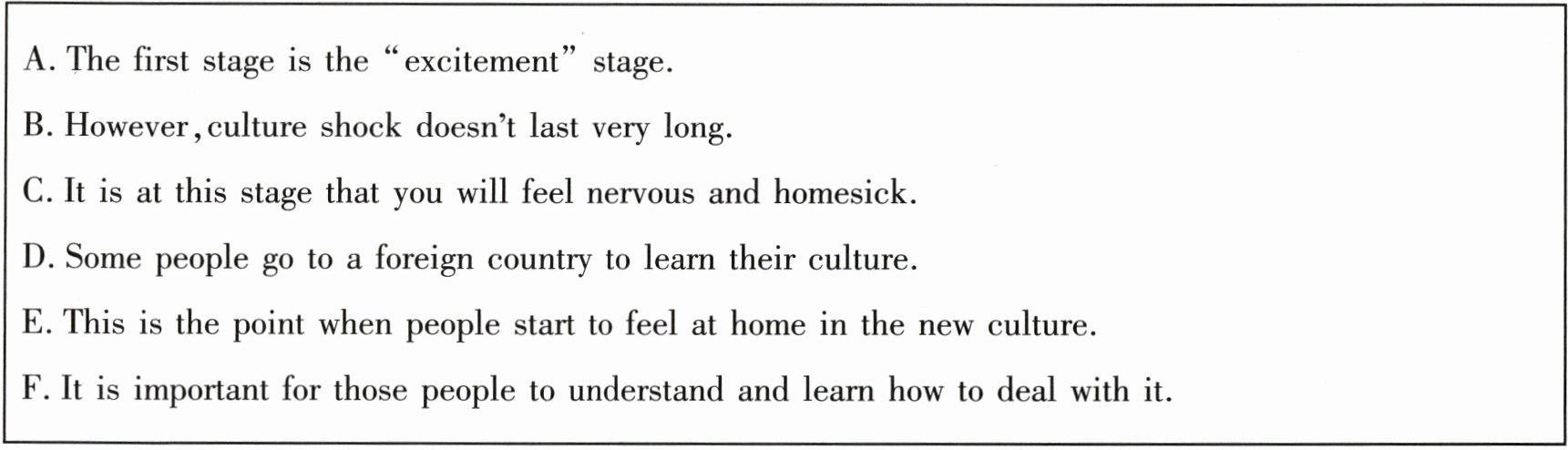
31.
Most people who move to a foreign country may experience a period of time when they feel very homesick and have a lot of stress. This feeling is often called "culture shock". 31
Generally speaking,there are four stages you'll experience if you move to a foreign country. 32 When arriving in a new environment,you'll be interested in the new culture. Everything will seem exciting. Everyone will seem friendly and helpful.
But it isn't long before this stage moves into the next stage. The excitement you felt before changes into stress. It seems that everything is difficult. The language is hard to learn,friends are difficult to make,and even simple things like shopping are challenges. 33 This is the stage which is called as "culture shock".
34 If you manage to go through,then you'll move into the "recovery" stage. At this point,you start to understand and accept the way people behave in your new environment.
The last stage is the "home" stage. 35 And you start to learn from your new home,and prefer certain aspects of the new culture to your own culture.
31.
F
32. A
33. C
34. B
35. E
答案
31. F 32. A 33. C 34. B 35. E
解析
【分析】
解题思路:首先通读短文,明确全文围绕“文化冲击的四个阶段”展开;再逐个分析空白处的上下文语境,结合选项的语义和逻辑衔接关系匹配对应选项:31题需承接前文的“文化冲击”,32题需对应阶段介绍的第一个阶段,33题需承接压力期的情绪表现,34题需衔接文化冲击与下一阶段的转折关系,35题需对应最后阶段的归属感特点。
【解析】
1. 31题:前文指出“这种感觉叫文化冲击”,F选项“对那些人来说,理解并学会处理它很重要”,承接前文的“文化冲击”,引出下文对文化冲击阶段的介绍,符合语境,故选F。
2. 32题:前文提到“你会经历四个阶段”,后文描述“兴奋阶段”的表现,A选项“第一个阶段是‘兴奋’阶段”,对应前后的阶段介绍,逻辑连贯,故选A。
3. 33题:前文讲兴奋期转为压力期(语言难学、交友难等),C选项“在这个阶段你会感到紧张和想家”,承接压力期的情绪感受,且后文提到“这就是文化冲击阶段”,符合语境,故选C。
4. 34题:前文介绍文化冲击阶段,后文说“如果度过就进入恢复阶段”,B选项“然而,文化冲击不会持续很久”,转折衔接,说明文化冲击的短暂,引出下一个阶段,逻辑合理,故选B。
5. 35题:前文提到最后一个阶段是“家”阶段,E选项“这是人们开始在新文化里有归属感的时刻”,对应“家”阶段的特点,符合语境,故选E。
【答案】
31.F 32.A 33.C 34.B 35.E
【知识点】
英语七选五阅读、语篇逻辑衔接、文化常识
【点评】
本题为英语七选五题型,围绕“文化冲击的四个阶段”命题,需结合上下文语境和逻辑关系匹配选项,考察学生的语篇理解与逻辑衔接能力,难度适中。
【难度系数】
0.6
