

 登录
D
How I study English
I often hear some students say English is difficult, and it gives them a headache. So they can't learn it well. But English is very easy for me. I'm good at it. I'm very glad to tell you something about how I study English.
First, I think an interest in English is very important. When I was in Grade One, we had a new subject—English. It was fresh for me. I was interested in it, so I worked hard at it. Soon we had an English exam and I got a very good mark. How happy I was! After that, I learned English harder and harder.
Our English teacher often teaches us English songs. The songs sound nice. I often think how interesting English is!
Second, I think English is a foreign language. I should learn it well in the following ways: Listen to the teacher carefully, speak bravely, read aloud and have a good vocabulary(词汇). Then practice again and again, never be tired. And I also have a good habit: Asking whenever I have a question, I must make it clear by asking our English teacher. How happy I am when I understand!
Besides this, I often read English stories, jokes and easy novels. From these I know English is not only interesting, but also useful. They help me understand a lot of things. So to do more reading is an important way to learn English well.
And I also do some exercises from our class magazines, and I often write English diaries. English has become a close friend of mine.
Now I have learned English for more than two years. I always keep the first position in our school. From these words, I hope every student can learn English well.
(
A. Because they are easy to catch a cold.
B. Because it's often very cold.
C. Because they don't think English is easy.
(
A. excited
B. interested
C. quiet
(
A. I got a good way
B. I had a good idea
C. I did well in the exam
(
A. Speaking bravely.
B. Writing to foreign friends.
C. Reading aloud.
第二节(共5小题;每小题2分,满分10分)
阅读下面短文,从短文后的选项中选出可以填入空白处的最佳选项。选项中有一项为多余选项。
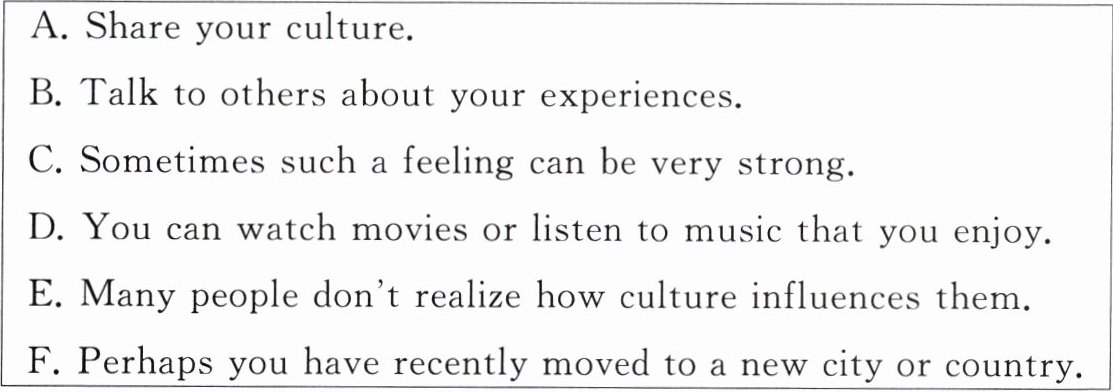
Culture shock is the feeling of uncertainty, confusion, or anxiety that people may get when they live in or visit another country that differs from their own. 36.
Have a good understanding of culture and culture shock. There are many factors that make up a culture, including shared beliefs, traditions and morals. 37.
Keep a journal(日记) of your thoughts. 38.
Do some things you usually like. Don't allow the culture shock to occupy your mind. And try to do something interesting to replace a range of negative emotions, including anxiety, sadness, anger, homesickness, and sometimes even depression. 40.
How I study English
I often hear some students say English is difficult, and it gives them a headache. So they can't learn it well. But English is very easy for me. I'm good at it. I'm very glad to tell you something about how I study English.
First, I think an interest in English is very important. When I was in Grade One, we had a new subject—English. It was fresh for me. I was interested in it, so I worked hard at it. Soon we had an English exam and I got a very good mark. How happy I was! After that, I learned English harder and harder.
Our English teacher often teaches us English songs. The songs sound nice. I often think how interesting English is!
Second, I think English is a foreign language. I should learn it well in the following ways: Listen to the teacher carefully, speak bravely, read aloud and have a good vocabulary(词汇). Then practice again and again, never be tired. And I also have a good habit: Asking whenever I have a question, I must make it clear by asking our English teacher. How happy I am when I understand!
Besides this, I often read English stories, jokes and easy novels. From these I know English is not only interesting, but also useful. They help me understand a lot of things. So to do more reading is an important way to learn English well.
And I also do some exercises from our class magazines, and I often write English diaries. English has become a close friend of mine.
Now I have learned English for more than two years. I always keep the first position in our school. From these words, I hope every student can learn English well.
(
C
)32. Why do some students often "have a headache"?A. Because they are easy to catch a cold.
B. Because it's often very cold.
C. Because they don't think English is easy.
(
B
)33. The writer tells us that we should be B
in English if we want to learn it well.A. excited
B. interested
C. quiet
(
C
)34. The sentence "I got a very good mark" means "C
".A. I got a good way
B. I had a good idea
C. I did well in the exam
(
B
)35. Which of the following is NOT the way the writer studies by?A. Speaking bravely.
B. Writing to foreign friends.
C. Reading aloud.
第二节(共5小题;每小题2分,满分10分)
阅读下面短文,从短文后的选项中选出可以填入空白处的最佳选项。选项中有一项为多余选项。
Culture shock is the feeling of uncertainty, confusion, or anxiety that people may get when they live in or visit another country that differs from their own. 36.
C
It can undoubtedly influence people's lives. The following are some ways to deal with culture shock.Have a good understanding of culture and culture shock. There are many factors that make up a culture, including shared beliefs, traditions and morals. 37.
E
It's because they are surrounded by people with the same beliefs and values, and cultural differences are only clear when you meet someone else's culture.Keep a journal(日记) of your thoughts. 38.
F
And you are feeling a bit overwhelmed(不知所措的) with the culture there. Rather than giving in to your anxiety, write it out. Write down how you felt at the moment and what troubled you or made you happy that day. You can also put something down if you're missing anyone from your hometown. 39. B
Don't allow yourself to become a recluse(隐居者) during this experience. You can share your feelings and experiences with your relatives and friends. If you are studying abroad and have other classmates who have similar feelings, connect with them as well as with those who are adjusting a bit more easily.Do some things you usually like. Don't allow the culture shock to occupy your mind. And try to do something interesting to replace a range of negative emotions, including anxiety, sadness, anger, homesickness, and sometimes even depression. 40.
D
Or practice your hobbies like reading and dancing.答案
32. C 33. B 34. C 35. B 36. C 37. E 38. F 39. B 40. D
