

 登录
登录
Ⅱ. 根据所给场景和词语提示,用 should/could/shouldn't补全对话。
1. —I often have a stomachache.
—You ___ so much hot food. (eat)
2. —I feel too tired, dad.
—You ___ a rest to relax yourself. (have)
3. —Mom, I'm going to school now.
—It’s raining outside. I think you ___ an umbrella. (take)
4. —My little son doesn't like vegetables and fruit.
—You ___ making a fruit salad or vegetable soup. (try)
5. —I can't sleep well at night.
—You ___ coffee before bedtime. (drink)
1. —I often have a stomachache.
—You ___ so much hot food. (eat)
2. —I feel too tired, dad.
—You ___ a rest to relax yourself. (have)
3. —Mom, I'm going to school now.
—It’s raining outside. I think you ___ an umbrella. (take)
4. —My little son doesn't like vegetables and fruit.
—You ___ making a fruit salad or vegetable soup. (try)
5. —I can't sleep well at night.
—You ___ coffee before bedtime. (drink)
答案
1. shouldn't eat 2. should have
3. should take 4. could try
5. shouldn't drink
3. should take 4. could try
5. shouldn't drink
解析
【分析】
解题思路:先通读每个对话,理解对话场景和说话人的需求,判断需要使用肯定建议(should)、否定建议(shouldn't)还是委婉建议(could),再结合括号内的动词,注意情态动词后接动词原形,从而补全对话。
1. 对方常胃疼,需给出否定建议;2. 对方太累,需给出肯定建议;3. 外面下雨,需给出带伞的肯定建议;4. 孩子不喜欢蔬果,需给出委婉的尝试建议;5. 睡不好,需给出不喝咖啡的否定建议。
【解析】
1. 对话中提到“经常胃疼”,说明吃太多辣的是诱因,应使用否定建议的情态动词shouldn't,后接动词原形eat,故填shouldn't eat;
2. 对方说“太累”,需要休息放松,应使用肯定建议的情态动词should,后接动词原形have,故填should have;
3. 场景是“外面下雨”,提醒对方带伞,应使用肯定建议的情态动词should,后接动词原形take,故填should take;
4. 对方说儿子不喜欢蔬果,为引导孩子接受,应使用委婉建议的情态动词could,后接动词原形try,故填could try;
5. 对方说“睡不好”,睡前喝咖啡会影响睡眠,应使用否定建议的情态动词shouldn't,后接动词原形drink,故填shouldn't drink。
【答案】
1. shouldn't eat 2. should have 3. should take 4. could try 5. shouldn't drink
【知识点】
情态动词用法;日常建议表达
【点评】
本题围绕日常场景考查情态动词在建议中的运用,需结合语境判断建议类型,属于基础知识点,难度较低,可巩固情态动词的用法。
【难度系数】
0.8
解题思路:先通读每个对话,理解对话场景和说话人的需求,判断需要使用肯定建议(should)、否定建议(shouldn't)还是委婉建议(could),再结合括号内的动词,注意情态动词后接动词原形,从而补全对话。
1. 对方常胃疼,需给出否定建议;2. 对方太累,需给出肯定建议;3. 外面下雨,需给出带伞的肯定建议;4. 孩子不喜欢蔬果,需给出委婉的尝试建议;5. 睡不好,需给出不喝咖啡的否定建议。
【解析】
1. 对话中提到“经常胃疼”,说明吃太多辣的是诱因,应使用否定建议的情态动词shouldn't,后接动词原形eat,故填shouldn't eat;
2. 对方说“太累”,需要休息放松,应使用肯定建议的情态动词should,后接动词原形have,故填should have;
3. 场景是“外面下雨”,提醒对方带伞,应使用肯定建议的情态动词should,后接动词原形take,故填should take;
4. 对方说儿子不喜欢蔬果,为引导孩子接受,应使用委婉建议的情态动词could,后接动词原形try,故填could try;
5. 对方说“睡不好”,睡前喝咖啡会影响睡眠,应使用否定建议的情态动词shouldn't,后接动词原形drink,故填shouldn't drink。
【答案】
1. shouldn't eat 2. should have 3. should take 4. could try 5. shouldn't drink
【知识点】
情态动词用法;日常建议表达
【点评】
本题围绕日常场景考查情态动词在建议中的运用,需结合语境判断建议类型,属于基础知识点,难度较低,可巩固情态动词的用法。
【难度系数】
0.8
Ⅲ. 从方框中选择合适的句子,完成对话。有一个选项多余。
Doctor: Good morning, David. Please have a seat. 1
David: Not very well, doctor. I have a sore throat and a bad cough.
Doctor: Let me check your throat... Yes, it's quite red. Do you have a fever?
David: I think so. 2 I also have a headache.
Doctor: I see. Let me take your temperature... It's a bit high.
David: I started feeling like this two days ago. I'm so tired and can't sleep well.
Doctor: We'll do a flu test, but I believe you have a fever.
David: What should I do?
Doctor: 3 I’ll give you some medicine for the fever and the cough.
Doctor: No, you should rest at home. You'd better wear a mask when you're outside. 4 David: Thank you, doctor. Can I go to school tomorrow?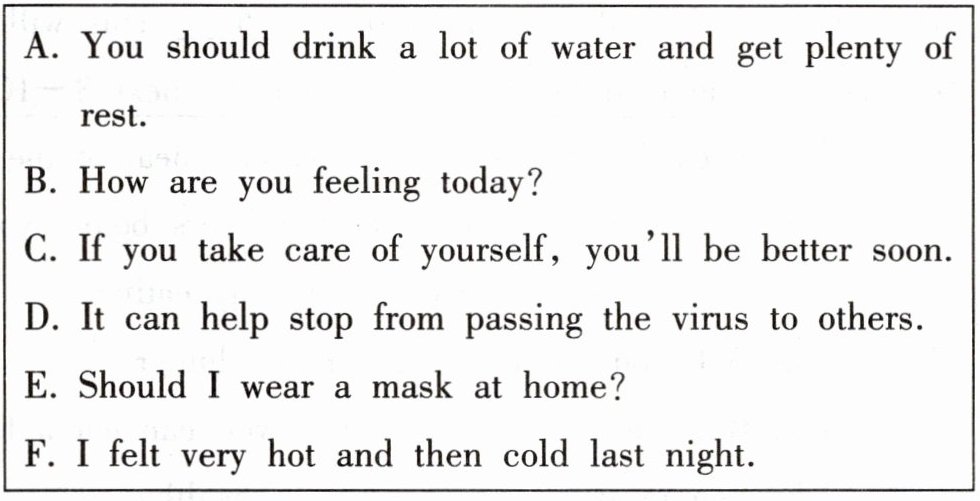
David: Sure, I will.
Doctor: 5
1. ___ 2. ___ 3. ___ 4. ___ 5. ___
Doctor: Good morning, David. Please have a seat. 1
David: Not very well, doctor. I have a sore throat and a bad cough.
Doctor: Let me check your throat... Yes, it's quite red. Do you have a fever?
David: I think so. 2 I also have a headache.
Doctor: I see. Let me take your temperature... It's a bit high.
David: I started feeling like this two days ago. I'm so tired and can't sleep well.
Doctor: We'll do a flu test, but I believe you have a fever.
David: What should I do?
Doctor: 3 I’ll give you some medicine for the fever and the cough.
Doctor: No, you should rest at home. You'd better wear a mask when you're outside. 4 David: Thank you, doctor. Can I go to school tomorrow?
David: Sure, I will.
Doctor: 5
1. ___ 2. ___ 3. ___ 4. ___ 5. ___
答案
1.B 2.F 3.A 4.D 5.C
解析
【分析】
这是一道就医场景的补全对话题,需结合上下文的问答逻辑、语境含义选择合适句子,步骤如下:
1. 第1空:医生请David坐下后询问身体状况,对应答语"Not very well",需选询问身体感受的句子;
2. 第2空:医生问是否发烧,David确认后需补充发烧的具体症状,选描述发烧表现的句子;
3. 第3空:David问该怎么做,医生需给出合理建议,选提建议的句子;
4. 第4空:医生提到戴口罩,需说明戴口罩的作用,选解释戴口罩意义的句子;
5. 第5空:对话结尾医生需鼓励David,选表达鼓励的句子。
【解析】
1. 第1空:根据答语"Not very well, doctor."可知,医生询问David的身体感受,B选项"How are you feeling today?"符合语境;
2. 第2空:医生问是否发烧,David回答后补充发烧时的冷热症状,F选项"I felt very hot and then cold last night."符合语境;
3. 第3空:David问"What should I do?",医生需给出建议,A选项"You should drink a lot of water and get plenty of rest."是合理建议;
4. 第4空:医生提到"wear a mask",D选项"It can help stop from passing the virus to others."解释戴口罩的作用,符合语境;
5. 第5空:对话结尾医生鼓励David,C选项"If you take care of yourself, you'll be better soon."符合语境。
【答案】
1.B 2.F 3.A 4.D 5.C
【知识点】
补全对话、日常交际用语、就医场景
【点评】
本题为基础情景补全对话,围绕就医场景展开,考查学生对日常交际用语的掌握,需结合上下文逻辑选择句子,难度适中。
【难度系数】
0.6
这是一道就医场景的补全对话题,需结合上下文的问答逻辑、语境含义选择合适句子,步骤如下:
1. 第1空:医生请David坐下后询问身体状况,对应答语"Not very well",需选询问身体感受的句子;
2. 第2空:医生问是否发烧,David确认后需补充发烧的具体症状,选描述发烧表现的句子;
3. 第3空:David问该怎么做,医生需给出合理建议,选提建议的句子;
4. 第4空:医生提到戴口罩,需说明戴口罩的作用,选解释戴口罩意义的句子;
5. 第5空:对话结尾医生需鼓励David,选表达鼓励的句子。
【解析】
1. 第1空:根据答语"Not very well, doctor."可知,医生询问David的身体感受,B选项"How are you feeling today?"符合语境;
2. 第2空:医生问是否发烧,David回答后补充发烧时的冷热症状,F选项"I felt very hot and then cold last night."符合语境;
3. 第3空:David问"What should I do?",医生需给出建议,A选项"You should drink a lot of water and get plenty of rest."是合理建议;
4. 第4空:医生提到"wear a mask",D选项"It can help stop from passing the virus to others."解释戴口罩的作用,符合语境;
5. 第5空:对话结尾医生鼓励David,C选项"If you take care of yourself, you'll be better soon."符合语境。
【答案】
1.B 2.F 3.A 4.D 5.C
【知识点】
补全对话、日常交际用语、就医场景
【点评】
本题为基础情景补全对话,围绕就医场景展开,考查学生对日常交际用语的掌握,需结合上下文逻辑选择句子,难度适中。
【难度系数】
0.6
