

 登录
登录
Ⅱ. Read and write. 读一读,用单词的正确形式填空。
door put child come wake
The Spring Festival is an important holiday in our country. It is up. On Chinese New Year’s Eve, we up Spring Festival couplets on the . We stay up late and welcome the new year. In the morning, my sister always up early and visits our family. She wants to get lucky money to help in need.
door put child come wake
The Spring Festival is an important holiday in our country. It is up. On Chinese New Year’s Eve, we up Spring Festival couplets on the . We stay up late and welcome the new year. In the morning, my sister always up early and visits our family. She wants to get lucky money to help in need.
答案
coming; put; door; wakes; children
解析
我们结合句意、固定搭配和语法规则逐个分析:
1. 第一空:句子表达春节即将到来,"come up"有“到来、临近”的含义,空前有be动词is,此处用现在进行时表将来,需要把come变为现在分词coming。
2. 第二空:"put up Spring Festival couplets"是固定搭配,意为“贴春联”,主语we是第一人称复数,句子为一般现在时,谓语动词用原形put。
3. 第三空:句意为把春联贴在门上,空前有定冠词the,后面接名词door即可。
4. 第四空:"wake up"是固定搭配,意为“醒来”,主语my sister是第三人称单数,由always可知句子是一般现在时,谓语动词要变为第三人称单数形式wakes。
5. 第五空:句意为她想用压岁钱帮助有需要的孩子们,此处要用child的复数形式children表示多个孩子。
1. 第一空:句子表达春节即将到来,"come up"有“到来、临近”的含义,空前有be动词is,此处用现在进行时表将来,需要把come变为现在分词coming。
2. 第二空:"put up Spring Festival couplets"是固定搭配,意为“贴春联”,主语we是第一人称复数,句子为一般现在时,谓语动词用原形put。
3. 第三空:句意为把春联贴在门上,空前有定冠词the,后面接名词door即可。
4. 第四空:"wake up"是固定搭配,意为“醒来”,主语my sister是第三人称单数,由always可知句子是一般现在时,谓语动词要变为第三人称单数形式wakes。
5. 第五空:句意为她想用压岁钱帮助有需要的孩子们,此处要用child的复数形式children表示多个孩子。
Ⅲ. Read and choose. 读一读,补全对话。
Hello! 1.
Hi! My favourite festival is the Dragon Boat Festival.
Really? When is this festival?
2.
What do people usually do during the festival?
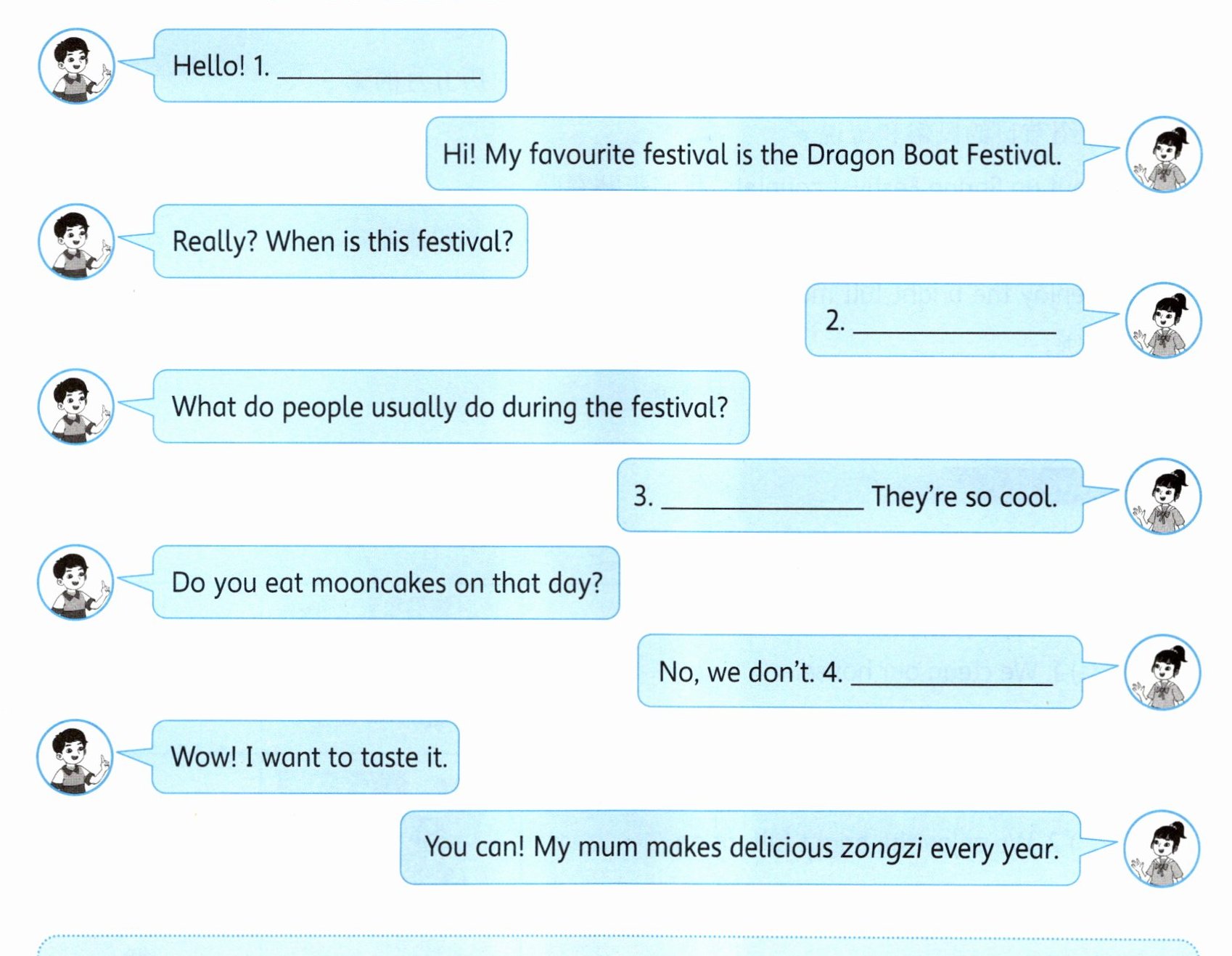 3. They’re so cool.
Do you eat mooncakes on that day?
No, we don’t. 4.
Wow! I want to taste it.
You can! My mum makes delicious zongzi every year.
A. We have exciting dragon boat races.
B. We eat yummy zongzi.
C. What’s your favourite Chinese festival?
D. It’s on the fifth day of the fifth lunar month.
Hello! 1.
Hi! My favourite festival is the Dragon Boat Festival.
Really? When is this festival?
2.
What do people usually do during the festival?
3. They’re so cool.Do you eat mooncakes on that day?
No, we don’t. 4.
Wow! I want to taste it.
You can! My mum makes delicious zongzi every year.
A. We have exciting dragon boat races.
B. We eat yummy zongzi.
C. What’s your favourite Chinese festival?
D. It’s on the fifth day of the fifth lunar month.
答案
1. C 2. D 3. A 4. B
解析
我们根据对话上下文的逻辑逐一匹配选项:
1. 空后的答句回答了自己最喜欢的节日,对应C选项“你最喜欢的中国节日是什么?”,符合提问逻辑。
2. 空前的问句询问端午节的时间,对应D选项“它在农历五月初五”,是对节日日期的正确回应。
3. 空前的问句询问节日期间的活动,后文的"They"指代复数事物,对应A选项“我们举办精彩的龙舟比赛”,符合语境。
4. 空前说明端午节不吃月饼,后文提到想要尝一尝相关食物,对应B选项“我们吃美味的粽子”,和后文提到的zongzi形成呼应。
1. 空后的答句回答了自己最喜欢的节日,对应C选项“你最喜欢的中国节日是什么?”,符合提问逻辑。
2. 空前的问句询问端午节的时间,对应D选项“它在农历五月初五”,是对节日日期的正确回应。
3. 空前的问句询问节日期间的活动,后文的"They"指代复数事物,对应A选项“我们举办精彩的龙舟比赛”,符合语境。
4. 空前说明端午节不吃月饼,后文提到想要尝一尝相关食物,对应B选项“我们吃美味的粽子”,和后文提到的zongzi形成呼应。
