

 登录
登录
一、听录音,圈出与所听内容相符的图片。
1. A.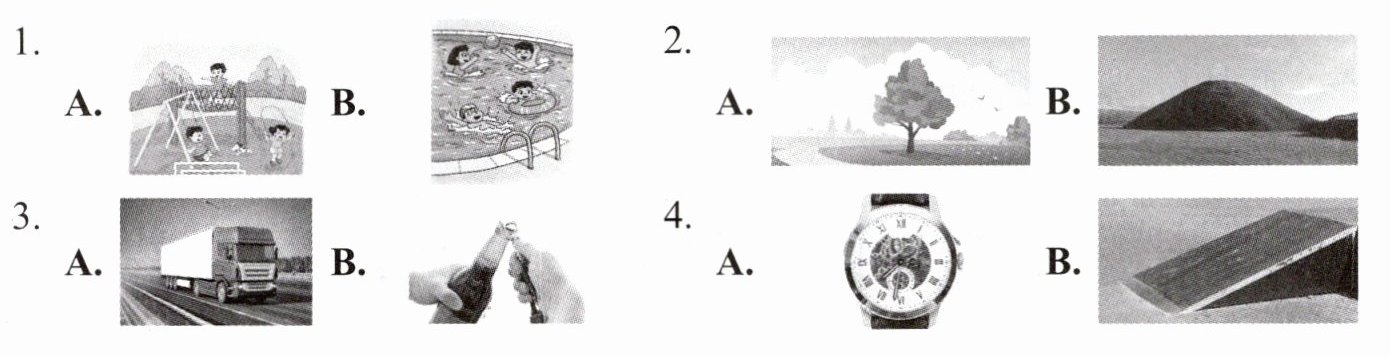 B.
B.
2. A. B.
3. A. B.
4. A. B.
1. A.
B.2. A. B.
3. A. B.
4. A. B.
答案
1. (A)
2. (B)
3. (A)
4. (B)
2. (B)
3. (A)
4. (B)
二、选择正确的单词填在横线上,使句子完整正确。
1. Can you find tiny wheels
2.
3. People in
4. Levers, wheels and ramps are all
5. There is a
6. What is the
1. Can you find tiny wheels
inside
(outside/inside) this old clock?2.
Hills
(Lakes/Hills) and mountains are ramps in nature.3. People in
wheelchairs
(wheels/wheelchairs) use ramps to go into a building.4. Levers, wheels and ramps are all
simple
(simple/heavy) machines.5. There is a
point
(point/ramp) in the middle of each lever.6. What is the
basic
(bright/basic) need for life? Food or water?答案
1. inside 2. Hills 3. wheelchairs
4. simple 5. point 6. basic
4. simple 5. point 6. basic
解析
【分析】
做这类选词填空题,需先理解每个句子的语境含义,再辨析括号内两个单词的词义,结合句子逻辑和常识选择合适的单词,确保句子完整通顺。
【解析】
1. 句子意为“你能在这个旧钟里找到小轮子吗?”,inside表示“在……里面”,outside是“在……外面”,钟的轮子位于内部,故选inside。
2. 句子意为“自然界中,丘陵和山脉是斜坡”,Lakes是“湖泊”,Hills是“丘陵”,结合常识丘陵和山脉属于斜坡类地形,故选Hills。
3. 句子意为“坐轮椅的人用斜坡进入建筑物”,wheels是“轮子”,wheelchairs是“轮椅”,指使用轮椅的人群,故选wheelchairs。
4. 句子意为“杠杆、轮子和斜坡都是简单机械”,simple是“简单的”,heavy是“重的”,这些属于简单机械范畴,故选simple。
5. 句子意为“每个杠杆的中间都有一个支点”,point在此指杠杆的“支点”,ramp是“斜坡”,结合杠杆常识,中间为支点,故选point。
6. 句子意为“生命的基本需求是什么?食物还是水?”,bright是“明亮的”,basic是“基本的”,basic need表示“基本需求”,故选basic。
【答案】
1. inside 2. Hills 3. wheelchairs 4. simple 5. point 6. basic
【知识点】
英语选词填空、词义辨析
【点评】
本题考查英语词汇在具体语境中的运用,结合常识和词义即可完成,属于基础题型。
【难度系数】
0.7
做这类选词填空题,需先理解每个句子的语境含义,再辨析括号内两个单词的词义,结合句子逻辑和常识选择合适的单词,确保句子完整通顺。
【解析】
1. 句子意为“你能在这个旧钟里找到小轮子吗?”,inside表示“在……里面”,outside是“在……外面”,钟的轮子位于内部,故选inside。
2. 句子意为“自然界中,丘陵和山脉是斜坡”,Lakes是“湖泊”,Hills是“丘陵”,结合常识丘陵和山脉属于斜坡类地形,故选Hills。
3. 句子意为“坐轮椅的人用斜坡进入建筑物”,wheels是“轮子”,wheelchairs是“轮椅”,指使用轮椅的人群,故选wheelchairs。
4. 句子意为“杠杆、轮子和斜坡都是简单机械”,simple是“简单的”,heavy是“重的”,这些属于简单机械范畴,故选simple。
5. 句子意为“每个杠杆的中间都有一个支点”,point在此指杠杆的“支点”,ramp是“斜坡”,结合杠杆常识,中间为支点,故选point。
6. 句子意为“生命的基本需求是什么?食物还是水?”,bright是“明亮的”,basic是“基本的”,basic need表示“基本需求”,故选basic。
【答案】
1. inside 2. Hills 3. wheelchairs 4. simple 5. point 6. basic
【知识点】
英语选词填空、词义辨析
【点评】
本题考查英语词汇在具体语境中的运用,结合常识和词义即可完成,属于基础题型。
【难度系数】
0.7
三、你了解电话的诞生吗?阅读短文,判断句子正(T)误(F)。
Alexander Graham Bell(亚历山大·格雷厄姆·贝尔)was a great inventor. He made the first telephone(电话)in 1876. Before that, people could only talk face to face or send letters. Letters took days or weeks to arrive. Bell’s telephone changed how people talk. The telephone made long-distance(长距离)communication easier. Families and friends could talk with each other easily. Factories and shops could also work better. Today, we have mobile phones. But Bell’s first telephone started it all. It is one of the most important inventions in the world.
(
(
(
(
Alexander Graham Bell(亚历山大·格雷厄姆·贝尔)was a great inventor. He made the first telephone(电话)in 1876. Before that, people could only talk face to face or send letters. Letters took days or weeks to arrive. Bell’s telephone changed how people talk. The telephone made long-distance(长距离)communication easier. Families and friends could talk with each other easily. Factories and shops could also work better. Today, we have mobile phones. But Bell’s first telephone started it all. It is one of the most important inventions in the world.
(
T
) 1. Alexander Graham Bell made the first telephone.(
F
) 2. The first telephone was invented in 1879.(
T
) 3. People only talked face to face or sent letters before the telephone.(
T
) 4. The telephone helped people talk easily from far away.答案
1. T 2. F 3. T 4. T
解析
【分析】
本题是英语阅读理解的判断正误题,解题思路为:①先通读短文,掌握短文关于电话发明者及作用的核心信息;②针对每个小题的句子,在短文中定位对应描述的内容;③将小题句子与原文内容逐一对比,若表述一致则判断为正(T),不一致则判断为误(F)。
【解析】
1. 原文明确提到“He made the first telephone(电话)in 1876”,与题目句子表述一致,故判断为T;
2. 原文指出电话发明年份是1876年,而非1879年,与题目句子不符,故判断为F;
3. 原文提到“Before that, people could only talk face to face or send letters”,与题目句子表述一致,故判断为T;
4. 原文说明“The telephone made long-distance(长距离)communication easier”,对应题目句子“talk easily from far away”,表述一致,故判断为T。
【答案】
1.T 2.F 3.T 4.T
【知识点】
英语阅读理解、细节判断
【点评】
本题考查学生对短文细节信息的提取与对比能力,属于基础阅读理解题型,只要认真阅读短文、准确定位对应内容即可完成判断。
【难度系数】
0.8
本题是英语阅读理解的判断正误题,解题思路为:①先通读短文,掌握短文关于电话发明者及作用的核心信息;②针对每个小题的句子,在短文中定位对应描述的内容;③将小题句子与原文内容逐一对比,若表述一致则判断为正(T),不一致则判断为误(F)。
【解析】
1. 原文明确提到“He made the first telephone(电话)in 1876”,与题目句子表述一致,故判断为T;
2. 原文指出电话发明年份是1876年,而非1879年,与题目句子不符,故判断为F;
3. 原文提到“Before that, people could only talk face to face or send letters”,与题目句子表述一致,故判断为T;
4. 原文说明“The telephone made long-distance(长距离)communication easier”,对应题目句子“talk easily from far away”,表述一致,故判断为T。
【答案】
1.T 2.F 3.T 4.T
【知识点】
英语阅读理解、细节判断
【点评】
本题考查学生对短文细节信息的提取与对比能力,属于基础阅读理解题型,只要认真阅读短文、准确定位对应内容即可完成判断。
【难度系数】
0.8
