

 登录
登录
任务型阅读。
• The Sun: It is a star. It is very hot and big. Earth travels around it.
• Mercury: It is the first planet to the Sun. It is very hot during the day, but it's very cold at night.
• Venus: It is the second planet to the Sun. It is the hottest planet. It has a temperature of about 467℃. It's covered with thick(厚的)clouds.
• Earth: It is the third planet to the Sun. It's our home. There is water and air on Earth. We can see blue seas, green plants, ...
• Mars: It's the "red planet". There aren't any living things on Mars.
任务一:阅读短文,选择正确的答案。
(
A. cold B. hot C. warm
(
A. Earth B. Mercury C. Venus
(
A. second B. third C. fourth
(
A. Mars B. The Sun C. Venus
任务二:阅读短文,回答问题。
What is the difference between Earth and Mars?
• The Sun: It is a star. It is very hot and big. Earth travels around it.
• Mercury: It is the first planet to the Sun. It is very hot during the day, but it's very cold at night.
• Venus: It is the second planet to the Sun. It is the hottest planet. It has a temperature of about 467℃. It's covered with thick(厚的)clouds.
• Earth: It is the third planet to the Sun. It's our home. There is water and air on Earth. We can see blue seas, green plants, ...
• Mars: It's the "red planet". There aren't any living things on Mars.
任务一:阅读短文,选择正确的答案。
(
B
)1. Mercury is very hot
during the daytime.A. cold B. hot C. warm
(
C
)2. Venus
is the hottest planet.A. Earth B. Mercury C. Venus
(
B
)3. Earth is the third
planet from the Sun.A. second B. third C. fourth
(
A
)4. Mars
is called the "red planet".A. Mars B. The Sun C. Venus
任务二:阅读短文,回答问题。
What is the difference between Earth and Mars?
We can't live on Mars, but we can live on Earth.
答案
1. B
2. C
3. B
4. A
任务二:We can't live on Mars, but we can live on Earth.
(答案不唯一)
2. C
3. B
4. A
任务二:We can't live on Mars, but we can live on Earth.
(答案不唯一)
解析
【分析】
本题是任务型阅读的细节理解类题目,解题时需先通读短文掌握各星球的基本信息,再根据题干中的关键词,回到原文定位对应内容,通过对比原文与选项或组织语言完成作答。
【解析】
任务一:1. 题干问水星白天的情况,定位原文Mercury段落中“It is very hot during the day”,对应选项B;2. 题干问最热的行星,定位Venus段落中“It is the hottest planet”,对应选项C;3. 题干问地球是太阳的第几颗行星,定位Earth段落中“It is the third planet to the Sun”,对应选项B;4. 题干问被称为“红色行星”的是哪个,定位Mars段落中“It's the 'red planet'”,对应选项A。
任务二:题干要求回答地球和火星的区别,结合原文Earth的信息(是人类家园,有空气和水)和Mars的信息(没有生物),组织语言作答即可。
【答案】
1.B;2.C;3.B;4.A;任务二:We can't live on Mars, but we can live on Earth.(答案不唯一)
【知识点】
任务型阅读、细节理解题、英语阅读理解
【点评】
本题为基础的任务型阅读题,侧重考查学生从文本中快速定位关键信息的能力,文本内容清晰,答案可直接从原文获取,难度较低。
【难度系数】
0.8
本题是任务型阅读的细节理解类题目,解题时需先通读短文掌握各星球的基本信息,再根据题干中的关键词,回到原文定位对应内容,通过对比原文与选项或组织语言完成作答。
【解析】
任务一:1. 题干问水星白天的情况,定位原文Mercury段落中“It is very hot during the day”,对应选项B;2. 题干问最热的行星,定位Venus段落中“It is the hottest planet”,对应选项C;3. 题干问地球是太阳的第几颗行星,定位Earth段落中“It is the third planet to the Sun”,对应选项B;4. 题干问被称为“红色行星”的是哪个,定位Mars段落中“It's the 'red planet'”,对应选项A。
任务二:题干要求回答地球和火星的区别,结合原文Earth的信息(是人类家园,有空气和水)和Mars的信息(没有生物),组织语言作答即可。
【答案】
1.B;2.C;3.B;4.A;任务二:We can't live on Mars, but we can live on Earth.(答案不唯一)
【知识点】
任务型阅读、细节理解题、英语阅读理解
【点评】
本题为基础的任务型阅读题,侧重考查学生从文本中快速定位关键信息的能力,文本内容清晰,答案可直接从原文获取,难度较低。
【难度系数】
0.8
二 书面表达。
本单元围绕我们在地球及外太空能看到什么展开。我们要学会描述我们在地球和太空中看到的景象,学习宇航员在太空中的日常生活以及感受地球和太空世界的美妙。
【写作指引】
开头——介绍自己是一名中国航天员。
示例:I am a taikonaut on a space station.
结尾——表达在太空中生活一天的感受。
示例:I love my day in space.
【写作实践】
假如你是一名中国航天员,请你描述你在太空中的一天。要求:语句通顺,不少于5句话。
本单元围绕我们在地球及外太空能看到什么展开。我们要学会描述我们在地球和太空中看到的景象,学习宇航员在太空中的日常生活以及感受地球和太空世界的美妙。
【写作指引】
开头——介绍自己是一名中国航天员。
示例:I am a taikonaut on a space station.
结尾——表达在太空中生活一天的感受。
示例:I love my day in space.
【写作实践】
假如你是一名中国航天员,请你描述你在太空中的一天。要求:语句通顺,不少于5句话。
I am a taikonaut.
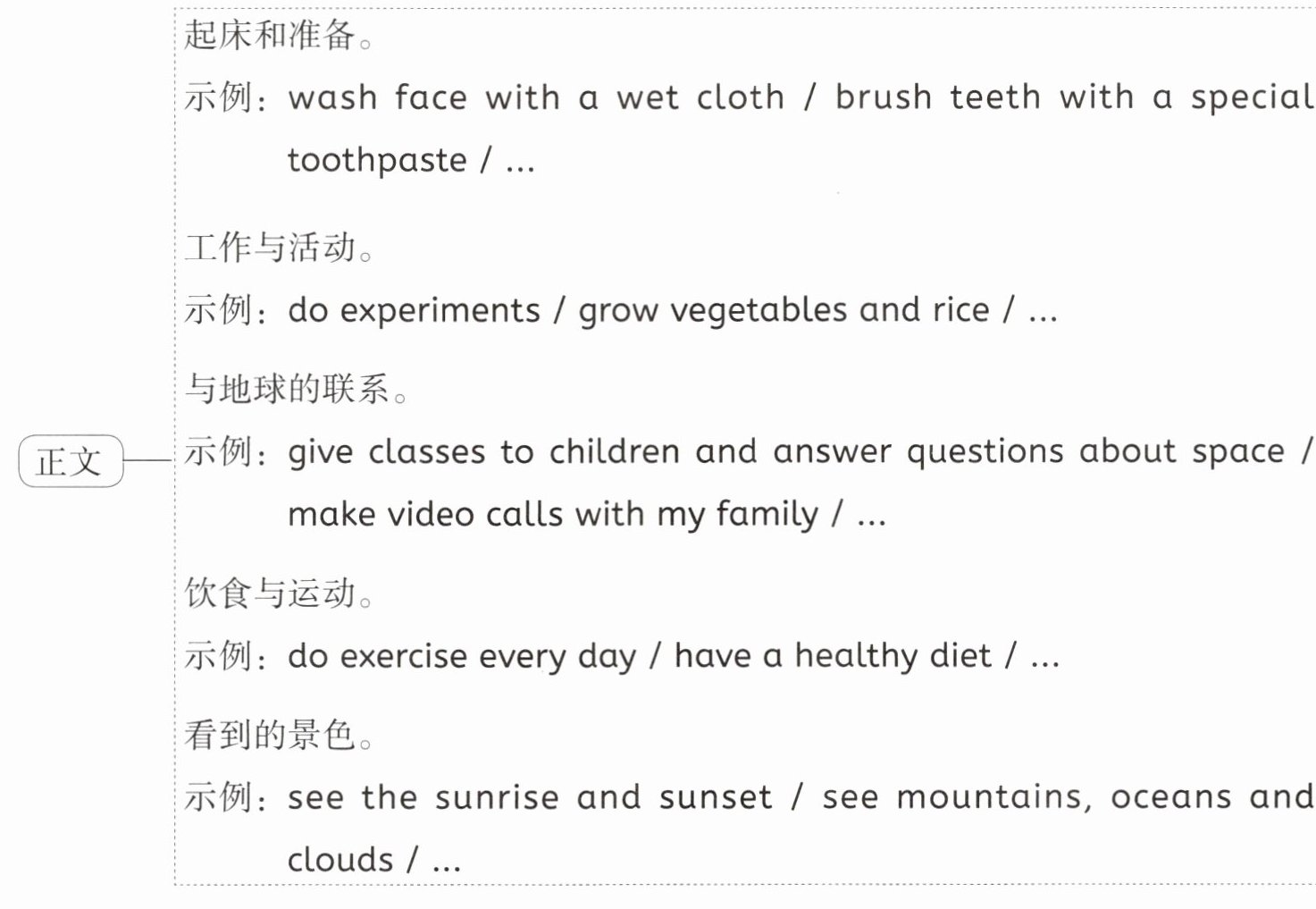
I get up early every day. I can't use water to wash my face. I use a wet cloth. I brush my teeth with a special toothpaste and have to "eat" it.
In the morning, I grow vegetables and rice. In the afternoon, I do exercise to keep healthy and strong.
Sometimes I give classes to children on Earth. I like looking out of the windows.
I can see the sunrise and sunset 16 times a day. Earth looks like a big blue marble. How beautiful!
I love my day in space.
答案
I am a taikonaut.
I get up early every day. I can't use water to wash my face. I use a wet cloth. I brush my teeth with a special toothpaste and have to "eat" it. In the morning, I grow vegetables and rice. In the afternoon, I do exercise to keep healthy and strong. Sometimes I give classes to children on Earth. I like looking out of the windows. I can see the sunrise and sunset 16 times a day. Earth looks like a big blue marble. How beautiful!
I love my day in space.
I get up early every day. I can't use water to wash my face. I use a wet cloth. I brush my teeth with a special toothpaste and have to "eat" it. In the morning, I grow vegetables and rice. In the afternoon, I do exercise to keep healthy and strong. Sometimes I give classes to children on Earth. I like looking out of the windows. I can see the sunrise and sunset 16 times a day. Earth looks like a big blue marble. How beautiful!
I love my day in space.
解析
【分析】首先明确题目要求:以中国航天员的身份描述在太空中的一天,开头需介绍身份,结尾表达感受,语句通顺且不少于5句。解题思路:1. 开头直接点明身份;2. 中间围绕太空生活的不同方面展开,结合太空的特殊特点(如用水限制、特殊洗漱用品、多次日出日落等),涵盖起床准备、工作活动、饮食运动、所见景色等内容;3. 结尾表达对太空一天的喜爱,确保内容连贯,符合要求。
【解析】写作步骤:1. 开头:按照示例介绍自己是中国航天员;2. 中间部分:依次描述起床准备(用湿布洗脸、特殊牙膏刷牙)、工作(种蔬菜、给地球孩子上课)、运动(锻炼保持健康)、看到的景色(多次日出日落、地球像蓝色大理石),内容具体贴合太空生活;3. 结尾:按照示例表达对太空一天的喜爱,确保语句通顺,满足不少于5句话的要求。
【答案】I am a taikonaut.
I get up early every day. I can't use water to wash my face. I use a wet cloth. I brush my teeth with a special toothpaste and have to "eat" it. In the morning, I grow vegetables and rice. In the afternoon, I do exercise to keep healthy and strong. Sometimes I give classes to children on Earth. I like looking out of the windows. I can see the sunrise and sunset 16 times a day. Earth looks like a big blue marble. How beautiful!
I love my day in space.
【知识点】英语书面表达;太空生活英语描述
【点评】本文符合题目要求,以中国航天员的身份生动描述了太空一天的生活,涵盖多个太空生活场景,内容具体,语句通顺,结尾情感真挚,符合写作要求。
【难度系数】0.5
【解析】写作步骤:1. 开头:按照示例介绍自己是中国航天员;2. 中间部分:依次描述起床准备(用湿布洗脸、特殊牙膏刷牙)、工作(种蔬菜、给地球孩子上课)、运动(锻炼保持健康)、看到的景色(多次日出日落、地球像蓝色大理石),内容具体贴合太空生活;3. 结尾:按照示例表达对太空一天的喜爱,确保语句通顺,满足不少于5句话的要求。
【答案】I am a taikonaut.
I get up early every day. I can't use water to wash my face. I use a wet cloth. I brush my teeth with a special toothpaste and have to "eat" it. In the morning, I grow vegetables and rice. In the afternoon, I do exercise to keep healthy and strong. Sometimes I give classes to children on Earth. I like looking out of the windows. I can see the sunrise and sunset 16 times a day. Earth looks like a big blue marble. How beautiful!
I love my day in space.
【知识点】英语书面表达;太空生活英语描述
【点评】本文符合题目要求,以中国航天员的身份生动描述了太空一天的生活,涵盖多个太空生活场景,内容具体,语句通顺,结尾情感真挚,符合写作要求。
【难度系数】0.5
