

 登录
Getting together
Traditional Chinese Festivals
Read & answer: When is the Spring Festival? What do people do then in China?
1. The Spring Festival
It is always in January or February. The weather is cold in most places. During the Spring Festival, people enjoy a long holiday with their families. They buy new clothes, eat special food, decorate their houses beautifully, visit their relatives and give money in red packets to children.
2. The Lantern Festival
It is always in February or March. It comes after the Spring Festival. People often eat sweet dumplings on that day. After that, they watch lantern shows for good wishes.
3. The Qingming Festival
It is on April 4th or 5th. It is a time to remember the dead and the dear departed. People always go and sweep the graves.
4. The Dragon Boat Festival
It is on the fifth day of the fifth month according to the Chinese lunar calendar. So it's usually in June. On that day, people make many zongzi. They eat zongzi and throw them into rivers to remind us of Qu Yuan. The festival is best known for its dragon boat races.
5. The Mid-Autumn Festival
It is always in September or October. It is a time for families to get together, so people far from home watch the moon and miss their families. They like to share mooncakes around the table at night.
图1、图2、图3、图4、图5
Ⅰ. Look and match. 看图,连线。
Spring Festival
Mid-Autumn Festival
Lantern Festival
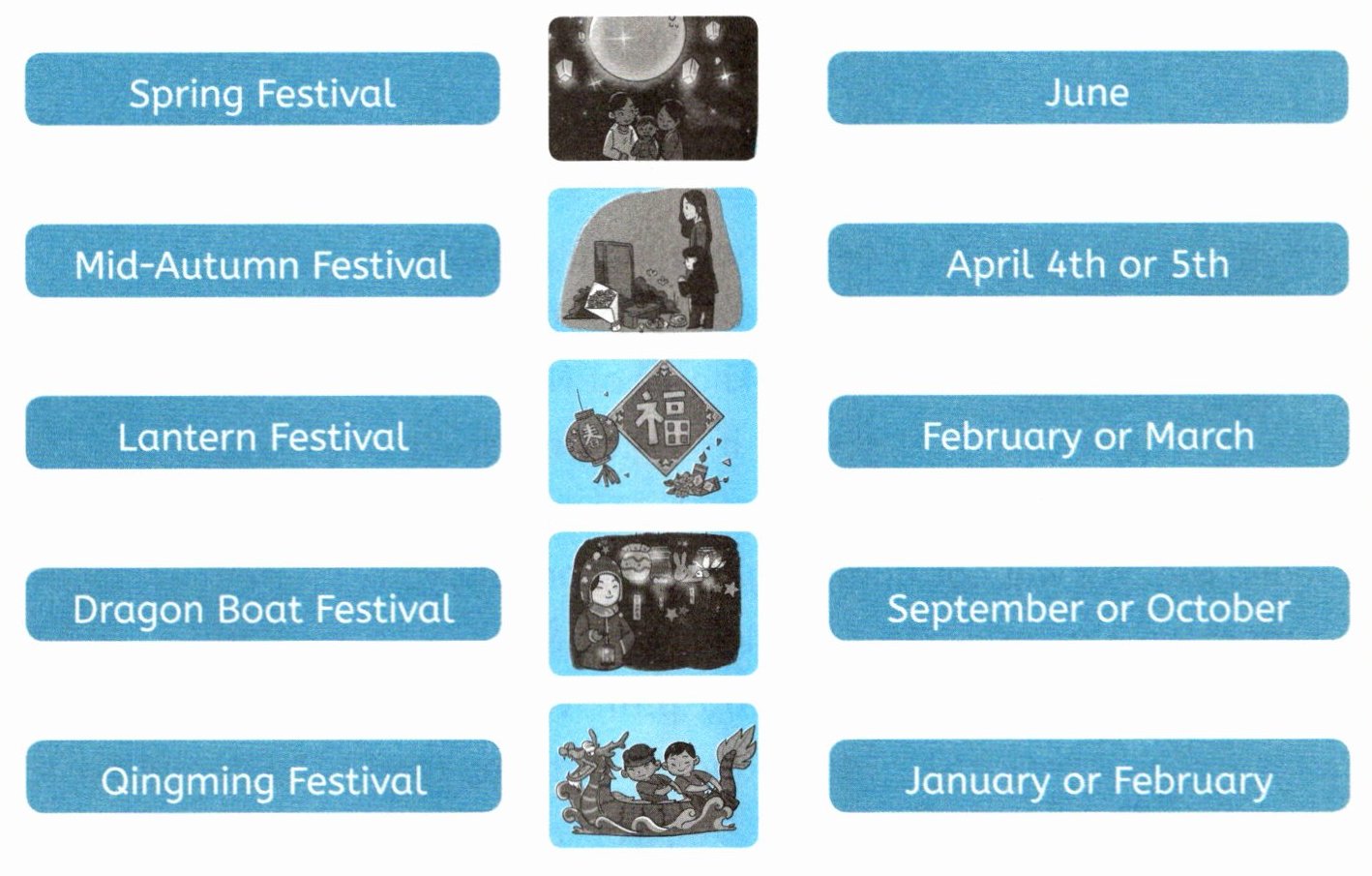
Dragon Boat Festival
Qingming Festival
June
April 4th or 5th
February or March
September or October
January or February
Ⅱ. Read and answer. 读一读,回答问题。
1. Which Chinese festivals do you like best? Why?
2. What do you usually do on the Dragon Boat Festival?
Traditional Chinese Festivals
Read & answer: When is the Spring Festival? What do people do then in China?
1. The Spring Festival
It is always in January or February. The weather is cold in most places. During the Spring Festival, people enjoy a long holiday with their families. They buy new clothes, eat special food, decorate their houses beautifully, visit their relatives and give money in red packets to children.
2. The Lantern Festival
It is always in February or March. It comes after the Spring Festival. People often eat sweet dumplings on that day. After that, they watch lantern shows for good wishes.
3. The Qingming Festival
It is on April 4th or 5th. It is a time to remember the dead and the dear departed. People always go and sweep the graves.
4. The Dragon Boat Festival
It is on the fifth day of the fifth month according to the Chinese lunar calendar. So it's usually in June. On that day, people make many zongzi. They eat zongzi and throw them into rivers to remind us of Qu Yuan. The festival is best known for its dragon boat races.
5. The Mid-Autumn Festival
It is always in September or October. It is a time for families to get together, so people far from home watch the moon and miss their families. They like to share mooncakes around the table at night.
图1、图2、图3、图4、图5
Ⅰ. Look and match. 看图,连线。
Spring Festival
Mid-Autumn Festival
Lantern Festival
Dragon Boat Festival
Qingming Festival
June
April 4th or 5th
February or March
September or October
January or February
Ⅱ. Read and answer. 读一读,回答问题。
1. Which Chinese festivals do you like best? Why?
略
2. What do you usually do on the Dragon Boat Festival?
略
答案
---
Ⅱ. Read and answer 参考作答:
1. I like the Mid-Autumn Festival best. Because all my family can get together, we eat sweet mooncakes and enjoy the bright full moon at night, it feels very warm and happy.
2. I usually eat delicious zongzi with my family, and I also go to watch the wonderful dragon boat races near the river with my friends to remember the great poet Qu Yuan.
解析
【分析】
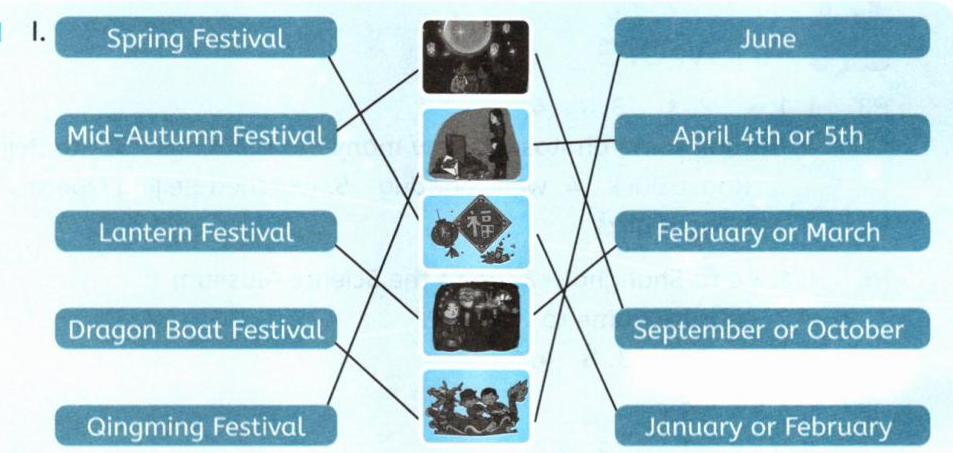
本题分为两部分:第一部分是看图连线,需先明确中国各传统节日的时间,再匹配对应选项;第二部分是阅读理解回答问题,需根据短文内容提取节日相关信息,组织语言作答。步骤:1. 回忆各传统节日的时间:春节在1月或2月,中秋节在9或10月,元宵节在2或3月,端午节在6月,清明节在4月4或5日;2. 完成连线;3. 阅读短文,提取问题对应的细节,回答问题。
【解析】
Ⅰ. 连线题:
1. Spring Festival(春节)→ January or February
2. Mid-Autumn Festival(中秋节)→ September or October
3. Lantern Festival(元宵节)→ February or March
4. Dragon Boat Festival(端午节)→ June
5. Qingming Festival(清明节)→ April 4th or 5th
Ⅱ. 阅读回答题:
1. 可根据短文内容选择节日,结合节日的团聚、习俗等原因作答;
2. 结合短文内容,提取端午节吃粽子、赛龙舟、纪念屈原的信息组织语言。
【答案】
---
Ⅱ. Read and answer 参考作答:
1. I like the Mid-Autumn Festival best. Because all my family can get together, we eat sweet mooncakes and enjoy the bright full moon at night, it feels very warm and happy.
2. I usually eat delicious zongzi with my family, and I also go to watch the wonderful dragon boat races near the river with my friends to remember the great poet Qu Yuan.
【知识点】
传统节日英语表达,阅读理解,书面表达
【点评】
本题结合中国传统节日的英语知识与阅读理解能力,既考查节日时间、习俗的匹配,又考查从短文中提取信息并组织语言回答问题的能力,贴近生活,难度适中。
【难度系数】
0.3
