

 登录
4.
A.Pour
B.Pours
C.Pouring
D.To pour
A
the mixture into the pie crust after adding all the ingredients.A.Pour
B.Pours
C.Pouring
D.To pour
答案
4. A
解析
【分析】首先观察句子,这是一个表达指令的祈使句,祈使句的句首需用动词原形构成,用于发出命令或要求。接下来结合选项的形式,判断符合祈使句结构的选项。
【解析】本题考查祈使句的用法,祈使句的基本结构为“动词原形+其他成分”,用于表达命令、请求等语气。句中缺少句首的核心动词,需使用动词原形。选项A Pour是动词原形,符合祈使句的结构要求;选项B Pours是第三人称单数形式,用于一般现在时主语为第三人称单数的句子,不符合祈使句规则;选项C Pouring是现在分词/动名词,不能直接作为祈使句的开头;选项D To pour是不定式,通常表目的或作非谓语成分,不符合此处结构。因此正确答案为A。
【答案】A
【知识点】祈使句的用法
【点评】本题为基础语法题,考查祈使句的核心结构,需牢记祈使句以动词原形开头的规则,属于易掌握的基础题型。
【难度系数】0.7
5. Before making a pie, you need to
A.mix
B.mixing
C.to mix
D.mixed
A
the flour and water well.A.mix
B.mixing
C.to mix
D.mixed
答案
5. A
解析
【分析】首先观察题干中的固定结构“need to”,实义动词need后接不定式作宾语,不定式符号to后必须跟动词原形,因此需要选择动词原形的选项。
【解析】根据英语语法规则,实义动词need的常用搭配为“need to do sth”,意为“需要做某事”,其中to是不定式符号,后面要接动词原形。选项A“mix”是动词原形,符合要求;选项B“mixing”为现在分词/动名词,选项C“to mix”是不定式(此处已有不定式符号to,无需重复),选项D“mixed”为过去式/过去分词,均不符合搭配要求,因此选A。
【答案】A
【知识点】固定搭配(need to do)、动词原形
【点评】本题考查基础的英语语法搭配,属于常见考点,只要掌握“need to + 动词原形”这一结构就能快速选出正确答案,难度较低。
【难度系数】0.8
Ⅴ. 完成句子。
1. The writer loves cooking because it's a great way to share love with others.(对下划线部分提问)
2. She learned to make pumpkin pie from her host family.(改为一般疑问句)
3. love, try, I, to, and, places, from, food, new, different, recipes (.)(连词成句)
4. She usually made the pie in autumn.(对下划线部分提问)
5. My mother taught me how to make an apple pie.(改为否定句)
My mother
1. The writer loves cooking because it's a great way to share love with others.(对下划线部分提问)
Why
does
the writer love cooking?2. She learned to make pumpkin pie from her host family.(改为一般疑问句)
Did
she learn
to make pumpkin pie from her host family?3. love, try, I, to, and, places, from, food, new, different, recipes (.)(连词成句)
I love to try new food and recipes from different places.
4. She usually made the pie in autumn.(对下划线部分提问)
When
did
she usually make the pie?5. My mother taught me how to make an apple pie.(改为否定句)
My mother
didn't
teach
me how to make an apple pie.答案
1. Why does
2. Did;learn
3. I love to try new food and recipes from different places.
4. When did
5. didn't teach
解析
【分析】
1. 划线部分是原因状语,需用特殊疑问词Why提问;原句是一般现在时,主语the writer为第三人称单数,变疑问句要借助助动词does,后面动词love用原形。
2. 原句是一般过去时,变一般疑问句需借助助动词Did,放在句首,谓语动词用原形learn。
3. 连词成句先确定主语I,谓语动词love,固定搭配love to do sth,再依次连接宾语、地点状语,按逻辑排列。
4. 划线部分是时间状语,用特殊疑问词When提问;原句是一般过去时,变疑问句借助助动词did,后面动词make用原形。
5. 原句是一般过去时,变否定句借助助动词didn't,后面动词taught还原为原形teach。
【解析】
1. 对原因提问用Why,原句为一般现在时且主语是第三人称单数,助动词用does,故填Why does。
2. 原句是一般过去时,变一般疑问句将助动词Did提前,谓语动词用原形learn,故填Did; learn。
3. 先确定主语I,谓语love,搭配love to try,宾语new food and recipes,地点状语from different places,组合为I love to try new food and recipes from different places.
4. 对时间提问用When,原句是一般过去时,助动词用did,故填When did。
5. 原句是一般过去时,变否定句用didn't加动词原形teach,故填didn't teach。
【答案】
1. Why does
2. Did; learn
3. I love to try new food and recipes from different places.
4. When did
5. didn't teach
【知识点】
特殊疑问句构成;一般过去时句型转换;连词成句
【点评】
本题为初中英语基础句型转换题,涵盖特殊疑问句、一般疑问句、否定句及连词成句,考查核心基础语法与句型,是英语学习的必备内容。
【难度系数】
0.8
Ⅵ.七选五,补对话。
A: Hi, I read an interesting article about food and memories.
B: Really? 1.
A: It's mainly about how food can create memories and show love. The writer talked about her grandmother's pumpkin pie.
B: Sounds nice. 2.
A: Her grandmother learned to make it from a host family when she was a college student in the US.
B: Cool. 3.
A: The writer said her grandmother always made it in autumn when it was colder.
B:I bet the pie must be delicious. 4.
A: Well, the smell of cinnamon filled the room with sweetness. And now every time the writer smells cinnamon, she thinks of the pie.
B:That's a sweet memory. 5.
A: Yes, she did. And she loves cooking now because it's a way to share love with others.
B:I also want to cook something special and create good memories.
A. When did her grandmother usually make the pie?
B. What's it about?
C. Did her grandmother teach her to make the pie?
D. How did the writer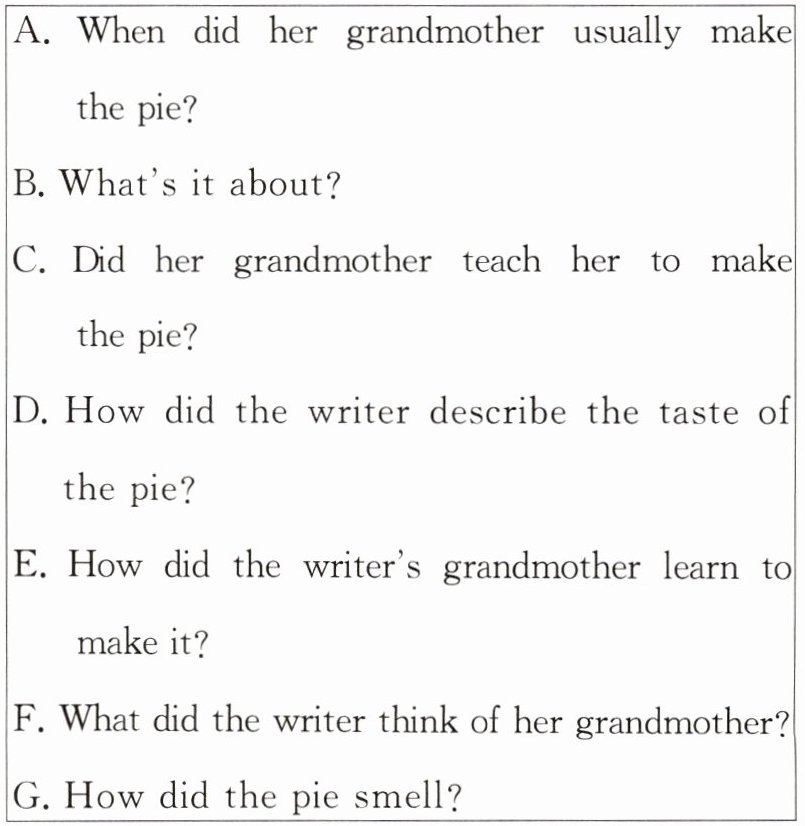 describe the taste of the pie?
E. How did the writer's grandmother learn to make it?
F. What did the writer think of her grandmother?
G. How did the pie smell?
A: Hi, I read an interesting article about food and memories.
B: Really? 1.
B
A: It's mainly about how food can create memories and show love. The writer talked about her grandmother's pumpkin pie.
B: Sounds nice. 2.
E
A: Her grandmother learned to make it from a host family when she was a college student in the US.
B: Cool. 3.
A
A: The writer said her grandmother always made it in autumn when it was colder.
B:I bet the pie must be delicious. 4.
G
A: Well, the smell of cinnamon filled the room with sweetness. And now every time the writer smells cinnamon, she thinks of the pie.
B:That's a sweet memory. 5.
C
A: Yes, she did. And she loves cooking now because it's a way to share love with others.
B:I also want to cook something special and create good memories.
A. When did her grandmother usually make the pie?
B. What's it about?
C. Did her grandmother teach her to make the pie?
D. How did the writer
describe the taste of the pie?E. How did the writer's grandmother learn to make it?
F. What did the writer think of her grandmother?
G. How did the pie smell?
答案
1. B
2. E
3. A
4. G
5. C
解析
【分析】本题为英语补全对话(七选五)题型,解题时需先通读对话把握核心主题,再逐一分析每个空格前后的语境,匹配对应选项:第1空需对应询问文章主题的问句,第2空对应询问祖母学做派的方式,第3空对应询问做派的时间,第4空对应询问派的气味,第5空对应一般疑问句的答句。
【解析】1. 第1空:A提到读了关于食物与记忆的文章,B询问“它是关于什么的?”,对应选项B,A的回答“It's mainly about...”也匹配该问句,故选B。2. 第2空:A回答“祖母在美国读大学时从寄宿家庭学会做派”,对应选项E(询问祖母如何学做派),故选E。3. 第3空:A回答“祖母总是在秋天做派”,对应选项A(询问祖母通常什么时候做派),故选A。4. 第4空:A提到“肉桂的香味充满房间”,对应选项G(询问派的气味如何),故选G。5. 第5空:A的答句是“Yes, she did.”,是一般疑问句的肯定回答,对应选项C(一般疑问句“祖母是否教她做派?”),故选C。
【答案】1.B 2.E 3.A 4.G 5.C
【知识点】英语补全对话,情景交际
【点评】本题考查英语情景交际中的补全对话,需结合上下文逻辑选择合适句子,难度适中,主要考察学生对对话语境的理解能力。
【难度系数】0.6
