

 登录
登录
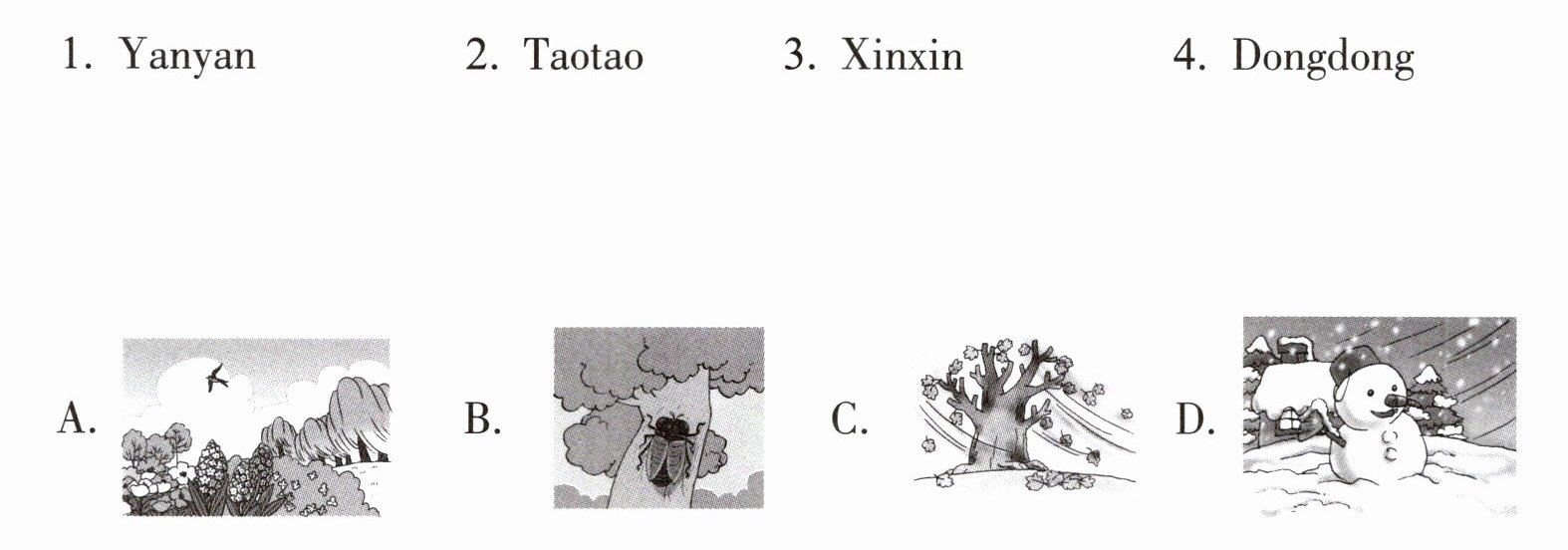
一、Listen and match. 同学们分别谈论了自己喜欢的季节。请你听一听,将下列人物与相应的图片连线。
1. Yanyan
2. Taotao
3. Xinxin
4. Dongdong
A.
B.
C.
D.
1. Yanyan
C
2. Taotao
D
3. Xinxin
A
4. Dongdong
B
A.
B.
C.
D.
答案
1-C 2-D 3-A 4-B
二、Read, choose and write. 诗歌是中华优秀传统文化的瑰宝。下列诗句中分别描述了哪个季节的风景呢?请你读一读,选出相应的英文单词,并将其写在四线三格内。
1. 竹外桃花三两枝,春江水暖鸭先知。______
2. 孤舟蓑笠翁,独钓寒江雪。______
3. 小荷才露尖尖角,早有蜻蜓立上头。______
4. 萧萧梧叶送寒声,江上秋风动客情。______
spring
summer
autumn
winter
1. 竹外桃花三两枝,春江水暖鸭先知。______
2. 孤舟蓑笠翁,独钓寒江雪。______
3. 小荷才露尖尖角,早有蜻蜓立上头。______
4. 萧萧梧叶送寒声,江上秋风动客情。______
spring
summer
autumn
winter
答案
1. spring
2. winter
3. summer
4. autumn
2. winter
3. summer
4. autumn
解析
1.诗句“竹外桃花三两枝,春江水暖鸭先知”中,“桃 花”和“春江”表明描述的是春季的景色,对应的英文单词是“spring”。
2.诗句“孤舟蓑笠翁,独钓寒江雪”中,“雪”表明描述的是冬季的景色,对应的英文单词是“winter”。
3.诗句“小荷才露尖尖角,早有蜻蜓立上头”中,“荷”和“蜻蜓”表明描述的是夏季的景色,对应的英文单词是“summer”。
4.诗句“萧萧梧叶送寒声,江上秋风动客情”中,“秋风”表明描述的是秋季的景色,对应的英文单词是“autumn”。
2.诗句“孤舟蓑笠翁,独钓寒江雪”中,“雪”表明描述的是冬季的景色,对应的英文单词是“winter”。
3.诗句“小荷才露尖尖角,早有蜻蜓立上头”中,“荷”和“蜻蜓”表明描述的是夏季的景色,对应的英文单词是“summer”。
4.诗句“萧萧梧叶送寒声,江上秋风动客情”中,“秋风”表明描述的是秋季的景色,对应的英文单词是“autumn”。
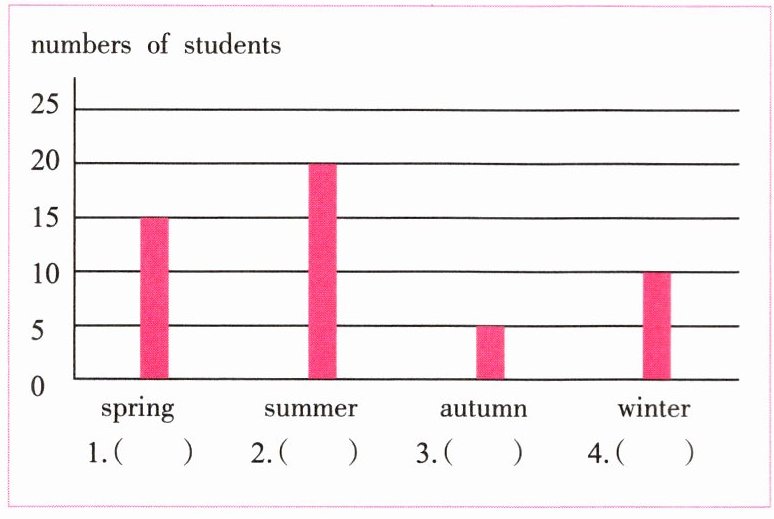
三、Look and choose. Mingming 针对班里各位同学喜欢的季节进行了一项调查,并制作了一幅统计图。请你看一看,选一选,将句子的序号填在对应的括号内。
Which seasons do you like?
A.Five students like autumn.
B.Ten students like winter.
C.Fifteen students like spring.
D.Twenty students like summer.
Which seasons do you like?
A.Five students like autumn.
B.Ten students like winter.
C.Fifteen students like spring.
D.Twenty students like summer.
答案
C、D、A、B
解析
本题可根据统计图中各季节对应的喜欢人数,与选项中描述的人数进行匹配,从而选出正确答案。由于没有给出统计图,我们假设在统计图中,喜欢spring(春天)的人数对应15人;喜欢summer(夏天)的人数对应20人;喜欢autumn(秋天)的人数对应5人;喜欢winter(冬天)的人数对应10人。那么选项C描述“Fifteen students like spring.”与统计图信息相符;选项D描述“Twenty students like summer.”与统计图信息相符;选项A描述“Five students like autumn.”与统计图信息相符;选项B描述“Ten students like winter.”与统计图信息相符。
四、Read and fill in the table. 学校英语社团开展英语文章赏析活动。Qianqian 正在分享自己的文章。请你读一读,根据短文内容完成表格。
We can do different things in different seasons. It’s warm in spring. I often go to the park and fly kites with my friends. In summer, it’s very hot. I can wear beautiful dresses and eat ice cream(冰激凌). It’s cool and windy in autumn. I often collect the fallen leaves(收集落叶). In winter, it’s very cold. It snows a lot. I can play in the snow and make a snowman.
|Seasons|Weather|Activities|
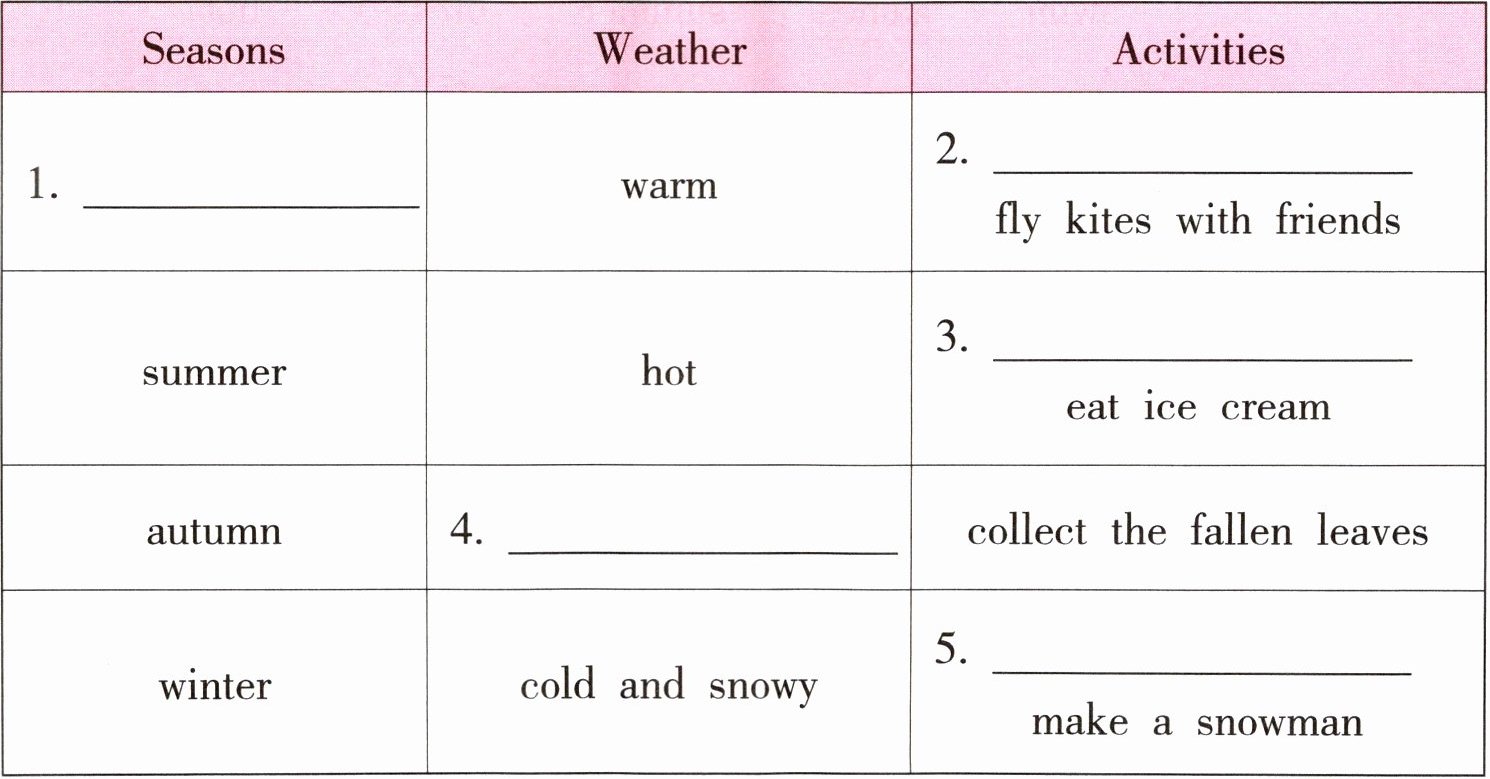
|1.
|summer|hot|3.
|autumn|4.
|winter|cold and snowy|5.
We can do different things in different seasons. It’s warm in spring. I often go to the park and fly kites with my friends. In summer, it’s very hot. I can wear beautiful dresses and eat ice cream(冰激凌). It’s cool and windy in autumn. I often collect the fallen leaves(收集落叶). In winter, it’s very cold. It snows a lot. I can play in the snow and make a snowman.
|Seasons|Weather|Activities|
|1.
spring
|warm|2.______go to the park
fly kites with friends||summer|hot|3.
wear beautiful dresses
eat ice cream||autumn|4.
cool and windy
|collect the fallen leaves||winter|cold and snowy|5.
play in the snow
make a snowman|答案
1. spring
2. go to the park
3. wear beautiful dresses
4. cool and windy
5. play in the snow
2. go to the park
3. wear beautiful dresses
4. cool and windy
5. play in the snow
解析
1. 根据“It’s warm in spring. I often go to the park and fly kites with my friends.”可知春天对应的天气是warm,活动是go to the park。
2. 根据“In summer, it’s very hot. I can wear beautiful dresses and eat ice - cream.”可知夏天除了吃冰淇淋的活动,这里要填wear beautiful dresses。
3. 根据“It’s cool and windy in autumn.”可知秋天天气是cool and windy。
4. 根据“In winter, it’s very cold. It snows a lot. I can play in the snow and make a snowman.”可知冬天活动是play in the snow。
2. 根据“In summer, it’s very hot. I can wear beautiful dresses and eat ice - cream.”可知夏天除了吃冰淇淋的活动,这里要填wear beautiful dresses。
3. 根据“It’s cool and windy in autumn.”可知秋天天气是cool and windy。
4. 根据“In winter, it’s very cold. It snows a lot. I can play in the snow and make a snowman.”可知冬天活动是play in the snow。
