登录
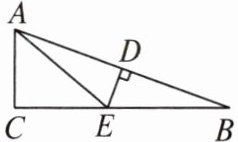
16. 如图,在$△ ABC$中,$∠ C=90°$, $DE$是$AB$的垂直平分线,$∠ CAE=∠ B+30°$,求$∠ AEB$的度数.
答案
16. 解 $\because DE$是$AB$的垂直平分线,$\therefore AE=BE$,
$\therefore ∠ EAB=∠ B. \because ∠ CAE=∠ B+30°,\therefore ∠ CAE=∠ B+30°=90°-2∠ B,\therefore ∠ B=20°,\therefore ∠ AEB=180°-20°×2=140°$.
$\therefore ∠ EAB=∠ B. \because ∠ CAE=∠ B+30°,\therefore ∠ CAE=∠ B+30°=90°-2∠ B,\therefore ∠ B=20°,\therefore ∠ AEB=180°-20°×2=140°$.
17.已知点$M(x-2y,2+x),N(2,-1)$.
(1)若点$M,N$关于$x$轴对称,求$x,y$的值;
(2)若点$M,N$关于$y$轴对称,求$(2xy)^2$的值.
(1)若点$M,N$关于$x$轴对称,求$x,y$的值;
(2)若点$M,N$关于$y$轴对称,求$(2xy)^2$的值.
答案
17. 解 (1)$\because$ 点$M,N$关于$x$轴对称,
$\therefore 2+x=1,x-2y=2,\therefore x=-1,y=-\frac{3}{2}$.
(2)$\because$ 点$M,N$关于$y$轴对称,
$\therefore 2+x=-1,x-2y=-2,\therefore x=-3,y=-\frac{1}{2}$,
$\therefore (2xy)^2=[2×(-3)×(-\frac{1}{2})]^2=9$.
$\therefore 2+x=1,x-2y=2,\therefore x=-1,y=-\frac{3}{2}$.
(2)$\because$ 点$M,N$关于$y$轴对称,
$\therefore 2+x=-1,x-2y=-2,\therefore x=-3,y=-\frac{1}{2}$,
$\therefore (2xy)^2=[2×(-3)×(-\frac{1}{2})]^2=9$.
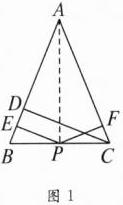
18. 如图,在△ABC中,AB=AC,CD⊥AB,垂足为D,P为BC(不含点B,C)上的任意一点,过点P分别作PE⊥AB,PF⊥CA,垂足分别为E,F.
(1)若P为边BC的中点,则PE,PF,CD三条线段有何数量关系?
(2)若P为线段BC(不含点B,C)上任意一点,则(1)中关系还成立吗?
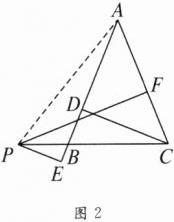
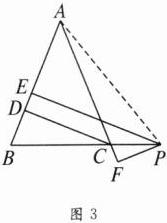
(3)若P为直线BC(不含点B,C)上任意一点,则PE,PF,CD三条线段间有何数量关系?(请写出结论,并说明理由)
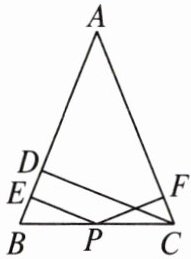
(1)若P为边BC的中点,则PE,PF,CD三条线段有何数量关系?
(2)若P为线段BC(不含点B,C)上任意一点,则(1)中关系还成立吗?
(3)若P为直线BC(不含点B,C)上任意一点,则PE,PF,CD三条线段间有何数量关系?(请写出结论,并说明理由)
答案
解 (1)$CD=PE+PF$. 理由如下:
如图1,连接$PA$. $\because CD⊥ AB,PE⊥ AB,PF⊥ AC$,
$\therefore S_{△ ABC}=\frac{1}{2}AB· CD,S_{△ PAB}=\frac{1}{2}AB· PE,S_{△ PAC}=\frac{1}{2}AC· PF. \because S_{△ ABC}=S_{△ PAB}+S_{△ PAC},\therefore \frac{1}{2}AB· CD=\frac{1}{2}AB· PE+\frac{1}{2}AC· PF. \because AB=AC,\therefore CD=PE+PF$.
(2)成立,理由如下:
连接$PA$(图略).
$\because CD⊥ AB,PE⊥ AB,PF⊥ AC$,
$\therefore S_{△ ABC}=\frac{1}{2}AB· CD,S_{△ PAB}=\frac{1}{2}AB· PE,S_{△ PAC}=\frac{1}{2}AC· PF. \because S_{△ ABC}=S_{△ PAB}+S_{△ PAC}$,
$\therefore \frac{1}{2}AB· CD=\frac{1}{2}AB· PE+\frac{1}{2}AC· PF$.
$\because AB=AC,\therefore CD=PE+PF$.
(3)结论:$CD=PE+PF$ 或 $CD=PE-PF$ 或 $CD=PF-PE$. 理由如下:
由(2)知,$CD=PE+PF$ 成立.
如图2,连接$PA$. $\because CD⊥ AB,PE⊥ AB,PF⊥ AC$,
$\therefore S_{△ ABC}=\frac{1}{2}AB· CD,S_{△ PAB}=\frac{1}{2}AB· PE,S_{△ PAC}=\frac{1}{2}AC· PF. \because S_{△ ABC}=S_{△ PAC}-S_{△ PAB}$,
$\therefore \frac{1}{2}AB· CD=\frac{1}{2}AC· PF-\frac{1}{2}AB· PE$.
$\because AB=AC,\therefore CD=PF-PE$.
如图3,连接$PA$. $\because CD⊥ AB,PE⊥ AB,PF⊥ AC$,
$\therefore S_{△ ABC}=\frac{1}{2}AB· CD,S_{△ PAB}=\frac{1}{2}AB· PE,S_{△ PAC}=\frac{1}{2}AC· PF. \because S_{△ ABC}=S_{△ PAB}-S_{△ PAC}$,
$\therefore \frac{1}{2}AB· CD=\frac{1}{2}AB· PE-\frac{1}{2}AC· PF$.
$\because AB=AC,\therefore CD=PE-PF$.