

 登录
Ⅱ.翻译句子
1. 放学后他经常和同学一起打排球。
2. 她从未后悔过选择成为一名演员。
3. 有时,我会创作奇幻故事并分享到网络上。
4. 爸爸很少缺席家庭聚餐。
5. 他们通常会在元宵节前做灯笼。
1. 放学后他经常和同学一起打排球。
2. 她从未后悔过选择成为一名演员。
3. 有时,我会创作奇幻故事并分享到网络上。
4. 爸爸很少缺席家庭聚餐。
5. 他们通常会在元宵节前做灯笼。
答案
1. He often plays volleyball with his classmates after school.
2. She never regrets choosing to be an actor.
3. Sometimes, I create fantastic stories and share them on the Internet.
4. Dad is seldom absent from family dinners.
5. They usually make lanterns before the Lantern Festival.
2. She never regrets choosing to be an actor.
3. Sometimes, I create fantastic stories and share them on the Internet.
4. Dad is seldom absent from family dinners.
5. They usually make lanterns before the Lantern Festival.
解析
本题考查七年级上册核心的一般现在时用法,重点掌握频度副词(often/never/sometimes/seldom/usually)的位置和常用基础短语搭配,注意主语为第三人称单数时谓语动词的变化,翻译贴合所学基础表达即可。
1. 对应核心短语:play volleyball打排球,after school放学后,with his classmates和同学一起;
2. 对应核心短语:regret doing sth.后悔做某事,choose to be an actor选择成为一名演员;
3. 对应核心短语:create fantastic stories创作奇幻故事,share sth. on the Internet把某物分享到网络上;
4. 对应核心短语:be absent from缺席,family dinner家庭聚餐;
5. 对应核心短语:make lanterns做灯笼,the Lantern Festival元宵节。
语法填空
Hi there! Welcome to 1. (I) blog about Chinese culture! Today, let's get to know the Chongyang Festival. Sometimes people call it the Double Ninth Festival, because it always 2. (take) place on the ninth day of the ninth lunar month.
The festival 3. (have) a long history. There are many 4. (kind) of activities for this festival. People 5. (usual) drink chrysanthemum (菊花) wines, eat Chongyang cakes, climb mountains 6. wear cornels (山茱萸).
The Chongyang Festival 7. (mean) a lot to older people, so it is a good time for us 8. (show) thanks and love to our grandparents. One of the best things you can do is to spend time 9. them. You can share a meal or go for a walk. You can also ask your grandparents to teach you about one of their 10. (hobby) and then do it together.
答案
1. my 2. takes 3. has 4. kinds 5. usually 6. and 7. means 8. to show 9. with 10. hobbies
解析
1. 空后是名词blog,需要用形容词性物主代词修饰名词,人称代词I对应的形容词性物主代词是my。
2. 主语it是第三人称单数,句子描述客观事实为一般现在时,谓语动词要用第三人称单数形式takes。
3. 主语The festival是单数,句子为一般现在时,谓语动词要用第三人称单数形式has。
4. many后接可数名词复数,kind的复数形式为kinds,many kinds of是固定搭配,意为“许多种类的”。
5. 此处修饰动词drink,需要用副词,形容词usual对应的副词形式是usually。
6. 此处是并列列举人们在重阳节的多个活动,用并列连词and连接并列的动作。
7. 主语The Chongyang Festival是单数,句子为一般现在时,谓语动词要用第三人称单数形式means。
8. 此处符合固定句型it is a good time for sb. to do sth.,意为“对某人来说是做某事的好时机”,填入不定式to show。
9. 固定搭配spend time with sb. 意为“和某人共度时光”,填入介词with。
10. one of后接可数名词复数,表示“……之一”,hobby的复数形式是hobbies。
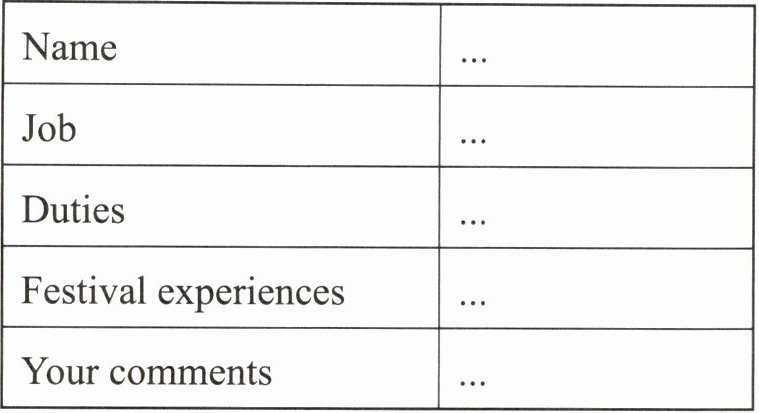
间默默地坚守在自己的工作岗位上,放弃了与家人团聚的机会,用他们的坚守和奉献来诠释责任和担当。请你根据下面的表格提示,写一篇英语短文,介绍节日期间坚守工作岗位的某个人物。注意使用本单元新学的词汇和句型。
名师点拨
这篇习作要求学生写某个人物,时态以一般现在时为主。文章需要介绍人物的姓名、工作、职责、节日期间执勤的经历以及你对该人物及其事迹的评论。
经典范文
Every morning, when I go to school, I see an old man cleaning the street. He wears orange clothes. He is a city cleaner (清洁工人) and we 1. (通常地) call him Grandpa Wang.
He 2. (work) early in the morning, when most people are sleeping at home. He often bends over (弯腰) and cleans up the street. For most people, festivals usually mean 3. (暂停) work and happy 4. (家庭团聚). But for Grandpa Wang, festivals only mean more work. He is often 5. (忙碌得多) during festivals. Sometimes he has to work until midnight because festivals often cause more rubbish. This 6. (使他疲倦), but he 7. (从未后悔) being a city cleaner.
Grandpa Wang always 8. (放弃) his family time to 9. (响应职责的召唤). In my heart, he is a shining star.
答案
1. usually
2. works
3. a break from
4. family reunions
5. much busier
6. makes him tired
7. never regrets
8. gives up
9. answer the call of duty
2. works
3. a break from
4. family reunions
5. much busier
6. makes him tired
7. never regrets
8. gives up
9. answer the call of duty
