

 登录
一、语法专练
第1~5小题:用适当的关系代词或关系副词填空;第6~10小题:用括号内所给单词的适当形式填空,或填入一个适当的词。
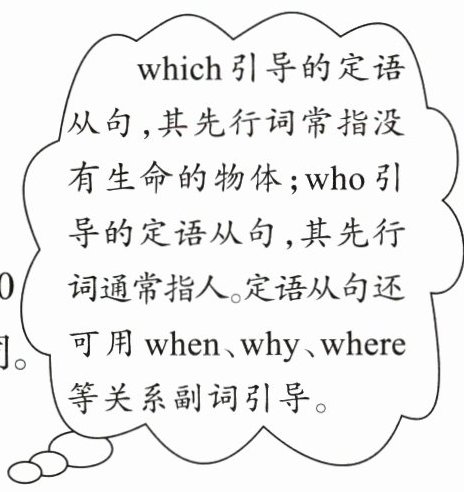
1. Tell us about the people and the places
2. The man
3. I showed the doctor the place
4. Do you know the reason
5. Can you see the old house
When I was ten, most of my friends had bicycles. I hoped I could also have 6.
第1~5小题:用适当的关系代词或关系副词填空;第6~10小题:用括号内所给单词的适当形式填空,或填入一个适当的词。
1. Tell us about the people and the places
that
are different from ours.2. The man
who / that
came to our party with a present just now is my uncle.3. I showed the doctor the place
where
I felt the pain.4. Do you know the reason
why
he didn't come to the meeting just now?5. Can you see the old house
whose
windows are broken?When I was ten, most of my friends had bicycles. I hoped I could also have 6.
one
. One day I saw a second-hand bicycle 7. that / which
was only one hundred yuan. I asked my father for 8. the
money. But he said he could only give me half of it. I should find the other half by myself. So I went to sell newspapers after school. My father was 9. pleased
(please) when I showed him how much money I had made later. 10. When / As
I rode on my own bicycle, you could imagine how happy I was.答案
1. that
2. who / that
3. where
4. why
5. whose
6. one
7. that / which
8. the
9. pleased
10. When / As
解析
【分析】本题分为两部分,1~5小题为定语从句填空,需先明确先行词的属性,再依据定语从句关系词的使用规则选择合适的关系词;6~10小题为语境填词,需结合上下文语义、语法规则确定答案。
【解析】1. 先行词同时包含人(the people)和物(the places),当先行词既有人又有物时,关系代词只能用that,故填that。
2. 先行词是指人的the man,关系词在从句中作主语,可用关系代词who或that,故填who/that。
3. 先行词是表示地点的the place,关系词在从句中作地点状语,需用关系副词where,故填where。
4. 先行词是表示原因的the reason,关系词在从句中作原因状语,需用关系副词why,故填why。
5. 先行词the old house与从句中的windows是所属关系,表“房子的窗户”,需用关系代词whose,故填whose。
6. 此处指代前文的bicycle,同类不同物,用代词one替代,故填one。
7. 先行词是指物的a second-hand bicycle,关系词在从句中作主语,可用关系代词that或which,故填that/which。
8. 此处特指买自行车的钱,需用定冠词the,故填the。
9. 此处需要形容词作表语,描述人的感受,please的形容词形式为pleased,故填pleased。
10. 此处引导时间状语从句,表“当……的时候”,可用When或As,故填When/As。
【答案】1. that;2. who / that;3. where;4. why;5. whose;6. one;7. that / which;8. the;9. pleased;10. When / As
【知识点】定语从句、代词、形容词
【点评】本题综合考查定语从句规则、词汇变形及语境填词,知识点覆盖基础语法,需学生熟练掌握相关用法,难度适中。
【难度系数】0.6
二、完形填空
阅读短文,掌握大意,然后从A、B、C、D四个选项中选出最佳选项。
Long ago there was a boy who really wanted to succeed. For him, winning was 1. One day the boy was to run in a race in his village. A large crowd came to 2. In the crowd was a wise old man. The race began. The runners were neck and neck(齐头并进). It's really a close game. But the boy ran faster and faster. So he beat 3 at the last minute, he became the winner of the race. The crowd 4 the boy. The little boy felt 5 and important. The wise man said nothing.
"Another race, another race!" cried the little boy. The wise old man came up to the little boy and told him to run with two new competitors(竞争者)— an old woman and a(n) 6 man.
"This is no race!" the little boy shouted.
"Race!" said the wise man. The race began again. The boy won. The crowd, however, 7 cheered for him this time.
"Why don't people cheer for my 8?" he asked the wise old man in surprise.
"Race again!" said the wise man,"9 this time, finish the race with the two competitors together." The boy thought a little and took the 10 of the blind man and the old woman. The 11 race began. And the little boy walked 12 together with the two competitors to the finishing line. The crowd cheered. The wise man 13. "14 is the crowd cheering for?" asked the little boy. The wise old man, putting his hands on the boy's shoulders, said quietly, "Little boy, for this race you have 15 much more than in any race that you have ever run before, and for this race the crowd cheer not for any winner, but for the person who cares for his competitors!"
(
B. everything
C. anything
D. something
(
B. play
C. help
D. watch
(
B. another
C. other
D. the other
(
B. worried about
C. cheered for
D. shouted at
(
B. proud
C. strange
D. relaxed
(
B. deaf
C. young
D. blind
(
B. first of all
C. no longer
D. at last
(
B. story
C. news
D. report
(
B. And
C. But
D. Until
(
B. legs
C. eyes
D. shoes
(
B. second
C. third
D. fourth
(
B. happily
C. slowly
D. politely
(
B. slept
C. dreamed
D. smiled
(
B. Why
C. When
D. What
(
B. won
C. walked
D. ran
阅读短文,掌握大意,然后从A、B、C、D四个选项中选出最佳选项。
Long ago there was a boy who really wanted to succeed. For him, winning was 1. One day the boy was to run in a race in his village. A large crowd came to 2. In the crowd was a wise old man. The race began. The runners were neck and neck(齐头并进). It's really a close game. But the boy ran faster and faster. So he beat 3 at the last minute, he became the winner of the race. The crowd 4 the boy. The little boy felt 5 and important. The wise man said nothing.
"Another race, another race!" cried the little boy. The wise old man came up to the little boy and told him to run with two new competitors(竞争者)— an old woman and a(n) 6 man.
"This is no race!" the little boy shouted.
"Race!" said the wise man. The race began again. The boy won. The crowd, however, 7 cheered for him this time.
"Why don't people cheer for my 8?" he asked the wise old man in surprise.
"Race again!" said the wise man,"9 this time, finish the race with the two competitors together." The boy thought a little and took the 10 of the blind man and the old woman. The 11 race began. And the little boy walked 12 together with the two competitors to the finishing line. The crowd cheered. The wise man 13. "14 is the crowd cheering for?" asked the little boy. The wise old man, putting his hands on the boy's shoulders, said quietly, "Little boy, for this race you have 15 much more than in any race that you have ever run before, and for this race the crowd cheer not for any winner, but for the person who cares for his competitors!"
(
B
)1. A. nothingB. everything
C. anything
D. something
(
D
)2. A. listenB. play
C. help
D. watch
(
D
)3. A. othersB. another
C. other
D. the other
(
C
)4. A. laughed atB. worried about
C. cheered for
D. shouted at
(
B
)5. A. sadB. proud
C. strange
D. relaxed
(
D
)6. A. oldB. deaf
C. young
D. blind
(
C
)7. A. so farB. first of all
C. no longer
D. at last
(
A
)8. A. successB. story
C. news
D. report
(
C
)9. A. SoB. And
C. But
D. Until
(
A
)10. A. handsB. legs
C. eyes
D. shoes
(
C
)11. A. firstB. second
C. third
D. fourth
(
C
)12. A. angrilyB. happily
C. slowly
D. politely
(
D
)13. A. criedB. slept
C. dreamed
D. smiled
(
D
)14. A. WhoB. Why
C. When
D. What
(
B
)15. A. paidB. won
C. walked
D. ran
答案
1. B
2. D
3. D
4. C
5. B
6. D
7. C
8. A
9. C
10. A
11. C
12. C
13. D
14. D
15. B
解析
【分析】
这是一篇讲述小男孩参加比赛的记叙文,解题思路为:1. 先通读全文把握主旨(小男孩从执着于“赢”到学会关心对手的成长过程);2. 逐题分析时,结合上下文语境、词汇词义辨析、固定搭配及逻辑关系确定选项,比如第1题根据前文“really wanted to succeed”判断“赢对他的意义”,第6题结合后文“the blind man”锁定对应词汇,第11题梳理比赛次数(第一次、第二次、第三次)确定选项,第15题结合语境匹配动词含义。
【解析】
1. 前文提到男孩“really wanted to succeed”,说明“赢对他来说是一切”,故选B(everything)。
2. 人群来观看村庄的比赛,watch表示“观看”,故选D。
3. 此处指比赛中特定范围内的其他所有选手,the other表示“(特定范围内)其他所有的”,故选D。
4. 男孩赢了比赛,人群为他欢呼,cheered for表示“为……欢呼”,故选C。
5. 男孩赢了比赛,感到骄傲且重要,proud表示“骄傲的”,故选B。
6. 后文提到“the blind man”,可知此处是盲人,故选D。
7. 这次男孩又赢了,但人群不再为他欢呼,no longer表示“不再”,故选C。
8. 男孩问为什么不为他的成功欢呼,success表示“成功”,故选A。
9. 智者让男孩这次和对手一起完成比赛,与前文形成转折,用but,故选C。
10. 男孩牵起盲人和老妇人的手,hands表示“手”,故选A。
11. 这是第三次比赛(第一次赢、第二次赢、第三次陪对手),故选C。
12. 男孩要陪老弱的对手,所以慢慢走,slowly表示“慢慢地”,故选C。
13. 智者看到男孩的改变,微笑,smiled表示“微笑”,故选D。
14. 男孩问人群为什么欢呼,此处询问欢呼的原因,用what指代欢呼的缘由,故选D。
15. 这次比赛男孩赢得的比之前多,won表示“赢得”,故选B。
【答案】
1.B 2.D 3.D 4.C 5.B 6.D 7.C 8.A 9.C 10.A 11.C 12.C 13.D 14.D 15.B
【知识点】
完形填空解题、词义辨析、语境理解
【点评】
本文是富有教育意义的记叙文,通过小男孩的比赛经历传递“关心对手比单纯获胜更重要”的道理,考察学生对上下文逻辑、词汇的理解与运用,需结合语境推理,难度适中。
【难度系数】
0.6
