

 登录
核心素养 中华优秀传统文化 During the Zhou Dynasty, a complete etiquette system was established. Today, many of these rules are not as strict as before. However, we can still learn about them, as they bring us a deep understanding of traditional Chinese culture.
Walking etiquette
① In ancient China, while walking with someone with a higher status(地位) or elderly people, one should lower his head, bend down, and walk a little bit behind them. If three people walk together, the eldest or a teacher should walk in the middle. One should bow down and walk fast using smaller steps when passing by an elder or a teacher.
Sitting etiquette and seating rules
② Everyone should sit in a proper position at dining tables. It is based on their titles, ranks, or age. If someone doesn't know the exact position, they should wait and follow the host's lead. The best seat is the one that faces the east or the door.
Bowing and the fist-and-palm salute(抱拳)
③ Zuoyi, a kind of Chinese bow etiquette, means having one's hands folded in front in different ways. Today, however, the simplest Zuoyi gesture is good enough, as well as nodding, smiling, and handshaking.
④ The fist-and-palm salute is another type of Yili, with the right fist covered by the left hand. It first appeared in the army when people held weapons(武器) while showing respect to others. So people always use the left hand to cover the right hand that holds weapons.
任务一 选择正确答案
1.(创新考法·信息还原)Where can we put the sentence "The seating order is still widely used in family and business dinners." in the passage?
A. ①
B. ②
C. ③
D. ④
2.(创新考法·图片理解)Which correctly describes "the fist-and-palm salute"?
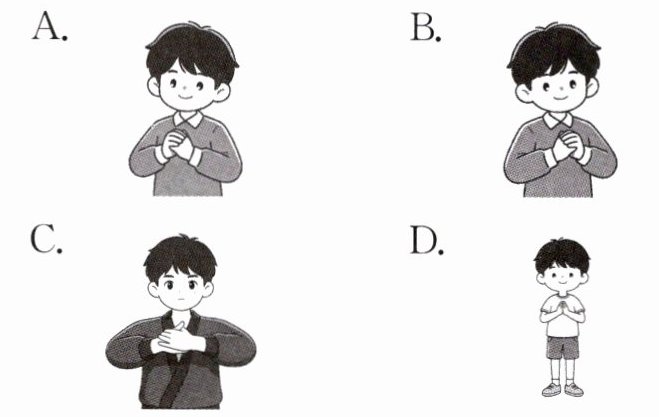
3. Why is the underlined sentence included in the last paragraph?
A. To answer a question.
B. To set the order.
C. To add more information.
D. To start a new point.
任务二 回答问题
1. When was the complete Chinese etiquette system formed?
2. What should you do if you don't know the proper seat at the dinner table?
3. What are common polite ways to greet people in modern China besides the simple Zuoyi?
4. Please give a proper title to the passage.
5. Please write one more paragraph to continue the passage. (About 30 words)
Walking etiquette
① In ancient China, while walking with someone with a higher status(地位) or elderly people, one should lower his head, bend down, and walk a little bit behind them. If three people walk together, the eldest or a teacher should walk in the middle. One should bow down and walk fast using smaller steps when passing by an elder or a teacher.
Sitting etiquette and seating rules
② Everyone should sit in a proper position at dining tables. It is based on their titles, ranks, or age. If someone doesn't know the exact position, they should wait and follow the host's lead. The best seat is the one that faces the east or the door.
Bowing and the fist-and-palm salute(抱拳)
③ Zuoyi, a kind of Chinese bow etiquette, means having one's hands folded in front in different ways. Today, however, the simplest Zuoyi gesture is good enough, as well as nodding, smiling, and handshaking.
④ The fist-and-palm salute is another type of Yili, with the right fist covered by the left hand. It first appeared in the army when people held weapons(武器) while showing respect to others. So people always use the left hand to cover the right hand that holds weapons.
任务一 选择正确答案
1.(创新考法·信息还原)Where can we put the sentence "The seating order is still widely used in family and business dinners." in the passage?
A. ①
B. ②
C. ③
D. ④
2.(创新考法·图片理解)Which correctly describes "the fist-and-palm salute"?
3. Why is the underlined sentence included in the last paragraph?
A. To answer a question.
B. To set the order.
C. To add more information.
D. To start a new point.
任务二 回答问题
1. When was the complete Chinese etiquette system formed?
In the Zhou Dynasty.
2. What should you do if you don't know the proper seat at the dinner table?
Wait for the host's lead.
3. What are common polite ways to greet people in modern China besides the simple Zuoyi?
Nodding, smiling and handshaking.
4. Please give a proper title to the passage.
Chinese Traditional Etiquette
5. Please write one more paragraph to continue the passage. (About 30 words)
Chinese traditional etiquette teaches us to respect the old and be polite to others. These good values are still widely accepted today and they will continue to influence our daily life.
答案
任务一
1. B 信息还原题。题干句子“The seating order is still widely used in family and business dinners.”介绍座次规则如今仍在家庭和商业晚宴中被广泛使用,和小标题 Sitting etiquette and seating rules 话题一致,因此放在②处。
2. B 图片理解题。根据 with the right fist covered by the left hand 可知,抱拳礼为左手盖住右手拳头。
3. C 推理判断题。最后一段画线句介绍抱拳礼最早起源于军队,补充抱拳礼的起源背景,是为原文增加更多相关信息。
任务二
1. In the Zhou Dynasty.
2. Wait for the host's lead.
3. Nodding, smiling and handshaking.
4. Chinese Traditional Etiquette
5. Chinese traditional etiquette teaches us to respect the old and be polite to others. These good values are still widely accepted today and they will continue to influence our daily life.
(答案不唯一)
