

 登录
登录
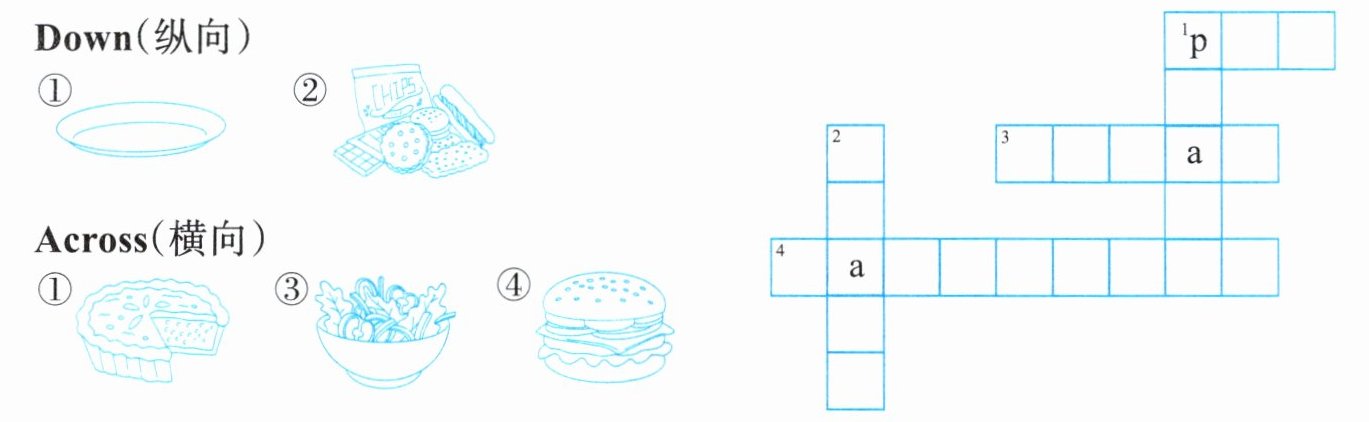
Ⅰ. Look at the pictures and write down the words.
答案
Down: 1. plate 2. snack
Across: 1. pie 3. salad 4. hamburger
Across: 1. pie 3. salad 4. hamburger
解析
【分析】
我们需要结合图片内容和填字格中的字母提示,分纵向(Down)和横向(Across)两步推理单词:
1. 纵向部分:先看①的图片是盘子,填字格首字母为p且共4个字母,对应单词plate;再看②的图片是零食类点心,结合填字格与横向单词交叉的字母a,确定单词snack。
2. 横向部分:①的图片是派,直接对应单词pie;③的图片是沙拉,填字格第四个字母为a,对应单词salad;④的图片是汉堡,填字格第二个字母为a,对应单词hamburger。
【解析】
Down(纵向)
1. 图①是盘子,英文单词为plate,首字母为p,且单词长度为4,与填字格匹配;
2. 图②是零食(饼干、薯片类点心),英文单词为snack,单词第三个字母为a,与填字格中横向单词交叉的字母位置匹配。
Across(横向)
1. 图①是派,英文单词为pie,符合图片内容;
2. 图③是沙拉,英文单词为salad,单词第四个字母为a,与填字格提示的字母位置匹配;
3. 图④是汉堡,英文单词为hamburger,单词第二个字母为a,与填字格提示的字母位置匹配。
【答案】
Down: 1. plate 2. snack
Across: 1. pie 3. salad 4. hamburger
【知识点】
食物类英文单词,单词拼写,填字推理技巧
【点评】
本题以图片结合填字格字母提示的形式,考查常见食物类英文词汇的掌握,既要求学生熟悉单词拼写,又需要结合提示进行简单推理,能有效巩固词汇量并锻炼逻辑思维。
【难度系数】
0.6
我们需要结合图片内容和填字格中的字母提示,分纵向(Down)和横向(Across)两步推理单词:
1. 纵向部分:先看①的图片是盘子,填字格首字母为p且共4个字母,对应单词plate;再看②的图片是零食类点心,结合填字格与横向单词交叉的字母a,确定单词snack。
2. 横向部分:①的图片是派,直接对应单词pie;③的图片是沙拉,填字格第四个字母为a,对应单词salad;④的图片是汉堡,填字格第二个字母为a,对应单词hamburger。
【解析】
Down(纵向)
1. 图①是盘子,英文单词为plate,首字母为p,且单词长度为4,与填字格匹配;
2. 图②是零食(饼干、薯片类点心),英文单词为snack,单词第三个字母为a,与填字格中横向单词交叉的字母位置匹配。
Across(横向)
1. 图①是派,英文单词为pie,符合图片内容;
2. 图③是沙拉,英文单词为salad,单词第四个字母为a,与填字格提示的字母位置匹配;
3. 图④是汉堡,英文单词为hamburger,单词第二个字母为a,与填字格提示的字母位置匹配。
【答案】
Down: 1. plate 2. snack
Across: 1. pie 3. salad 4. hamburger
【知识点】
食物类英文单词,单词拼写,填字推理技巧
【点评】
本题以图片结合填字格字母提示的形式,考查常见食物类英文词汇的掌握,既要求学生熟悉单词拼写,又需要结合提示进行简单推理,能有效巩固词汇量并锻炼逻辑思维。
【难度系数】
0.6
Ⅱ. Complete the sentences according to the phonetic symbols given.
1. While making sandwiches, Joe often
2. People in Sichuan like food with much
3. Doctors ask us to use vegetable
4. Teens should eat about 5 g of
1. While making sandwiches, Joe often
adds
/ædz/ cheese because he loves it.2. People in Sichuan like food with much
pepper
/'pepə(r)/.3. Doctors ask us to use vegetable
oil
/ɔɪl/ when cooking.4. Teens should eat about 5 g of
salt
/sɔ:lt/ a day for good health.答案
1. adds 2. pepper 3. oil 4. salt
解析
【分析】
这道题要求根据给定音标填写合适的单词,解题思路分为两步:首先,准确识别每个音标对应的英文单词;其次,结合句子的语境、语法规则(如动词时态、名词数的变化)验证单词形式是否正确。具体来看:第1题,先根据音标/ædz/拼出单词add,再结合主语Joe是第三人称单数、时态为一般现在时,确定动词用第三人称单数形式adds;第2题,根据音标/'pepə(r)/拼出pepper,结合语境“四川人喜欢多放胡椒的食物”,确认pepper(不可数名词)符合要求;第3题,音标/ɔɪl/对应oil,vegetable oil是固定搭配“植物油”,符合医生的饮食建议语境;第4题,音标/sɔ:lt/对应salt,“5克盐”符合健康饮食的表述,salt作为不可数名词适用。
【解析】
1. 音标/ædz/对应的单词是adds。句子主语Joe是第三人称单数,且often提示时态为一般现在时,谓语动词需用第三人称单数形式,故填adds。
2. 音标/'pepə(r)/对应的单词是pepper,意为“胡椒”,是不可数名词,符合“四川人喜爱多含胡椒的食物”的语境,故填pepper。
3. 音标/ɔɪl/对应的单词是oil,vegetable oil为固定表达“植物油”,契合医生建议烹饪使用植物油的语境,故填oil。
4. 音标/sɔ:lt/对应的单词是salt,意为“盐”,是不可数名词,“5 g of salt”符合健康饮食的用量表述,故填salt。
【答案】
1. adds 2. pepper 3. oil 4. salt
【知识点】
音标识词、名词用法、动词第三人称单数
【点评】
本题围绕生活饮食类词汇展开,既考查学生对音标与单词对应关系的掌握,又结合了一般现在时动词形式、不可数名词等基础语法点,题目贴近日常,有助于学生巩固词汇和语法的实际运用能力。
【难度系数】
0.7
这道题要求根据给定音标填写合适的单词,解题思路分为两步:首先,准确识别每个音标对应的英文单词;其次,结合句子的语境、语法规则(如动词时态、名词数的变化)验证单词形式是否正确。具体来看:第1题,先根据音标/ædz/拼出单词add,再结合主语Joe是第三人称单数、时态为一般现在时,确定动词用第三人称单数形式adds;第2题,根据音标/'pepə(r)/拼出pepper,结合语境“四川人喜欢多放胡椒的食物”,确认pepper(不可数名词)符合要求;第3题,音标/ɔɪl/对应oil,vegetable oil是固定搭配“植物油”,符合医生的饮食建议语境;第4题,音标/sɔ:lt/对应salt,“5克盐”符合健康饮食的表述,salt作为不可数名词适用。
【解析】
1. 音标/ædz/对应的单词是adds。句子主语Joe是第三人称单数,且often提示时态为一般现在时,谓语动词需用第三人称单数形式,故填adds。
2. 音标/'pepə(r)/对应的单词是pepper,意为“胡椒”,是不可数名词,符合“四川人喜爱多含胡椒的食物”的语境,故填pepper。
3. 音标/ɔɪl/对应的单词是oil,vegetable oil为固定表达“植物油”,契合医生建议烹饪使用植物油的语境,故填oil。
4. 音标/sɔ:lt/对应的单词是salt,意为“盐”,是不可数名词,“5 g of salt”符合健康饮食的用量表述,故填salt。
【答案】
1. adds 2. pepper 3. oil 4. salt
【知识点】
音标识词、名词用法、动词第三人称单数
【点评】
本题围绕生活饮食类词汇展开,既考查学生对音标与单词对应关系的掌握,又结合了一般现在时动词形式、不可数名词等基础语法点,题目贴近日常,有助于学生巩固词汇和语法的实际运用能力。
【难度系数】
0.7
Ⅲ. Complete the sentences with the proper form of the words given.
1. It's easy to choose the dishes when we see
2. If you want to make a cake, you should
3. After cooking the dishes, my pot
4. We always plan our meals to get balanced
5. When making a cake, Scott often
1. It's easy to choose the dishes when we see
menus
(menu) with pictures.2. If you want to make a cake, you should
beat
(beat) eggs first.3. After cooking the dishes, my pot
remains/remained
(remain) hot even after an hour.4. We always plan our meals to get balanced
diets
(diet) each day.5. When making a cake, Scott often
stirs
(stir) the butter and sugar together.答案
1. menus 2. beat 3. remains/remained 4. diets 5. stirs
解析
【分析】
这道题要求用所给单词的适当形式完成句子,需结合语境和基础语法规则来判断正确形式:
1. 第1空:menu是可数名词,句中无单数限定词,结合“看到带图片的菜单”的语境,此处指一类或多个菜单,要用复数形式。
2. 第2空:should是情态动词,情态动词后必须接动词原形,因此直接用beat的原形。
3. 第3空:主语my pot是第三人称单数。若描述客观事实用一般现在时remains;若描述过去某次做饭后的情况用一般过去时remained,两种形式都符合语境。
4. 第4空:diet是可数名词,主语we为复数,此处指多人的饮食,需用复数形式。
5. 第5空:主语Scott是第三人称单数,often提示句子用一般现在时,动词要变第三人称单数形式。
【解析】
1. 可数名词menu前无单数限定词,结合语境用复数形式,故填menus。
2. 情态动词should后接动词原形,故填beat。
3. 主语my pot为第三人称单数,一般现在时用remains;描述过去情况用一般过去时remained,两者均正确,故填remains/remained。
4. diet是可数名词,主语we表复数,此处指多人的饮食,用复数形式diets,故填diets。
5. 主语Scott是第三人称单数,often表明用一般现在时,动词变第三人称单数形式stirs,故填stirs。
【答案】
1. menus 2. beat 3. remains/remained 4. diets 5. stirs
【知识点】
1. 名词单复数变化
2. 情态动词用法
3. 一般现在时主谓一致
【点评】
本题聚焦英语基础语法的语境运用,覆盖名词单复数、情态动词规则、动词时态及主谓一致等核心知识点,需要学生结合语境精准判断单词形式,对基础语法的掌握和语境理解能力有一定要求。
【难度系数】
0.7
这道题要求用所给单词的适当形式完成句子,需结合语境和基础语法规则来判断正确形式:
1. 第1空:menu是可数名词,句中无单数限定词,结合“看到带图片的菜单”的语境,此处指一类或多个菜单,要用复数形式。
2. 第2空:should是情态动词,情态动词后必须接动词原形,因此直接用beat的原形。
3. 第3空:主语my pot是第三人称单数。若描述客观事实用一般现在时remains;若描述过去某次做饭后的情况用一般过去时remained,两种形式都符合语境。
4. 第4空:diet是可数名词,主语we为复数,此处指多人的饮食,需用复数形式。
5. 第5空:主语Scott是第三人称单数,often提示句子用一般现在时,动词要变第三人称单数形式。
【解析】
1. 可数名词menu前无单数限定词,结合语境用复数形式,故填menus。
2. 情态动词should后接动词原形,故填beat。
3. 主语my pot为第三人称单数,一般现在时用remains;描述过去情况用一般过去时remained,两者均正确,故填remains/remained。
4. diet是可数名词,主语we表复数,此处指多人的饮食,用复数形式diets,故填diets。
5. 主语Scott是第三人称单数,often表明用一般现在时,动词变第三人称单数形式stirs,故填stirs。
【答案】
1. menus 2. beat 3. remains/remained 4. diets 5. stirs
【知识点】
1. 名词单复数变化
2. 情态动词用法
3. 一般现在时主谓一致
【点评】
本题聚焦英语基础语法的语境运用,覆盖名词单复数、情态动词规则、动词时态及主谓一致等核心知识点,需要学生结合语境精准判断单词形式,对基础语法的掌握和语境理解能力有一定要求。
【难度系数】
0.7
Ⅳ. Read and complete the tasks.
A. Complete the conversation with proper sentences in the box. There is one extra option.
Oliver: Betty, some people say that we should eat as many fruit and vegetables as we can. Is that right?
Betty: 1.
Oliver: Really? What else should we eat?
Betty: 2.
Oliver: I see. What about snacks? Are they unhealthy?
Betty: I read a health guide yesterday. Actually, you can eat some snacks. 3.
Oliver: Got it! What about fat and salt? I think they are always bad for us.
Betty: 4.
Oliver: It seems that everything can be good for us if we eat it in the right way.
Betty: You're right!
A. That's not true.
B. I don't agree with you.
C. Snacks are always bad for our health.
D. Just choose healthy snacks between meals.
E. We should eat all kinds of food to be healthy.
B. Answer the questions.
(
A. Most snacks are not healthy.
B. We should only eat vegetables.
C. Fat and salt are bad for our health.
D. We should eat many kinds of food.
2. What other healthy eating tips do you know?
C. Find out the sentences in the conversation showing disagreement and correcting false information.
1. Disagreement:
2. Correcting false information:
A. Complete the conversation with proper sentences in the box. There is one extra option.
Oliver: Betty, some people say that we should eat as many fruit and vegetables as we can. Is that right?
Betty: 1.
A
They are really good for us. But in fact, we can't only eat those.Oliver: Really? What else should we eat?
Betty: 2.
E
In this way, our bodies can get different nutrients(营养).Oliver: I see. What about snacks? Are they unhealthy?
Betty: I read a health guide yesterday. Actually, you can eat some snacks. 3.
D
Oliver: Got it! What about fat and salt? I think they are always bad for us.
Betty: 4.
B
Too much fat and salt is bad for your health. However, we need them for our bodies to be healthy.Oliver: It seems that everything can be good for us if we eat it in the right way.
Betty: You're right!
A. That's not true.
B. I don't agree with you.
C. Snacks are always bad for our health.
D. Just choose healthy snacks between meals.
E. We should eat all kinds of food to be healthy.
B. Answer the questions.
(
D
)1. What can we learn from the conversation?A. Most snacks are not healthy.
B. We should only eat vegetables.
C. Fat and salt are bad for our health.
D. We should eat many kinds of food.
2. What other healthy eating tips do you know?
One possible version: Junk food is not good for us. It can make us feel sick. Try to eat less junk food.
C. Find out the sentences in the conversation showing disagreement and correcting false information.
1. Disagreement:
That's not true./I don't agree with you.
2. Correcting false information:
But in fact, .../Actually, ...
答案
A. 1. A 2. E 3. D 4. B
B. 1. D
2. One possible version: Junk food is not good for us. It can make us feel sick. Try to eat less junk food.
C. 1. That's not true./I don't agree with you. 2. But in fact, .../Actually, ...
B. 1. D
2. One possible version: Junk food is not good for us. It can make us feel sick. Try to eat less junk food.
C. 1. That's not true./I don't agree with you. 2. But in fact, .../Actually, ...
解析
【分析】
首先处理A部分补全对话:需结合上下文的问答逻辑,分析每空前后的语境,匹配选项含义。第1空,Oliver询问“尽可能多吃水果蔬菜”的说法是否正确,Betty后续提到水果蔬菜有益但不能只吃,说明该说法不完全正确,需选否定类表述;第2空,Oliver询问还应吃什么,Betty要给出饮食建议,需匹配“吃多种食物获取营养”的内容;第3空,Betty表明可以吃零食,需补充健康吃零食的具体建议;第4空,Oliver认为脂肪和盐总是有害,Betty要表达不同意并纠正,需选对应表述。
B部分第1题是细节理解题,需逐一核对选项与对话内容是否相符;第2题是开放性问题,只需给出合理的健康饮食建议即可。
C部分需从对话中找出明确表达不同意的句子,以及用于纠正错误信息的过渡句,结合对话内容定位即可。
【解析】
A. Complete the conversation
1. 第1空:Oliver提出“应尽可能多吃水果蔬菜”的观点并询问是否正确,Betty回应“它们确实有益,但不能只吃这些”,说明该观点不完全正确,故选A(That's not true.)。
2. 第2空:Oliver询问还应吃什么,Betty回答要让身体获取不同营养,对应选项E(We should eat all kinds of food to be healthy.),符合“吃多种食物补充营养”的逻辑。
3. 第3空:Betty表明可以吃零食,后续应补充健康吃零食的建议,选项D(Just choose healthy snacks between meals.)符合语境。
4. 第4空:Oliver认为脂肪和盐总是有害,Betty反驳说过量才有害但身体需要它们,故选B(I don't agree with you.)表达不同意。
B. Answer the questions
1. 第1题:
A选项:对话未提及“大部分零食不健康”,错误;
B选项:对话明确说“不能只吃水果蔬菜”,错误;
C选项:对话指出“过量脂肪和盐有害,但身体需要它们”,并非总是有害,错误;
D选项:对话提到“要吃各种食物获取不同营养”,符合内容,正确。
2. 第2题:开放性问题,示例:We should have three meals on time every day and avoid eating too much before going to bed.(合理即可)
C. Find out the sentences
1. 表达不同意的句子:对话中直接表达否定观点的是“That's not true.”和“I don't agree with you.”。
2. 纠正错误信息的句子:用于纠正错误认知的过渡句是“But in fact, we can't only eat those.”和“Actually, you can eat some snacks.”。
【答案】
A. 1. A 2. E 3. D 4. B
B. 1. D
2. One possible version: Junk food is not good for us. It can make us feel sick. Try to eat less junk food.
C. 1. That's not true./I don't agree with you. 2. But in fact, .../Actually, ...
【知识点】
情景对话补全、细节理解判断、健康话题表达
【点评】
本题围绕健康饮食的实用话题展开,综合考查学生的情景对话逻辑分析能力、阅读理解细节判断能力和英语语言输出能力,内容贴近日常生活,能帮助学生积累健康相关的英语表达,提升语言运用的实用性。
【难度系数】
0.6
首先处理A部分补全对话:需结合上下文的问答逻辑,分析每空前后的语境,匹配选项含义。第1空,Oliver询问“尽可能多吃水果蔬菜”的说法是否正确,Betty后续提到水果蔬菜有益但不能只吃,说明该说法不完全正确,需选否定类表述;第2空,Oliver询问还应吃什么,Betty要给出饮食建议,需匹配“吃多种食物获取营养”的内容;第3空,Betty表明可以吃零食,需补充健康吃零食的具体建议;第4空,Oliver认为脂肪和盐总是有害,Betty要表达不同意并纠正,需选对应表述。
B部分第1题是细节理解题,需逐一核对选项与对话内容是否相符;第2题是开放性问题,只需给出合理的健康饮食建议即可。
C部分需从对话中找出明确表达不同意的句子,以及用于纠正错误信息的过渡句,结合对话内容定位即可。
【解析】
A. Complete the conversation
1. 第1空:Oliver提出“应尽可能多吃水果蔬菜”的观点并询问是否正确,Betty回应“它们确实有益,但不能只吃这些”,说明该观点不完全正确,故选A(That's not true.)。
2. 第2空:Oliver询问还应吃什么,Betty回答要让身体获取不同营养,对应选项E(We should eat all kinds of food to be healthy.),符合“吃多种食物补充营养”的逻辑。
3. 第3空:Betty表明可以吃零食,后续应补充健康吃零食的建议,选项D(Just choose healthy snacks between meals.)符合语境。
4. 第4空:Oliver认为脂肪和盐总是有害,Betty反驳说过量才有害但身体需要它们,故选B(I don't agree with you.)表达不同意。
B. Answer the questions
1. 第1题:
A选项:对话未提及“大部分零食不健康”,错误;
B选项:对话明确说“不能只吃水果蔬菜”,错误;
C选项:对话指出“过量脂肪和盐有害,但身体需要它们”,并非总是有害,错误;
D选项:对话提到“要吃各种食物获取不同营养”,符合内容,正确。
2. 第2题:开放性问题,示例:We should have three meals on time every day and avoid eating too much before going to bed.(合理即可)
C. Find out the sentences
1. 表达不同意的句子:对话中直接表达否定观点的是“That's not true.”和“I don't agree with you.”。
2. 纠正错误信息的句子:用于纠正错误认知的过渡句是“But in fact, we can't only eat those.”和“Actually, you can eat some snacks.”。
【答案】
A. 1. A 2. E 3. D 4. B
B. 1. D
2. One possible version: Junk food is not good for us. It can make us feel sick. Try to eat less junk food.
C. 1. That's not true./I don't agree with you. 2. But in fact, .../Actually, ...
【知识点】
情景对话补全、细节理解判断、健康话题表达
【点评】
本题围绕健康饮食的实用话题展开,综合考查学生的情景对话逻辑分析能力、阅读理解细节判断能力和英语语言输出能力,内容贴近日常生活,能帮助学生积累健康相关的英语表达,提升语言运用的实用性。
【难度系数】
0.6
