

 登录
登录
一、新语篇 海报网页 Su Hai 和 Mike 想要去农场游玩。观察农场的海报,判断句子正(T)误(F)。
Happy Farm
Open time: 10:00 in the morning-5:00 in the afternoon
Call: 0151413
Price: Students: ¥10/person(人) Adults: ¥20/person
Do things: pick apples, pears and grapes; feed cows and sheep; play with dogs and cats; pick up eggs ...
Don't: swim in the lake, throw rubbish, shout ...
(
(
(
(
(
Happy Farm
Open time: 10:00 in the morning-5:00 in the afternoon
Call: 0151413
Price: Students: ¥10/person(人) Adults: ¥20/person
Do things: pick apples, pears and grapes; feed cows and sheep; play with dogs and cats; pick up eggs ...
Don't: swim in the lake, throw rubbish, shout ...
(
T
)1. The name of the farm is Happy Farm.(
T
)2. "Open time" means "开放时间".(
F
)3. Mike and Su Hai need to pay ¥30 altogether(总共).(
T
)4. We can pick up eggs on the farm.(
F
)5. We can swim on the farm.答案
1. T 2. T 3. F 4. T 5. F
解析
【解析】
1. 海报开头明确标注农场名称为Happy Farm,该表述符合海报内容,故正确。
2. "Open time"是常用英文短语,对应的中文意思为“开放时间”,表述正确。
3. Su Hai和Mike均为学生,单人票价是¥10,两人总共需支付¥10×2=¥20,并非¥30,该表述错误。
4. 海报里“Do things”板块包含“pick up eggs”的内容,说明在农场可以捡鸡蛋,表述正确。
5. 海报“Don't”部分明确指出不能在湖里游泳,所以该表述错误。
【答案】
1. T 2. T 3. F 4. T 5. F
【知识点】
海报信息提取、词义猜测、细节理解
【点评】
本题借助英文农场海报,考查学生对信息的提取与细节理解能力,要求学生细致阅读海报内容,区分可做与禁止的行为,同时准确计算费用,能锻炼学生的信息筛选与逻辑判断能力。
【难度系数】
0.8
1. 海报开头明确标注农场名称为Happy Farm,该表述符合海报内容,故正确。
2. "Open time"是常用英文短语,对应的中文意思为“开放时间”,表述正确。
3. Su Hai和Mike均为学生,单人票价是¥10,两人总共需支付¥10×2=¥20,并非¥30,该表述错误。
4. 海报里“Do things”板块包含“pick up eggs”的内容,说明在农场可以捡鸡蛋,表述正确。
5. 海报“Don't”部分明确指出不能在湖里游泳,所以该表述错误。
【答案】
1. T 2. T 3. F 4. T 5. F
【知识点】
海报信息提取、词义猜测、细节理解
【点评】
本题借助英文农场海报,考查学生对信息的提取与细节理解能力,要求学生细致阅读海报内容,区分可做与禁止的行为,同时准确计算费用,能锻炼学生的信息筛选与逻辑判断能力。
【难度系数】
0.8
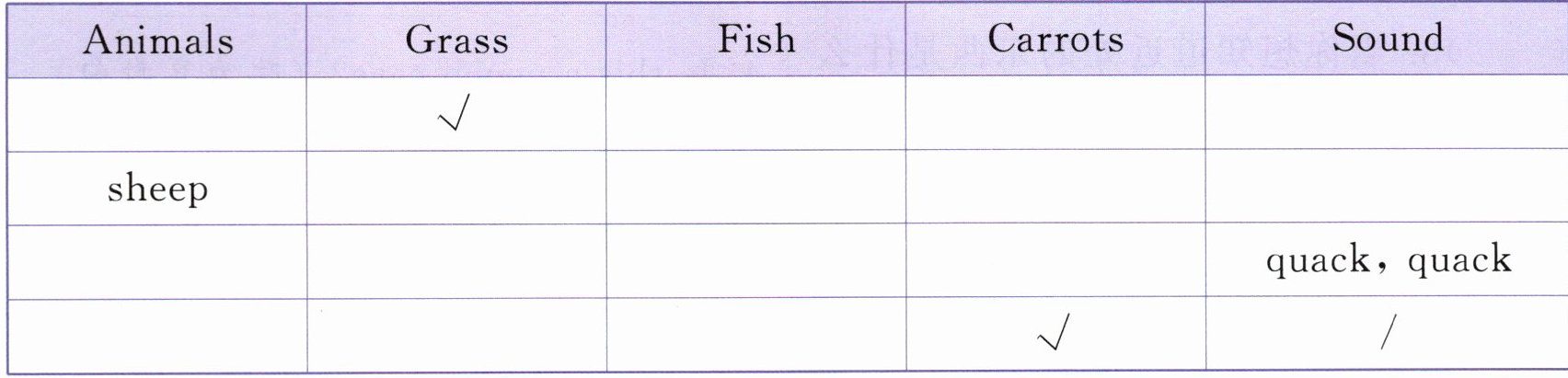
二、新考法 思维导图 Tina 和弟弟 Timmy 来到了农场,他们想了解农场动物的叫声以及喜欢的食物。请根据对话内容,完成下面的表格。
Tina: Hello, Grandpa! Your farm is big. Are those cows? What do they like?
Grandpa: Yes, they are. They like grass and they go "moo, moo".
Timmy: And what about the sheep?
Grandpa: Sheep like grass too. They say "baa, baa".
Tina: Cool! What do the ducks like?
Grandpa: Ducks like fish(鱼) and they go "quack, quack".
Timmy: What about the rabbits?
Grandpa: Rabbits like carrots. They are so cute.
Tina: Hello, Grandpa! Your farm is big. Are those cows? What do they like?
Grandpa: Yes, they are. They like grass and they go "moo, moo".
Timmy: And what about the sheep?
Grandpa: Sheep like grass too. They say "baa, baa".
Tina: Cool! What do the ducks like?
Grandpa: Ducks like fish(鱼) and they go "quack, quack".
Timmy: What about the rabbits?
Grandpa: Rabbits like carrots. They are so cute.
答案
解析
【解析】
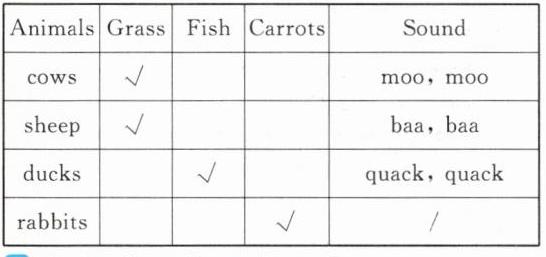
本题需根据对话内容提取每种农场动物对应的喜好食物与叫声,再匹配填入表格:
1. 由对话可知,奶牛(cows)喜欢草(Grass),叫声为"moo, moo";
2. 绵羊(sheep)喜欢草(Grass),叫声为"baa, baa";
3. 鸭子(ducks)喜欢鱼(Fish),叫声为"quack, quack";
4. 兔子(rabbits)喜欢胡萝卜(Carrots),无对应叫声标注,填"/"。
【答案】
| Animals | Grass | Fish | Carrots | Sound |
| --- | --- | --- | --- | --- |
| cows | √ | | | moo, moo |
| sheep | √ | | | baa, baa |
| ducks | | √ | | quack, quack |
| rabbits | | | √ | / |
【知识点】
农场动物认知、对话信息提取、英语词汇应用
【点评】
本题以农场对话为场景,考查学生从英语对话中提取关键信息的能力,同时巩固常见农场动物的食物与叫声相关知识,贴近生活实际,有助于提升学生的语言运用能力。
【难度系数】
0.9
本题需根据对话内容提取每种农场动物对应的喜好食物与叫声,再匹配填入表格:
1. 由对话可知,奶牛(cows)喜欢草(Grass),叫声为"moo, moo";
2. 绵羊(sheep)喜欢草(Grass),叫声为"baa, baa";
3. 鸭子(ducks)喜欢鱼(Fish),叫声为"quack, quack";
4. 兔子(rabbits)喜欢胡萝卜(Carrots),无对应叫声标注,填"/"。
【答案】
| Animals | Grass | Fish | Carrots | Sound |
| --- | --- | --- | --- | --- |
| cows | √ | | | moo, moo |
| sheep | √ | | | baa, baa |
| ducks | | √ | | quack, quack |
| rabbits | | | √ | / |
【知识点】
农场动物认知、对话信息提取、英语词汇应用
【点评】
本题以农场对话为场景,考查学生从英语对话中提取关键信息的能力,同时巩固常见农场动物的食物与叫声相关知识,贴近生活实际,有助于提升学生的语言运用能力。
【难度系数】
0.9
