

 登录
登录
1. They are going to have a picnic at weekends. (改为一般疑问句,并作否定回答)
— __________ __________ __________ have a picnic at weekends?
— No, __________ __________.
2. I will volunteer at the Children’s Centre next Saturday. (对画线部分提问)
__________ __________ you __________ next Saturday?
3. My cousin will ask someone to help him. (改为否定句)
My cousin __________ __________ __________ help him.
4. Nothing is wrong with your computer. (改为同义句)
__________ __________ __________ __________ your computer.
5. Our community is large and beautiful. (对画线部分提问)
__________ __________ your community __________?
— __________ __________ __________ have a picnic at weekends?
— No, __________ __________.
2. I will volunteer at the Children’s Centre next Saturday. (对画线部分提问)
__________ __________ you __________ next Saturday?
3. My cousin will ask someone to help him. (改为否定句)
My cousin __________ __________ __________ help him.
4. Nothing is wrong with your computer. (改为同义句)
__________ __________ __________ __________ your computer.
5. Our community is large and beautiful. (对画线部分提问)
__________ __________ your community __________?
答案
三、1. Are they going to; they aren’t 2. Where will you volunteer
3. won’t ask anyone to 4. There’s nothing wrong with
5. How is your community/What is your community like
3. won’t ask anyone to 4. There’s nothing wrong with
5. How is your community/What is your community like
1. 如果你很赶,你可以乘坐出租车。
You can take a taxi __________ __________ __________ __________.
2. 下周天气很好。你们打算外出一天吗?
It’s going to be fine next week. __________ __________ __________ __________ __________?
3. 本周末,我们将要在公园里捡垃圾。
We __________ __________ __________ __________ in the park this weekend.
4. 如果明天下雨,你将要做什么?
What __________ you __________ __________ __________ tomorrow?
5. 你打算邀请你的朋友们加入这个俱乐部吗?
__________ you __________ __________ __________ your friends __________ __________ the club?
You can take a taxi __________ __________ __________ __________.
2. 下周天气很好。你们打算外出一天吗?
It’s going to be fine next week. __________ __________ __________ __________ __________?
3. 本周末,我们将要在公园里捡垃圾。
We __________ __________ __________ __________ in the park this weekend.
4. 如果明天下雨,你将要做什么?
What __________ you __________ __________ __________ tomorrow?
5. 你打算邀请你的朋友们加入这个俱乐部吗?
__________ you __________ __________ __________ your friends __________ __________ the club?
答案
四、1. if you are in a hurry 2. Are you going to have a day out
3. will pick up the rubbish in the park 4. will you do if it rains
5. Are you going to invite your friends to join
3. will pick up the rubbish in the park 4. will you do if it rains
5. Are you going to invite your friends to join
Winston Churchill once said, “We make a living by what we get, but we make a life by what we give.” 1. ______ One of the ways of giving to those around us is through voluntary work.
Volunteering lets me understand more about people who have less than me. Once, I volunteered to clean up the homes of those in need. I was surprised at how old and crowded (拥挤) their homes were. When I talked to them, I learned about their sad stories and how difficult their life was. 2. ______ It also reminds (提醒) me to do more for them.
When I volunteered at a school to teach students with disabilities (残疾), I noticed how much they were thankful for small things. When I helped them with everyday tasks, they would smile and say “thank you”; when I taught them something new, they would smile and say “thank you”; when I played with them, they would smile and say “thank you”. 3. ______
Volunteering matters a lot to me. 4. ______ I am able to see a bigger world and care about others. It’s not just about going through daily life. It’s about making a difference to the world around me.
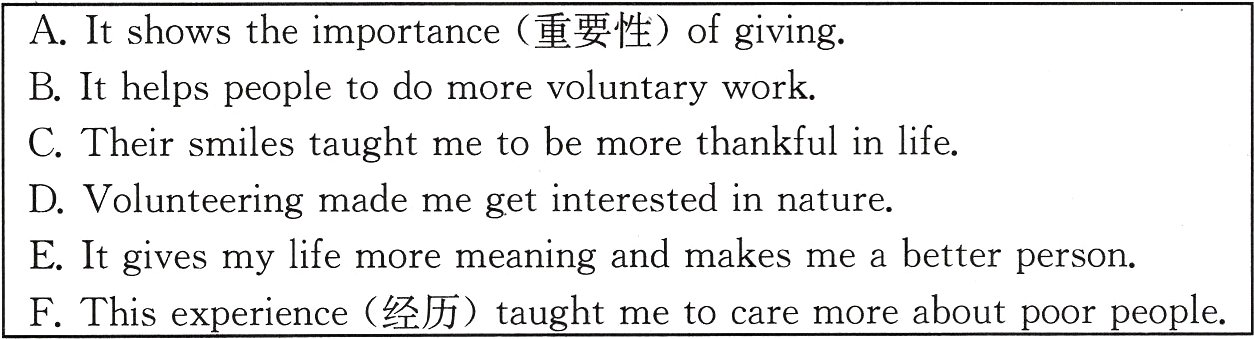
A. It shows the importance (重要性) of giving.
B. It helps people to do more voluntary work.
C. Their smiles taught me to be more thankful in life.
D. Volunteering made me get interested in nature.
E. It gives my life more meaning and makes me a better person.
F. This experience (经历) taught me to care more about poor people.
Volunteering lets me understand more about people who have less than me. Once, I volunteered to clean up the homes of those in need. I was surprised at how old and crowded (拥挤) their homes were. When I talked to them, I learned about their sad stories and how difficult their life was. 2. ______ It also reminds (提醒) me to do more for them.
When I volunteered at a school to teach students with disabilities (残疾), I noticed how much they were thankful for small things. When I helped them with everyday tasks, they would smile and say “thank you”; when I taught them something new, they would smile and say “thank you”; when I played with them, they would smile and say “thank you”. 3. ______
Volunteering matters a lot to me. 4. ______ I am able to see a bigger world and care about others. It’s not just about going through daily life. It’s about making a difference to the world around me.
A. It shows the importance (重要性) of giving.
B. It helps people to do more voluntary work.
C. Their smiles taught me to be more thankful in life.
D. Volunteering made me get interested in nature.
E. It gives my life more meaning and makes me a better person.
F. This experience (经历) taught me to care more about poor people.
答案
五、1 - 4 AFCE
