

 登录
登录
三、阅读理解(共15小题;每小题2分,满分30分)
A
The Four Great Inventions of China
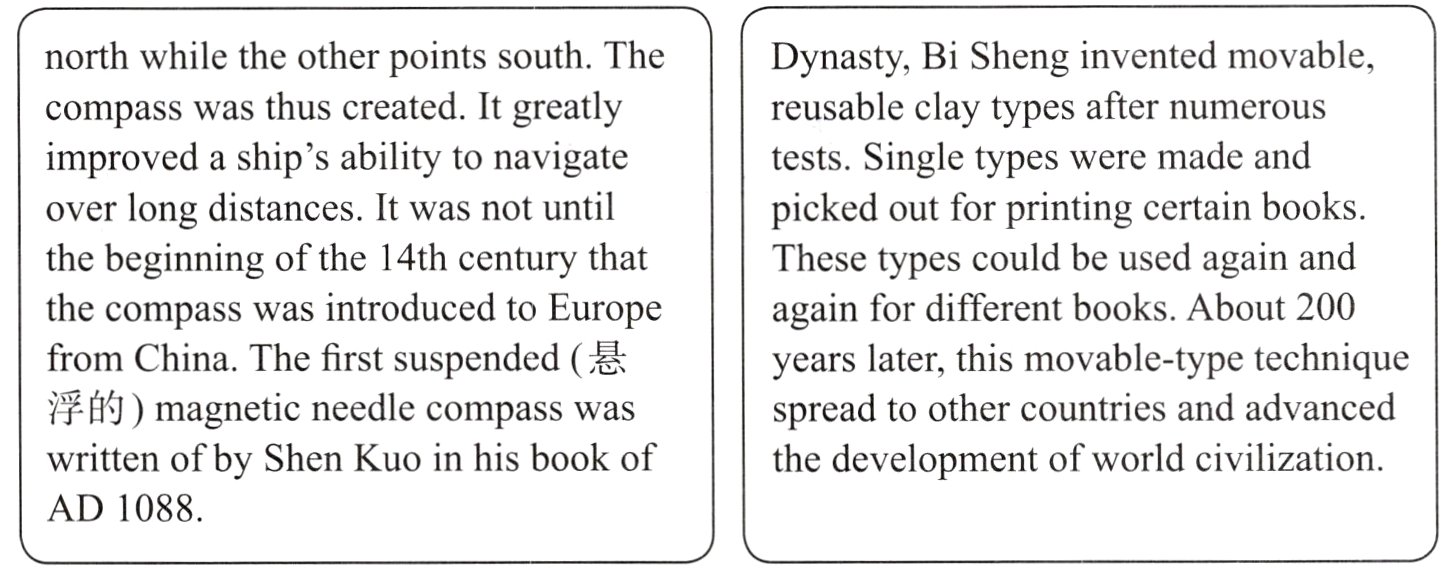
(continued)
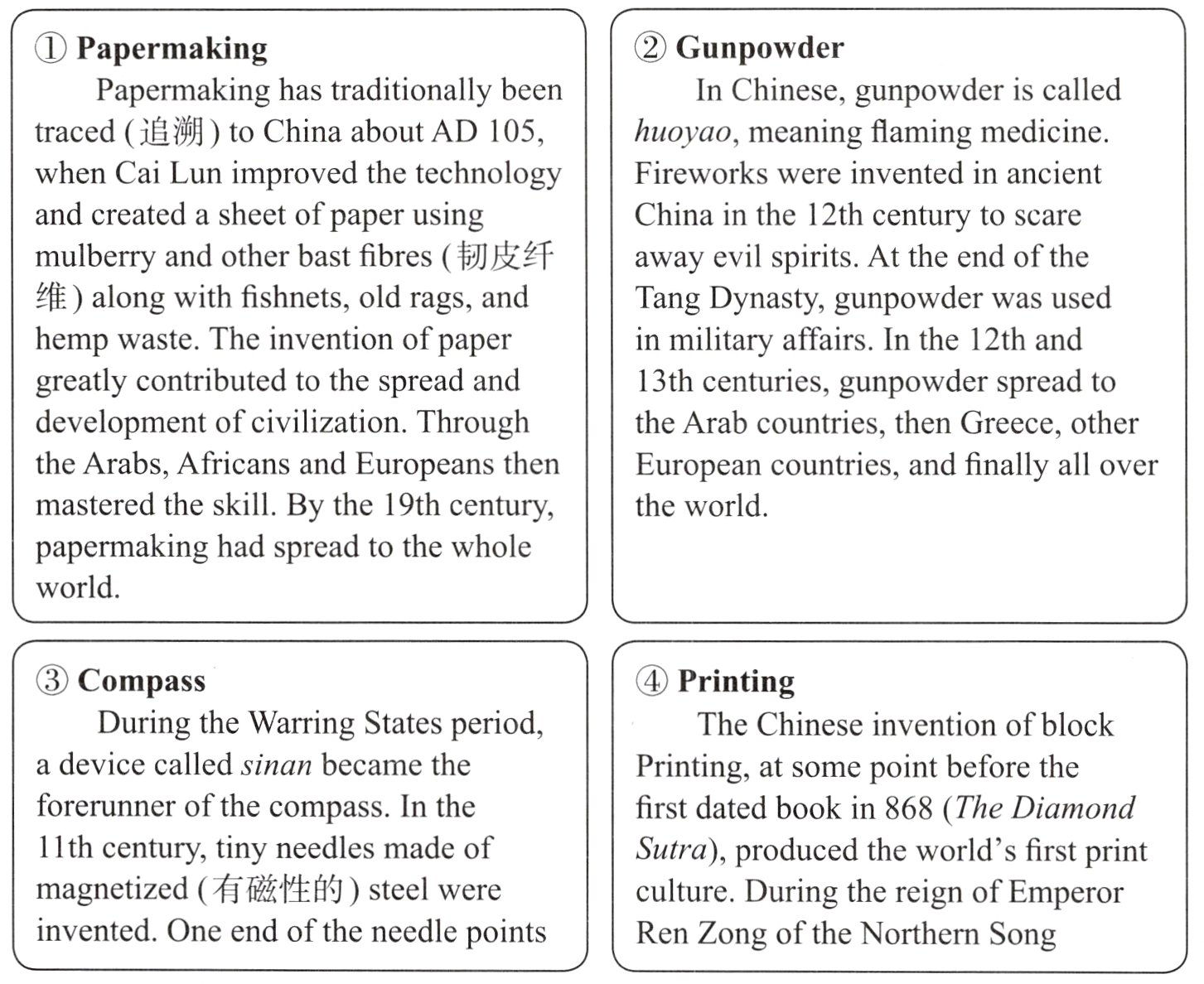
① Papermaking
Papermaking has traditionally been traced (追溯) to China about AD 105, when Cai Lun improved the technology and created a sheet of paper using mulberry and other bast fibres (韧皮纤维) along with fishnets, old rags, and hemp waste. The invention of paper greatly contributed to the spread and development of civilization. Through the Arabs, Africans and Europeans then mastered the skill. By the 19th century, papermaking had spread to the whole world.
② Gunpowder
In Chinese, gunpowder is called huoyao, meaning flaming medicine. Fireworks were invented in ancient China in the 12th century to scare away evil spirits. At the end of the Tang Dynasty, gunpowder was used in military affairs. In the 12th and 13th centuries, gunpowder spread to the Arab countries, then Greece, other European countries, and finally all over the world.
③ Compass
During the Warring States period, a device called sinan became the forerunner of the compass. In the 11th century, tiny needles made of magnetized (有磁性的) steel were invented. One end of the needle points north while the other points south. The compass was thus created. It greatly improved a ship’s ability to navigate over long distances. It was not until the beginning of the 14th century that the compass was introduced to Europe from China. The first suspended (悬浮的) magnetic needle compass was written of by Shen Kuo in his book of AD 1088.
④ Printing
The Chinese invention of block Printing, at some point before the first dated book in 868 (The Diamond Sutra), produced the world’s first print culture. During the reign of Emperor Ren Zong of the Northern Song Dynasty, Bi Sheng invented movable, reusable clay types after numerous tests. Single types were made and picked out for printing certain books. These types could be used again and again for different books. About 200 years later, this movable - type technique spread to other countries and advanced the development of world civilization.
( ) 31. Which was used by Cai Lun to create paper?
A. Mulberry and steel. B. Old rags and hemp waste.
C. Bast fibres and fish. D. Water and berries.
( ) 32. The compass was introduced to Europe __________.
A. during the Warring States period B. in the 11th century
C. at the beginning of the 14th century D. in the 12th century
( ) 33. Which of the following is true according to the passage?
A. During the Tang Dynasty, Bi Sheng invented movable, reusable clay types.
B. The Four Great Inventions advanced the development of world civilization.
C. At the end of the Song Dynasty, gunpowder was being used in military affairs.
D. Gunpowder spread to Greece, then Arab countries and other European countries.
B
Mr Sun is in the hot seat for stealing a woman’s seat on a high - speed train on Aug 21, 2018.
An online video showed the man, Sun, taking a window seat in a second - class coach (车厢) of a train from Jinan to Beijing on Tuesday and refusing to give it to the woman who had the seat on her ticket.
“You have three choices—stand, take my seat or go to the dining coach,” Sun told the young woman in the video. According to the tickets, Sun’s seat was one row behind the woman’s. Sun refused to return to his own seat, saying that he couldn’t stand up. When asked by a train worker why he did not stand up, he answered, “I did not know how.” He kept his words even after the train arrived at his stop, requiring train workers to find a wheelchair for him. Clearly, he did not need one when getting on the train. Later, the woman was led to the business - class coach where she was given a better seat for the trip.
The video quickly spread online. Many Internet users criticized (批评) Sun for his actions. Some even dug up his name, education and work history and posted the information online. In the end, Sun was fined 200 yuan and would not be allowed to buy train tickets for 180 days.
This punishment was based on rules for dealing with troublesome passengers set by railway authorities. The rules came into use on May 1, 2018. According to the rules, passengers who trouble public order will be fined up to 500 yuan and be prevented from buying train tickets for some time.
However, more things like this have still happened, pushing authorities to work out even stricter rules. A month later, Mrs Zhou took a window seat on a train from Hunan to Guangdong. When the window seat passenger asked her to give the seat back, she refused.
In turn, the government of Guangdong Province set up new rules that came into use in the same year. High - speed train passengers who refuse to move after taking others’ seats will face fines from 500 to 2,000 yuan. Their information will be shared with other parts of the national railway network, which will influence their right to buy train tickets.
( ) 34. What may the underlined words “in the hot seat” in Paragraph 1 mean?
A. Staying in the centre of a room. B. Facing the public’s attention.
C. Being in a warm seat. D. Entering a popular situation.
( ) 35. According to the passage, which is the right order of the following things?
① A worker in the train tried to ask the man to return to his own seat.
② A man took a woman’s seat on a high - speed train.
③ A woman refused to give the window seat back.
④ The man wouldn’t be allowed to buy train tickets for 180 days.
⑤ The woman had to sit on another seat.
A. ③⑤②①④ B. ②①⑤④③ C. ③②①⑤④ D. ②①⑤③④
( ) 36. What can be inferred (推断) from the passage?
A. Mr Sun’s legs were hurt and couldn’t stand up.
B. Fewer people would like to take a high - speed train because of the new rules.
C. People in Guangdong won’t be allowed to take a plane if they break the new rules.
D. Authorities will make stricter rules to prevent such things happening.
( ) 37. What is the passage mainly about?
A. Strange passengers on the train. B. Bad behaviour on the train.
C. Punishment on the train. D. Rules on the train.
C
Many people complain that their memory is bad, especially as they get older. Phone numbers, names, facts we studied only a few days ago—life would be so much easier if we could remember them all effortlessly. So how can we improve our memory?
Many people think that repeating things is the best way to remember them. While this undoubtedly helps short - term memory (remembering a telephone number for a few seconds, for example), psychologists (心理学家) doubt whether it can help you to remember things for very long. The British psychologist E. C. Stanford seemed to prove this point when he tested himself on five articles that he had read aloud every morning for over 25 years. He found that he could remember no more than three words of them! More helpful, especially for remembering numbers, is grouping the information. The following numbers would be impossible for most of us to remember: 1492178919931848. But look at them in chunks, and it becomes much easier: 1492 1789 1993 1848.
So what about “memory training”? We’ve all heard about people who can memorize packs of cards by heart—how is this done and can anyone learn how to do it? According to experts, there are many ways of training your memory. Many of them include forming a mental picture of the items to be memorized. One method, which may be useful in learning foreign languages, is to create a picture in your mind connected to a word you want to remember.
Another method is to invent a story that includes all the things you want to remember. In experiments (实验), people were asked to remember up to 120 words using this skill; when tested afterwards, on average, they were able to recall 90% of them!
However, not all of us are interested in learning long lists of names and numbers just for fun. For those studying large amounts of information, psychologists suggest that the best way to form meaningful connections (should) be to ask yourself lots of questions as you go along. So, for example, if you were reading about a particular disease, you would ask yourself questions like, “Do people get it from water?” “What parts of the body does it influence?” and so on. This is said to be far more effective (有效的) than time spent passively reading and re - reading notes.
( ) 38. Which of the following is true about repeating things according to the passage?
A. It helps short - time memory for sure.
B. It helps to remember things for long.
C. It makes remembering things interesting.
D. It makes remembering prayers effortless.
( ) 39. The underlined word “chunks” in Paragraph 2 probably means “__________”.
A. details B. groups C. turns D. lines
( ) 40. What can we infer from the passage?
A. Creating a picture is useful in learning Maths.
B. Inventing a prayer trains our memory quickly.
C. Remembering long numbers is easy for people.
D. Asking yourself questions helps remember things.
( ) 41. What’s the writer’s main purpose in writing this passage?
A. To complain that his memory is bad.
B. To discuss some memory problems.
C. To explain some memory experiments.
D. To share some ways of improving memory.
D
I strongly believe that we can have an important effect on anyone we meet. The right words at just the right time could totally change someone’s life.
Years ago, that’s what happened to me. My life was completely changed because a simple three - word phrase was delivered at the right time in just the right way.
When I was three years old, my parents discovered I was totally deaf. After asking many educational specialists, doctors, psychologists, and parents of other deaf children, they decided to put me in a “mainstream” school. All of my classmates and teachers would have normal hearing.
From the time I started going there in the third grade, I was the only deaf child at Blue Creek Elementary School in the small quiet town of Latham, New York. From almost the first day there, the other kids made fun of me and called me names because of my hearing aid and the way I talked.
I worried throughout elementary school because, besides the problems of “fitting in” with the other students, I also struggled with most of my schoolwork. Although I seemed outgoing, my self - esteem was quite low. I saw myself as an ugly kid wearing a strange - looking box around his neck who wasn’t even smart enough to keep up with the other kids.
Mrs Jordan, my fifth - grade teacher, changed all that with a simple three - word phrase. Mrs Jordan was a large woman with a voice that bounced (反弹) off the walls of her tiny classroom.
One morning, she asked the class a question. I read her lips and immediately raised my hand. For once I knew the answer. But, when she called on me, I was afraid. I took a deep breath and nervously answered Mrs Jordan’s question. I will never forget what happened next. Mrs Jordan pointed directly at me. With sparkling eyes and a wide smile she cried, “THAT’S RIGHT, STEPHEN!” For the first time in my young life, I was an instant star. My confidence soared like never before.
I decided right then and there that I would make a place for myself in this world. No matter how many difficulties I might meet in life, I knew I could overcome them. A simple three - word phrase delivered with incredible enthusiasm (热情) had totally changed my young life. “THAT’S RIGHT, STEPHEN!”
( ) 42. A “mainstream” school is probably where __________.
A. students can receive extra care
B. there are many wonderful teachers
C. students with disabilities go to study
D. most students do not have disabilities
( ) 43. What was the author’s school life like?
A. He could deal with his homework easily.
B. He kept up with others by working hard.
C. He got along very well with his classmates.
D. He felt ashamed of his performance in school.
( ) 44. When Mrs Jordan called on the author, __________.
A. he was so nervous that he forgot the answer
B. he didn’t expect to receive such encouraging praise
C. he was afraid that his classmates might laugh at him
D. he knew he would become an instant star afterwards
( ) 45. With his story, the author mainly wants to tell us that __________.
A. the right words at the right time could make a difference
B. teachers should help their students build their confidence
C. you need to prove yourself when you are given the chance
D. being disabled doesn’t mean being less important than others
A
The Four Great Inventions of China
(continued)
① Papermaking
Papermaking has traditionally been traced (追溯) to China about AD 105, when Cai Lun improved the technology and created a sheet of paper using mulberry and other bast fibres (韧皮纤维) along with fishnets, old rags, and hemp waste. The invention of paper greatly contributed to the spread and development of civilization. Through the Arabs, Africans and Europeans then mastered the skill. By the 19th century, papermaking had spread to the whole world.
② Gunpowder
In Chinese, gunpowder is called huoyao, meaning flaming medicine. Fireworks were invented in ancient China in the 12th century to scare away evil spirits. At the end of the Tang Dynasty, gunpowder was used in military affairs. In the 12th and 13th centuries, gunpowder spread to the Arab countries, then Greece, other European countries, and finally all over the world.
③ Compass
During the Warring States period, a device called sinan became the forerunner of the compass. In the 11th century, tiny needles made of magnetized (有磁性的) steel were invented. One end of the needle points north while the other points south. The compass was thus created. It greatly improved a ship’s ability to navigate over long distances. It was not until the beginning of the 14th century that the compass was introduced to Europe from China. The first suspended (悬浮的) magnetic needle compass was written of by Shen Kuo in his book of AD 1088.
④ Printing
The Chinese invention of block Printing, at some point before the first dated book in 868 (The Diamond Sutra), produced the world’s first print culture. During the reign of Emperor Ren Zong of the Northern Song Dynasty, Bi Sheng invented movable, reusable clay types after numerous tests. Single types were made and picked out for printing certain books. These types could be used again and again for different books. About 200 years later, this movable - type technique spread to other countries and advanced the development of world civilization.
( ) 31. Which was used by Cai Lun to create paper?
A. Mulberry and steel. B. Old rags and hemp waste.
C. Bast fibres and fish. D. Water and berries.
( ) 32. The compass was introduced to Europe __________.
A. during the Warring States period B. in the 11th century
C. at the beginning of the 14th century D. in the 12th century
( ) 33. Which of the following is true according to the passage?
A. During the Tang Dynasty, Bi Sheng invented movable, reusable clay types.
B. The Four Great Inventions advanced the development of world civilization.
C. At the end of the Song Dynasty, gunpowder was being used in military affairs.
D. Gunpowder spread to Greece, then Arab countries and other European countries.
B
Mr Sun is in the hot seat for stealing a woman’s seat on a high - speed train on Aug 21, 2018.
An online video showed the man, Sun, taking a window seat in a second - class coach (车厢) of a train from Jinan to Beijing on Tuesday and refusing to give it to the woman who had the seat on her ticket.
“You have three choices—stand, take my seat or go to the dining coach,” Sun told the young woman in the video. According to the tickets, Sun’s seat was one row behind the woman’s. Sun refused to return to his own seat, saying that he couldn’t stand up. When asked by a train worker why he did not stand up, he answered, “I did not know how.” He kept his words even after the train arrived at his stop, requiring train workers to find a wheelchair for him. Clearly, he did not need one when getting on the train. Later, the woman was led to the business - class coach where she was given a better seat for the trip.
The video quickly spread online. Many Internet users criticized (批评) Sun for his actions. Some even dug up his name, education and work history and posted the information online. In the end, Sun was fined 200 yuan and would not be allowed to buy train tickets for 180 days.
This punishment was based on rules for dealing with troublesome passengers set by railway authorities. The rules came into use on May 1, 2018. According to the rules, passengers who trouble public order will be fined up to 500 yuan and be prevented from buying train tickets for some time.
However, more things like this have still happened, pushing authorities to work out even stricter rules. A month later, Mrs Zhou took a window seat on a train from Hunan to Guangdong. When the window seat passenger asked her to give the seat back, she refused.
In turn, the government of Guangdong Province set up new rules that came into use in the same year. High - speed train passengers who refuse to move after taking others’ seats will face fines from 500 to 2,000 yuan. Their information will be shared with other parts of the national railway network, which will influence their right to buy train tickets.
( ) 34. What may the underlined words “in the hot seat” in Paragraph 1 mean?
A. Staying in the centre of a room. B. Facing the public’s attention.
C. Being in a warm seat. D. Entering a popular situation.
( ) 35. According to the passage, which is the right order of the following things?
① A worker in the train tried to ask the man to return to his own seat.
② A man took a woman’s seat on a high - speed train.
③ A woman refused to give the window seat back.
④ The man wouldn’t be allowed to buy train tickets for 180 days.
⑤ The woman had to sit on another seat.
A. ③⑤②①④ B. ②①⑤④③ C. ③②①⑤④ D. ②①⑤③④
( ) 36. What can be inferred (推断) from the passage?
A. Mr Sun’s legs were hurt and couldn’t stand up.
B. Fewer people would like to take a high - speed train because of the new rules.
C. People in Guangdong won’t be allowed to take a plane if they break the new rules.
D. Authorities will make stricter rules to prevent such things happening.
( ) 37. What is the passage mainly about?
A. Strange passengers on the train. B. Bad behaviour on the train.
C. Punishment on the train. D. Rules on the train.
C
Many people complain that their memory is bad, especially as they get older. Phone numbers, names, facts we studied only a few days ago—life would be so much easier if we could remember them all effortlessly. So how can we improve our memory?
Many people think that repeating things is the best way to remember them. While this undoubtedly helps short - term memory (remembering a telephone number for a few seconds, for example), psychologists (心理学家) doubt whether it can help you to remember things for very long. The British psychologist E. C. Stanford seemed to prove this point when he tested himself on five articles that he had read aloud every morning for over 25 years. He found that he could remember no more than three words of them! More helpful, especially for remembering numbers, is grouping the information. The following numbers would be impossible for most of us to remember: 1492178919931848. But look at them in chunks, and it becomes much easier: 1492 1789 1993 1848.
So what about “memory training”? We’ve all heard about people who can memorize packs of cards by heart—how is this done and can anyone learn how to do it? According to experts, there are many ways of training your memory. Many of them include forming a mental picture of the items to be memorized. One method, which may be useful in learning foreign languages, is to create a picture in your mind connected to a word you want to remember.
Another method is to invent a story that includes all the things you want to remember. In experiments (实验), people were asked to remember up to 120 words using this skill; when tested afterwards, on average, they were able to recall 90% of them!
However, not all of us are interested in learning long lists of names and numbers just for fun. For those studying large amounts of information, psychologists suggest that the best way to form meaningful connections (should) be to ask yourself lots of questions as you go along. So, for example, if you were reading about a particular disease, you would ask yourself questions like, “Do people get it from water?” “What parts of the body does it influence?” and so on. This is said to be far more effective (有效的) than time spent passively reading and re - reading notes.
( ) 38. Which of the following is true about repeating things according to the passage?
A. It helps short - time memory for sure.
B. It helps to remember things for long.
C. It makes remembering things interesting.
D. It makes remembering prayers effortless.
( ) 39. The underlined word “chunks” in Paragraph 2 probably means “__________”.
A. details B. groups C. turns D. lines
( ) 40. What can we infer from the passage?
A. Creating a picture is useful in learning Maths.
B. Inventing a prayer trains our memory quickly.
C. Remembering long numbers is easy for people.
D. Asking yourself questions helps remember things.
( ) 41. What’s the writer’s main purpose in writing this passage?
A. To complain that his memory is bad.
B. To discuss some memory problems.
C. To explain some memory experiments.
D. To share some ways of improving memory.
D
I strongly believe that we can have an important effect on anyone we meet. The right words at just the right time could totally change someone’s life.
Years ago, that’s what happened to me. My life was completely changed because a simple three - word phrase was delivered at the right time in just the right way.
When I was three years old, my parents discovered I was totally deaf. After asking many educational specialists, doctors, psychologists, and parents of other deaf children, they decided to put me in a “mainstream” school. All of my classmates and teachers would have normal hearing.
From the time I started going there in the third grade, I was the only deaf child at Blue Creek Elementary School in the small quiet town of Latham, New York. From almost the first day there, the other kids made fun of me and called me names because of my hearing aid and the way I talked.
I worried throughout elementary school because, besides the problems of “fitting in” with the other students, I also struggled with most of my schoolwork. Although I seemed outgoing, my self - esteem was quite low. I saw myself as an ugly kid wearing a strange - looking box around his neck who wasn’t even smart enough to keep up with the other kids.
Mrs Jordan, my fifth - grade teacher, changed all that with a simple three - word phrase. Mrs Jordan was a large woman with a voice that bounced (反弹) off the walls of her tiny classroom.
One morning, she asked the class a question. I read her lips and immediately raised my hand. For once I knew the answer. But, when she called on me, I was afraid. I took a deep breath and nervously answered Mrs Jordan’s question. I will never forget what happened next. Mrs Jordan pointed directly at me. With sparkling eyes and a wide smile she cried, “THAT’S RIGHT, STEPHEN!” For the first time in my young life, I was an instant star. My confidence soared like never before.
I decided right then and there that I would make a place for myself in this world. No matter how many difficulties I might meet in life, I knew I could overcome them. A simple three - word phrase delivered with incredible enthusiasm (热情) had totally changed my young life. “THAT’S RIGHT, STEPHEN!”
( ) 42. A “mainstream” school is probably where __________.
A. students can receive extra care
B. there are many wonderful teachers
C. students with disabilities go to study
D. most students do not have disabilities
( ) 43. What was the author’s school life like?
A. He could deal with his homework easily.
B. He kept up with others by working hard.
C. He got along very well with his classmates.
D. He felt ashamed of his performance in school.
( ) 44. When Mrs Jordan called on the author, __________.
A. he was so nervous that he forgot the answer
B. he didn’t expect to receive such encouraging praise
C. he was afraid that his classmates might laugh at him
D. he knew he would become an instant star afterwards
( ) 45. With his story, the author mainly wants to tell us that __________.
A. the right words at the right time could make a difference
B. teachers should help their students build their confidence
C. you need to prove yourself when you are given the chance
D. being disabled doesn’t mean being less important than others
答案
31—33 BCB 34—37 BBDB 38—41 ABDD 42—45 DDBA
